
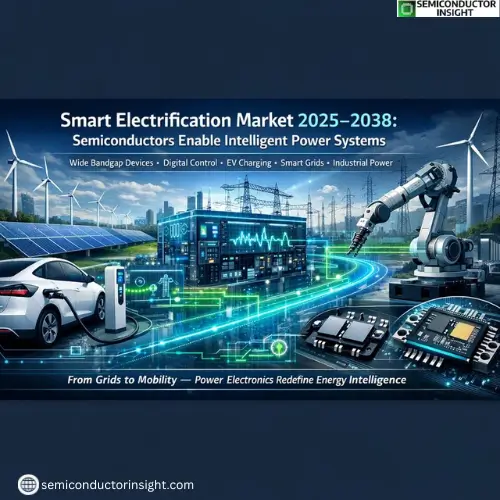
Smart Electrification Market Momentum Builds as Digital Power Systems Redefine Infrastructure Investment
Smart electrification is no longer a future-focused concept; it is now a foundational shift in how electricity is generated, distributed, and consumed. At the centre of this transition sits the semiconductor industry. As grids become intelligent, vehicles electrify, factories digitize, and buildings adopt energy-aware systems, semiconductors are transforming electrical infrastructure from passive networks into responsive, data-driven systems.
Smart electrification market refers to the integration of digital control, sensing, and power electronics into electrical systems to improve efficiency, reliability, and flexibility. Unlike traditional electrification, this market is defined by software-enabled hardware, advanced power devices, and real-time decision-making at the edge.
Why Semiconductors Are the Backbone of Smart Electrification?
Smart electrification cannot function without semiconductor innovation. Power conversion, monitoring, and control all rely on silicon-based technologies capable of operating under high voltage, high temperature, and continuous load conditions.
Wide band gap semiconductors such as silicon carbide (SiC) and gallium nitride (GaN) are reshaping the market by enabling:
- Higher switching frequencies with lower energy loss
- Compact power modules for space-constrained applications
- Improved thermal performance in demanding environments
These advantages are accelerating adoption across renewable energy systems, electric mobility, and industrial automation.
Recent Innovations and Developments:
In January 2026, Lauritz Knudsen Electrical and Automation displayed its next-generation energy portfolio at the Bharat Renewable Expo 2026 in Jaipur, as the country’s renewable energy industry moves into a stage where asset dependability, grid connectivity, and lifecycle performance are more important than quick capacity expansion.
In May 2025, ABB has announced the release of ABB Smart EMS, a smart energy management system that gives homeowners control over how much energy they consume, reducing expenses, increasing efficiency, and automating energy management through an easy-to-use app. By automating energy flows, ABB Smart EMS ensures that households balance energy expenses and consumption while making the most of each kilowatt produced locally.
Grid Modernization Driving New Semiconductor Requirements
One of the strongest demand drivers for smart electrification is grid modernization. Aging power grids are being upgraded with intelligent substations, digital transformers, and automated distribution networks. These upgrades require power semiconductors, embedded controllers, communication ICs, and advanced sensors.
Grid-level semiconductor installations require lengthy operational lifespans and high reliability, in contrast to consumer devices. This has shifted procurement strategies toward suppliers that offer stable production nodes, extended support cycles, and proven field performance.
Electrification of Mobility Reshaping Power Device Demand
Electric vehicles, charging infrastructure, and rail electrification are central to smart electrification strategies worldwide. Each of these segments relies on power modules that can handle rapid load changes, regenerative braking, and bidirectional energy flow.
From a semiconductor market perspective, this has resulted in:
- Rising demand for high-voltage MOSFETs and IGBTs
- Increased adoption of SiC devices in fast-charging systems
- Growing integration of power control and safety functions on single chips
This convergence is increasing semiconductor value per system while tightening performance expectations.
You can freely browse our most recent updated report to learn more about it before scrolling further:
https://semiconductorinsight.com/report/smart-grid-sensors-market/
Industrial Electrification and the Shift toward Digital Factories
Manufacturing facilities are undergoing electrification alongside automation. Motors, drives, and control systems are being redesigned for energy optimization and predictive maintenance. Smart electrification in industrial settings depends heavily on real-time sensing, digital signal processing, and power management ICs.
Factories now require electrical systems that adapt to demand fluctuations, reduce downtime, and integrate seamlessly with industrial software platforms. This trend is expanding semiconductor demand beyond pure power devices into mixed-signal and embedded processing segments.
Role of Semiconductors in Energy Storage Integration
Energy storage systems are becoming critical components of smart electrification architectures. Batteries, super capacitors, and hybrid storage systems depend on precise power conversion and monitoring.
Semiconductor solutions enable:
- Accurate state-of-charge and health estimation
- Safe charging and discharging cycles
- Grid-interactive storage capable of peak shaving and load balancing
As storage becomes more distributed, semiconductor intelligence at the system edge is becoming essential.
Policy, Regulation, and Their Influence on Chip Demand
Government policies aimed at decarbonisation and energy efficiency are indirectly shaping semiconductor demand. Grid codes, efficiency standards, and safety regulations increasingly specify performance thresholds that can only be met through advanced semiconductor technologies.
This regulatory push is accelerating investment in next-generation power devices and favoring manufacturers with strong compliance capabilities.
Strategic Implications for Semiconductor Stakeholders
For semiconductor manufacturers, smart electrification represents a high-value, long-cycle market rather than a short-term volume play. Design wins often lead to multi-year supply agreements and deep customer integration.
Key strategic considerations include:
- Balancing performance innovation with long-term reliability
- Supporting system-level design, not just discrete components
Smart electrification market is expected to expand steadily as energy systems become more decentralized and digitally managed. Growth will be driven less by raw electricity demand and more by the intelligence embedded within power infrastructure.
Semiconductors that combine power efficiency, digital control, and system resilience will define competitive advantage in the coming decade.
Smart electrification is redefining how electricity functions in modern economies. As this transformation accelerates, the semiconductor industry is no longer a supporting player—it is the architect of intelligent power systems. The market’s long-term trajectory points toward deeper silicon integration, higher performance expectations, and sustained demand across multiple end-use sectors.

Comments (0)