

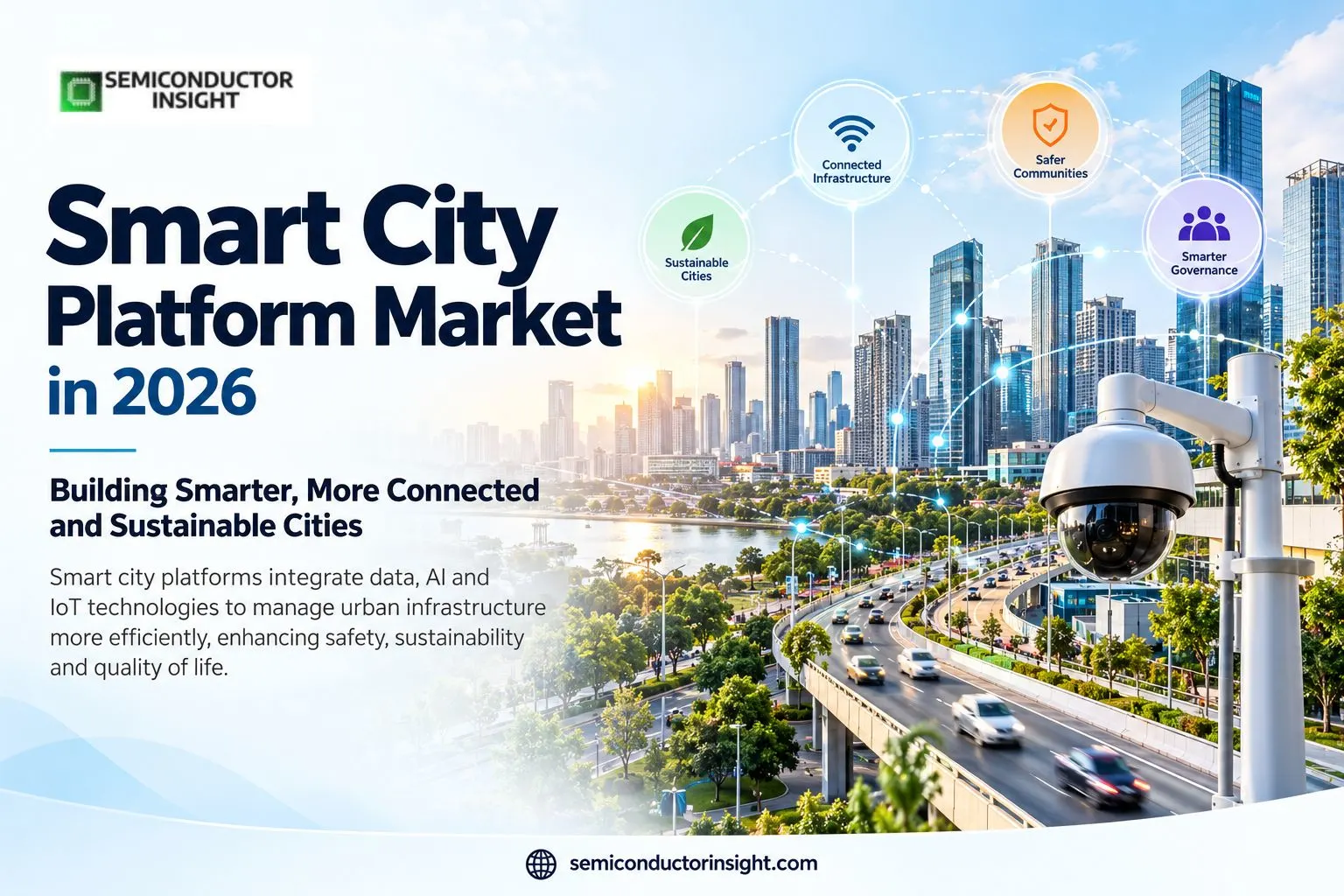
Smart City Platform Market in 2026 as AI-Driven Urban Digital Twins, Edge Computing and Connected Infrastructure Transform City Management
Smart City Platform Market is evolving as municipal authorities move beyond isolated traffic sensors, surveillance networks and utility dashboards towards integrated digital infrastructure. These platforms combine Internet of Things (IoT) devices, cloud computing, geographic information systems (GIS), artificial intelligence and real-time analytics to coordinate essential urban services.
For the semiconductor industry, this transformation creates demand for processors, memory, connectivity chipsets, power-management integrated circuits and edge-computing hardware. Each connected traffic signal, smart meter, camera and environmental sensor generates data that must be collected, processed and transmitted reliably.
The emerging opportunity lies in making these devices work as a coordinated system. Rather than purchasing disconnected technology for individual departments, cities are increasingly exploring platforms that connect transport, utilities, public safety and infrastructure planning.
Dubai Live Brings Real-Time City Intelligence into Municipal Operations
- On October 13, 2025, Dubai Municipality announced Dubai Live, a digital platform integrating artificial intelligence, digital twins and predictive analytics for city operations. The system consolidates information about infrastructure, construction activities, planning and transport networks to support operational monitoring and strategic decisions.
- This development illustrates how smart city platforms are expanding from visual dashboards into operational decision-making environments. Digital twins can represent physical infrastructure digitally, allowing planners to examine urban changes and assess potential interventions.
- Behind these capabilities sit semiconductor-dependent technologies such as graphics processors, AI accelerators, networking chips and storage controllers. Processing requirements vary depending on whether analysis occurs within roadside equipment, local data centres or cloud infrastructure.
India’s 100 Smart Cities Show the Scale of Digital Infrastructure Deployment
India provides a substantial real-world example of city-platform implementation. According to the Press Information Bureau’s June 2025 update, the Smart Cities Mission had completed 94% of its 8,067 projects, while all 100 participating cities had operational Integrated Command and Control Centres. These centres integrate information to support services including transport, water management and solid-waste operations.
The deployment scale matters for semiconductor suppliers because urban digital infrastructure requires more than central servers. Cameras need image-processing capabilities, sensors require low-power electronics, and communications equipment depends on networking and radio-frequency components.
As systems expand, maintenance, replacement cycles and compatibility with existing equipment become important purchasing considerations for city authorities.
For More Detailed Insights, You Can Surf Our Latest Report Here: https://semiconductorinsight.com/report/smart-city-sensors-market/
Singapore’s Digital District Model Connects Building Systems with Urban Intelligence
Singapore’s Government Technology Agency describes its Open Digital Platform as a government-developed smart city operating system that integrates district-management functions through real-time data. The platform supports digital-twin capabilities and can coordinate systems such as district cooling, security and parking. Its published objectives include reducing manpower requirements by 50% and energy consumption by 30%; these are stated targets rather than universal measured outcomes.
For semiconductor companies, this type of deployment highlights the importance of efficient edge processors and connected controllers. Building systems may need to process equipment status locally, while the wider platform coordinates operations across multiple facilities.
- Low-power chipsets, reliable wireless connectivity and hardware designed for extended operating life are particularly relevant where devices must function continuously.
The Chip Architecture behind a Responsive City
Smart city platforms rely on several semiconductor layers working together. Edge processors handle local decisions, AI accelerators analyse complex data, memory stores operational information, and connectivity chips link devices to networks. Power-management components help reduce electricity consumption in battery-operated sensors and distributed monitoring equipment.
A typical data pathway looks like this:
- Urban sensors and cameras
- Traffic, water, air quality and public safety
- Edge semiconductor devices
- Local processing, filtering and rapid response
- Networks and cloud infrastructure
- Data exchange, storage and AI analysis
- City platform
- Coordinated decisions and service management
Digital Twins Are Becoming More Useful When City Data Can Be Shared
Japan’s Ministry of Land, Infrastructure, Transport and Tourism launched Project PLATEAU in 2020 to develop and distribute three-dimensional urban models. The initiative supports urban management, planning and the integration of city information. It’s open-data approach illustrates how digital representations can become reusable infrastructure rather than isolated modelling projects.
The next step is connecting these models with live information from infrastructure assets. This requires dependable sensor networks, consistent data formats and computing systems capable of processing large streams of information.
- Cybersecurity and privacy are equally important. Platforms handling transport movements, public cameras and municipal records require access controls, secure communications and carefully governed data-sharing arrangements.
What Semiconductor Suppliers Should Watch as Urban Platforms Expand?
Smart City Platform Market is creating an increasingly interconnected demand environment for semiconductor components. AI-enabled monitoring increases processing requirements, while distributed sensors create demand for efficient chips that can operate for long periods with limited maintenance.
The strongest technology propositions will combine processing performance with energy efficiency, secure connectivity and long-term component availability. For platform developers and semiconductor suppliers alike, success will depend on supporting interoperable systems that cities can expand without repeatedly replacing their underlying infrastructure.

Comments (0)