
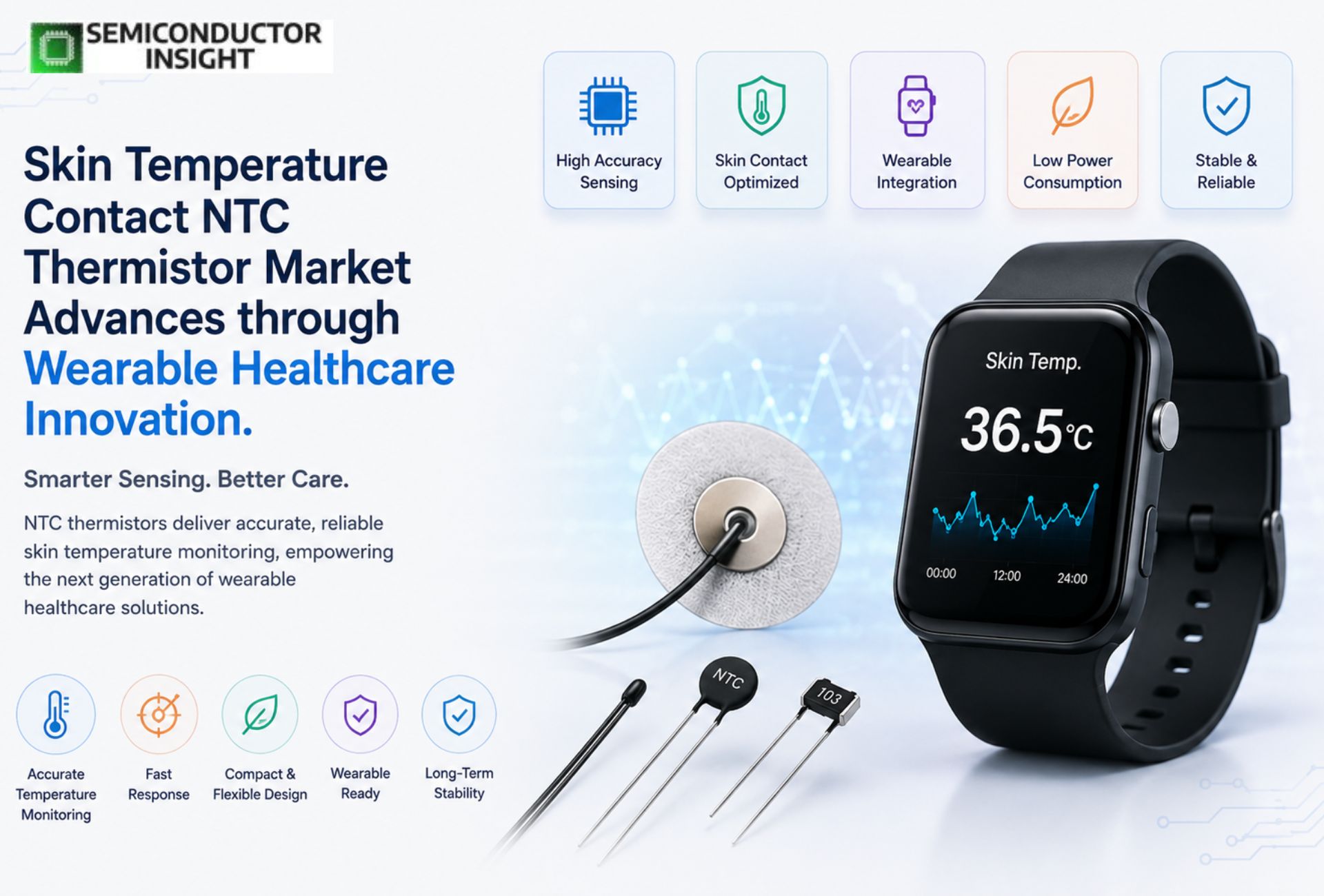
Skin Temperature Contact NTC Thermistor Market Advances through Wearable Healthcare Innovation
Skin Temperature Contact NTC Thermistor Market Advances through Wearable Healthcare Innovation
The global market for skin temperature contact NTC thermistors is expanding rapidly as wearable electronics, digital healthcare systems, and continuous health monitoring devices become more integrated into daily life. These compact temperature-sensitive resistors are increasingly being used in smart watches, fitness trackers, medical patches, portable diagnostic tools, and patient monitoring systems where precise body temperature measurement is critical. Contact NTC thermistors are extremely dependable for medical and wellness applications because they deliver direct and stable readings through skin contact, in contrast to conventional infrared measurement methods that can change according on external conditions.
- The healthcare technology ecosystem has changed significantly in recent years. Consumers are no longer relying only on hospital-based monitoring systems. Instead, portable and real-time health tracking devices are becoming part of routine lifestyle management.
- This transformation has pushed semiconductor and sensor manufacturers to focus on smaller, faster, and more accurate thermistor technologies that can fit into lightweight wearable products without compromising performance or battery efficiency.
- According to industry-linked electronics manufacturing data, global wearable device shipments crossed 520 million units in recent years, with smart health wearable contributing a major share of that volume.
- Many premium wearable devices now include continuous skin temperature sensing capabilities for sleep tracking, stress monitoring, menstrual cycle prediction, fever detection, and athletic recovery analysis. This growing integration is creating strong commercial opportunities for contact-based NTC thermistors.
Medical Wearable’s Are Redefining Temperature Monitoring Standards
One of the biggest shifts influencing this market is the transition from occasional temperature checks to continuous physiological monitoring. Hospitals and healthcare providers are increasingly adopting wearable monitoring systems that allow patients to be observed remotely while reducing physical hospital visits. Skin temperature thermistors are playing a central role in this transformation because they deliver stable readings while consuming very little power.
In remote patient monitoring systems, even slight temperature fluctuations can help physicians identify infection risks or inflammatory conditions at an early stage. This capability became especially valuable during global healthcare emergencies, where continuous temperature monitoring gained attention in both clinical and home-care environments.
Flexible skin patches equipped with NTC thermistors are now being developed for neonatal care, elderly monitoring, and post-surgical recovery tracking. In several healthcare pilot programs across Asia and Europe, wearable temperature patches have demonstrated the ability to record body temperature variations continuously for more than 48 hours while maintaining low energy consumption. This is encouraging medical device manufacturers to expand production of semiconductor-based sensing components designed specifically for skin-contact applications.
Sensor Miniaturization Is Creating New Product Possibilities
- Another major transformation within the industry is aggressive component miniaturization.
- Modern wearable products demand ultra-small sensors that can operate efficiently within compact circuit boards and flexible electronic structures. NTC thermistors used for skin temperature monitoring are becoming thinner, lighter, and more responsive to meet these product design requirements.
- Some advanced thermistor models now measure less than 1.2 millimeters in diameter, enabling seamless integration into earbuds, smart rings, adhesive medical patches, and thin fitness bands.
- This miniaturization trend is particularly important for next-generation consumer electronics where comfort and aesthetics directly influence purchasing decisions.
- Battery efficiency has also become a major development focus. Since wearable devices operate continuously throughout the day, manufacturers are prioritizing low-power thermistor systems that support extended battery life.
- Several semiconductor component suppliers are now developing highly stable thermistor materials capable of operating across wider temperature ranges without signal instability.
Sports Technology and Sleep Science Expand Commercial Usage
The sports technology sector is becoming an unexpected growth avenue for skin temperature contact thermistors. Elite athletes and fitness-focused consumers increasingly use wearable devices to monitor recovery cycles, heat stress, hydration balance, and sleep quality. Skin temperature patterns provide important insights into metabolic changes, recovery performance, and fatigue detection.
Sports performance laboratories and fitness technology companies are integrating advanced temperature sensing systems into biometric wearable used during training sessions and endurance events. Some high-performance wearable devices can now collect thousands of temperature data points daily, helping users optimize training intensity and recovery schedules.
Sleep technology companies are also adopting thermistor-based sensing systems for advanced sleep analysis. Changes in skin temperature during sleep cycles can indicate circadian rhythm disruptions, hormonal fluctuations, and stress responses. This has encouraged wearable manufacturers to combine temperature sensing with heart rate and oxygen tracking features to create more comprehensive health monitoring platforms.
Our most recent updated related study is available for free at this link: https://semiconductorinsight.com/report/skin-temperature-contact-ntc-thermistor-market/
Consumer Electronics Brands Accelerate Sensor Integration
- The semiconductor ecosystem supporting skin temperature thermistors is becoming increasingly connected with consumer electronics innovation.
- Global technology brands are investing heavily in biosensor integration as health-focused features become key product differentiators in premium devices.
- Smart rings, AI-powered wellness trackers, and compact health wearable are pushing thermistor suppliers to deliver highly accurate sensing solutions with rapid response times.
- As consumer expectations shift toward preventive healthcare and personalized wellness insights, skin temperature monitoring is evolving from a niche medical function into a mainstream electronic feature.
This shift is transforming contact NTC thermistors from simple sensing components into critical semiconductor elements supporting the future of connected healthcare, wearable intelligence, and human-centred electronics.

Comments (0)