

Silicon vs. Silicon Carbide Diodes in PN Junction Diode Market 2026: Application-Level Comparison
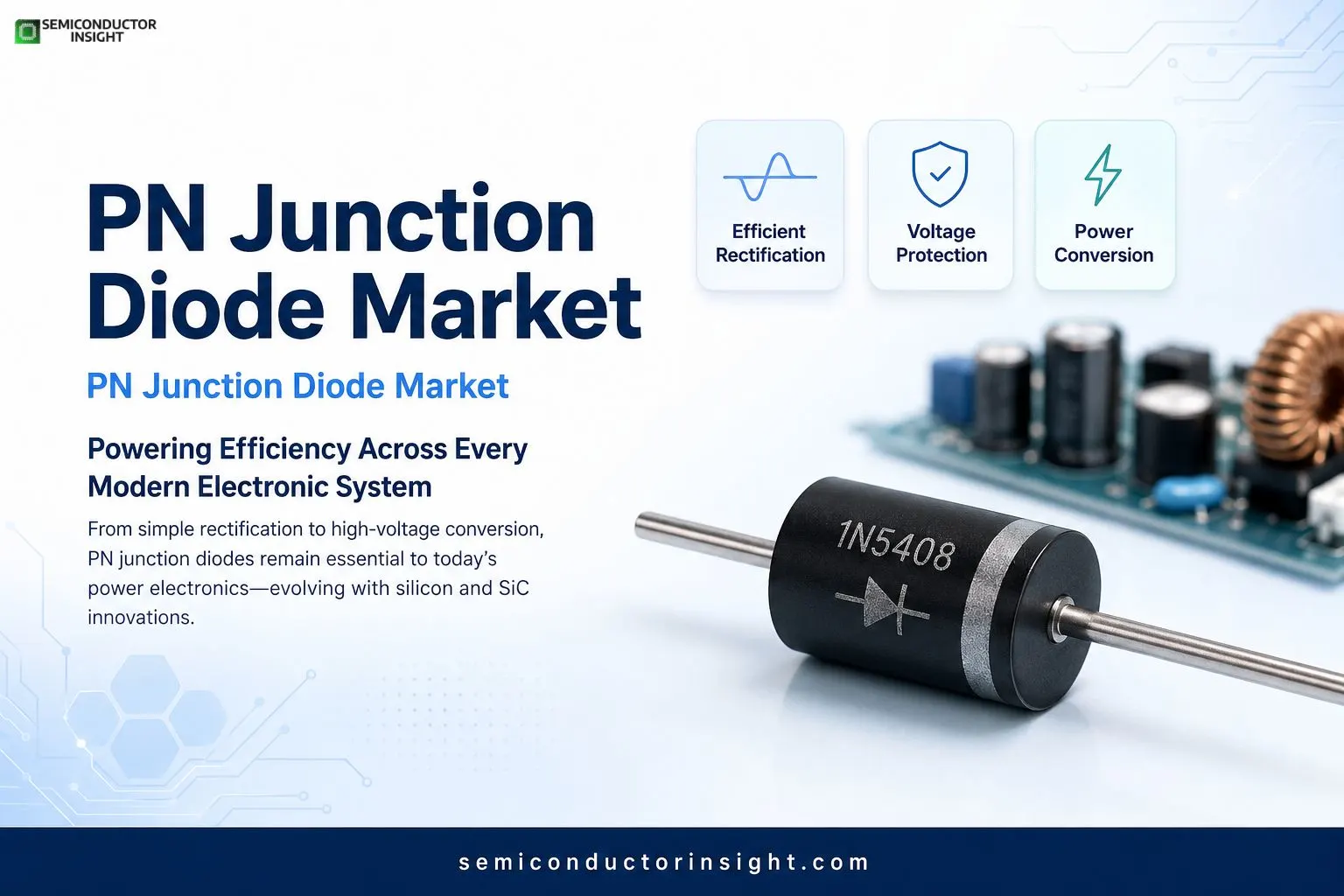
The PN junction diode is one of the simplest semiconductor structures, yet its operating principle remains fundamental to modern electronics. Built by joining P-type and N-type semiconductor regions, the device allows current to flow preferentially in one direction and blocks it in the opposite direction. That basic behavior makes PN junction technology central to rectification, voltage protection, and signal control and power conversion. Silicon remains the dominant material for conventional PN junction diodes, while silicon carbide is extending the same fundamental semiconductor concept into higher-temperature and higher-voltage applications.
What makes PN Junction Diode Market particularly relevant in 2026 is not a sudden reinvention of the diode. It is the expanding number of electronic systems in which efficient current control has become essential.
From a textbook junction to a system-level component
AC input → Rectification → DC link → Power switching → Voltage conversion → Load
In a conventional power supply, the diode may perform straightforward AC-to-DC rectification. In a vehicle charger or industrial converter, however, its requirements become considerably more demanding. Reverse-recovery behavior, leakage current, forward voltage, thermal performance and switching frequency can all influence the efficiency of the complete system.
This is why diode selection has shifted from simply asking whether a device can withstand a voltage to evaluating how it behaves under the exact operating conditions of the circuit.
The 2026 semiconductor backdrop
The wider semiconductor manufacturing environment is providing a useful indication of where demand for power-related devices is heading. Worldwide silicon wafer shipments reached 3,275 million square inches in Q1 2026, up 13.1% year over year from 2,896 million square inches in Q1 2025. SEMI also reported that demand was increasingly extending beyond AI logic and memory toward power-management devices.
The number is important for the diode ecosystem because PN junction devices are manufactured within the broader silicon semiconductor supply chain. At the same time, the industry is experiencing two different technology trajectories: leading-edge logic is pushing advanced nodes, while power electronics continues to depend heavily on mature semiconductor processes where voltage handling, reliability and cost are more important than transistor density.
Six engineering changes worth watching
Faster recovery is becoming a design priority. In high-frequency converters, a diode that takes longer to switch from conduction to blocking can generate additional losses and electromagnetic effects. Fast-recovery PN diodes therefore remain important in switching power supplies, motor-control systems and industrial converters.
Higher voltage operation is expanding the design envelope. Power conversion increasingly requires devices capable of handling substantial voltage while maintaining controlled leakage and thermal characteristics. PN-junction structures also appear in high-voltage semiconductor architectures; Infineon, for example, describes integrated protection functions based on controlled PN-junction behavior in its high-power thyristor technology.
Thermal design is moving closer to the device itself. As power density rises, packaging, heat spreading and junction temperature become inseparable from diode performance. This trend is particularly visible in automotive and industrial power electronics.
Silicon carbide is extending the diode family. SiC is being used where high voltage, high temperature and lower switching losses justify the additional material and manufacturing complexity. This does not eliminate conventional silicon PN diodes; instead, it creates a wider device-selection spectrum.
Automotive electronics are raising reliability requirements. Electrified vehicles contain multiple power-conversion stages, including onboard chargers and DC/DC converters. In February 2026, Toyota selected Infineon’s SiC power semiconductor technology for the new bZ4X, including its onboard charger and DC/DC converter, illustrating how material and device innovation are becoming closely connected to vehicle power architecture.
Power density is becoming a packaging problem as much as a semiconductor problem. Infineon’s June 2026 introduction of a 750 V CoolSiC half-bridge package with top-side cooling illustrates the direction of modern power electronics: more electrical functionality and thermal capability are being compressed into smaller board areas.
Where PN junction diodes continue to earn their place
The application map remains remarkably broad:
- AC/DC power supplies and adapters
- Automotive charging and power-conversion systems
- Industrial motor drives
- Solar and energy-storage equipment
- Telecom power supplies
- Consumer electronics
- Protection and clamping circuits
- Welding and industrial power equipment
- High-voltage conversion systems
- General-purpose rectification
The technology does not need to be the most sophisticated component in a circuit to be commercially important. A low-cost rectifier used across thousands of power supplies can have a very different economic role from a specialized high-voltage diode used in an industrial converter.
For additional report info, feel free to view our most recent edition: https://semiconductorinsight.com/report/pn-junction-diode-market/
Why the wafer numbers matter to diode manufacturers?
The semiconductor industry’s manufacturing base continues to operate across several technology generations simultaneously. SEMI reported 12,973 million square inches of worldwide silicon-wafer shipments during 2025, with mature-node automotive, industrial and consumer applications beginning to recover after inventory adjustments.
That mature-node recovery is relevant to PN junction diodes because many power devices do not require the newest logic process. Their performance depends more heavily on controlled doping, junction engineering, wafer thickness, epitaxial structures, thermal behavior and packaging.
The result is a less visible but highly persistent part of semiconductor manufacturing: technologies that may be decades old in principle can remain commercially important when their electrical characteristics match the application.
The diode is becoming part of the efficiency equation
The next phase of PN Junction Diode Market is therefore less about replacing the basic diode and more about optimizing its role within increasingly sophisticated power architectures. Silicon remains valuable where cost, reliability and established manufacturing dominate. SiC and other advanced power technologies become attractive when voltage, switching frequency, temperature or efficiency requirements move beyond conventional silicon’s practical range.
The broader power-electronics industry is simultaneously moving toward more efficient architectures. In May 2026, Infineon launched the EU-backed Moore4Power project with 62 European partners across 15 countries, targeting smarter and more efficient power electronics for areas including renewable energy, e-mobility and industrial systems.
That development captures the direction of the industry well. The PN junction diode may be one of semiconductor engineering’s oldest building blocks, but its role continues to change as every watt, volt, square millimeter and degree of operating temperature becomes more important inside modern electronic systems.

Comments (0)