
Silicon to System Design Advances Reshaping In-vehicle Fanless Computer Market Landscape
In-vehicle Fanless Computer Market is becoming a critical pillar of modern automotive electronics, particularly as vehicles transition into software-defined and autonomous platforms. Fanless systems, in contrast to conventional computing units, solely rely on passive cooling mechanisms, which greatly emphasises power optimisation, thermal design, and semiconductor efficiency. These systems are extensively used in fleet telematics, entertainment clusters, advanced driver assistance systems (ADAS), and industrial-grade transport trucks where dependability in harsh environments is essential.
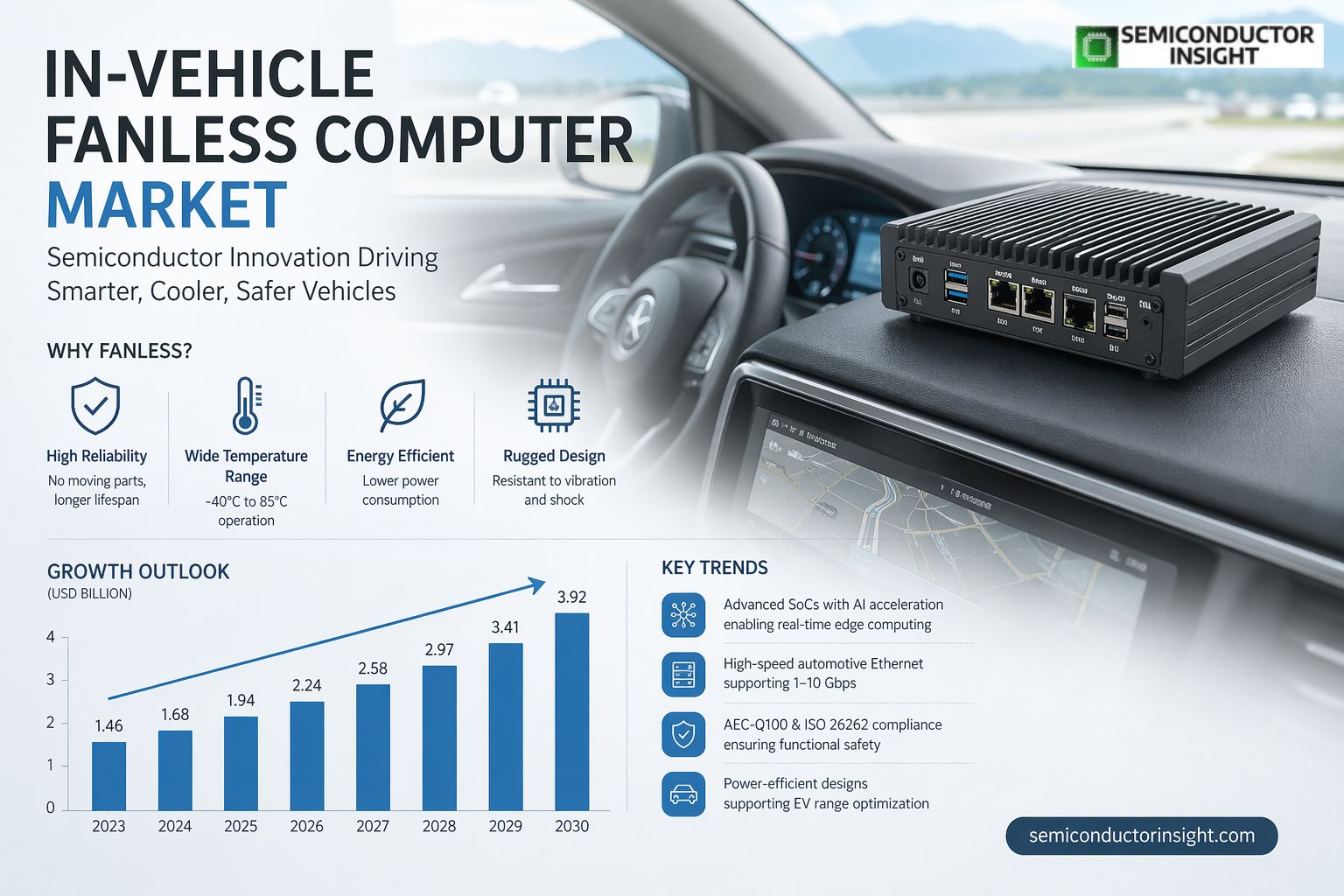
Automotive environments typically expose hardware to temperature ranges between -40°C and 85°C, with localized hotspots exceeding 100°C near engine compartments. Fanless computers eliminate mechanical cooling failures, reducing maintenance cycles and extending operational lifespans beyond 50,000 hours in many embedded deployments. This makes semiconductor-level thermal efficiency not just desirable, but essential.
Semiconductor Architectures Enabling Fanless Designs
- At the core of these systems are highly optimized processors built on advanced semiconductor nodes such as 7nm, 10nm, and increasingly 5nm fabrication technologies. These nodes significantly reduce power consumption while maintaining computational throughput. Automotive-grade SoCs now integrate CPU, GPU, AI accelerators, and I/O controllers into a single chip, reducing board complexity and heat generation.
- A notable shift is the adoption of ARM-based architectures in automotive embedded computing. These processors typically operate within a thermal design power (TDP) range of 5W to 25W, making them ideal for fanless configurations. In comparison, traditional x86 processors in automotive systems historically consumed upwards of 35W to 65W, requiring active cooling solutions.
- Modern chipsets also incorporate dynamic voltage and frequency scaling (DVFS), allowing systems to adjust power consumption in real time based on workload demands. This capability is crucial in vehicles where computing loads fluctuate between idle navigation states and high-intensity AI processing during autonomous driving.
Thermal Engineering beyond Heat Sinks
Fanless computer systems depend heavily on advanced thermal interface materials (TIMs), heat spreaders, and chassis-level heat dissipation. Aluminum alloy enclosures are commonly used, with thermal conductivity values around 205 W/mK, enabling efficient passive cooling. Some systems also utilize heat pipes and vapor chambers, technologies borrowed from high-performance computing, to distribute heat evenly across surfaces.
Interestingly, automotive fanless systems often integrate the enclosure as part of the thermal solution itself. This approach reduces component count and enhances durability. In heavy-duty vehicles such as mining trucks or long-haul freight systems, these computers must withstand vibration levels exceeding 5 Grms and shock ratings above 50G, making mechanical simplicity a significant advantage.
Data Throughput and Edge Processing Demands
Modern vehicles generate vast amounts of data. A Level 2+ autonomous vehicle can produce between 1 TB to 4 TB of data per day from cameras, LiDAR, radar, and ultrasonic sensors. Fanless in-vehicle computers act as edge processing units, handling real-time analytics before transmitting selective data to cloud systems.
This shift toward edge computing is driving demand for high-bandwidth memory (HBM) and PCIe Gen4/Gen5 interfaces within automotive chipsets. Data transfer speeds now exceed 16 GT/s per lane in advanced configurations, ensuring that latency-sensitive applications such as collision avoidance and lane detection operate seamlessly.
Our most recent updated related study is available for free at this link: https://semiconductorinsight.com/report/in-vehicle-fanless-computer-market/
Reliability Standards and Semiconductor Qualification
Semiconductors used in fanless automotive computers must comply with stringent standards such as AEC-Q100 for integrated circuits and ISO 26262 for functional safety. These standards ensure that chips can operate reliably under electrical stress, temperature cycling, and long-term usage conditions.
For example, AEC-Q100 Grade 1 components are qualified for operation up to 125°C, while Grade 0 components extend this to 150°C. These specifications directly influence the design of fanless systems, as higher tolerance chips reduce the burden on thermal management systems.
Additionally, error correction technologies such as ECC memory are increasingly integrated into automotive computing platforms, reducing the risk of data corruption in mission-critical applications.
Power Efficiency as a Design Philosophy
Power efficiency is not merely a feature but a foundational requirement in the In-vehicle Fanless Computer Market. Electric vehicles (EVs), in particular, demand ultra-efficient computing systems to preserve battery range. A typical EV battery pack ranges from 50 kWh to 100 kWh, and even a 10W reduction in auxiliary system consumption can translate into measurable range improvements over time.
Semiconductor companies are responding with ultra-low-power microcontrollers and AI accelerators capable of delivering tera operations per second (TOPS) at sub-10W power envelopes. This efficiency enables continuous operation of features like driver monitoring systems and predictive maintenance analytics without compromising vehicle energy budgets.
Integration with Vehicle Network Architectures
Fanless computers are increasingly integrated into centralized vehicle architectures, replacing distributed electronic control units (ECUs). Modern vehicles can contain over 100 ECUs, but new designs are consolidating these into domain controllers powered by high-performance fanless systems.
These computers interface with automotive Ethernet networks operating at speeds of 1 Gbps to 10 Gbps, significantly higher than traditional CAN bus systems. This transition supports real-time data exchange across vehicle subsystems, enabling coordinated decision-making and improved system responsiveness.
Emerging Use Cases and Deployment Expansion
Beyond passenger vehicles, fanless in-vehicle computers are gaining traction in public transportation, logistics fleets, and autonomous delivery systems. For instance, smart buses equipped with these systems can process passenger data, monitor vehicle health, and optimize routes dynamically.
In logistics, fleet operators deploy fanless systems for real-time tracking and predictive maintenance, reducing downtime and operational costs. These applications highlight the growing importance of rugged, semiconductor-driven computing platforms in mobility ecosystems.
Unique Industry Shifts worth Noting
- Increasing adoption of chiplet-based semiconductor designs to improve scalability and reduce thermal density
- Use of AI inference chips specifically optimized for edge environments with less than 15W power consumption
- Growing reliance on automotive-grade LPDDR5 memory with speeds exceeding 6400 MT/s for faster data handling
- Integration of cybersecurity hardware modules directly into SoCs to protect vehicle data pipelines
- Rise of software-defined vehicles pushing demand for upgradable, modular fanless computing platforms
The In-vehicle Fanless Computer Market is no longer just about eliminating fans—it is about redefining how semiconductor innovation supports resilient, efficient, and intelligent mobility systems.

Comments (0)