In-vehicle Fanless Computer Market Insights
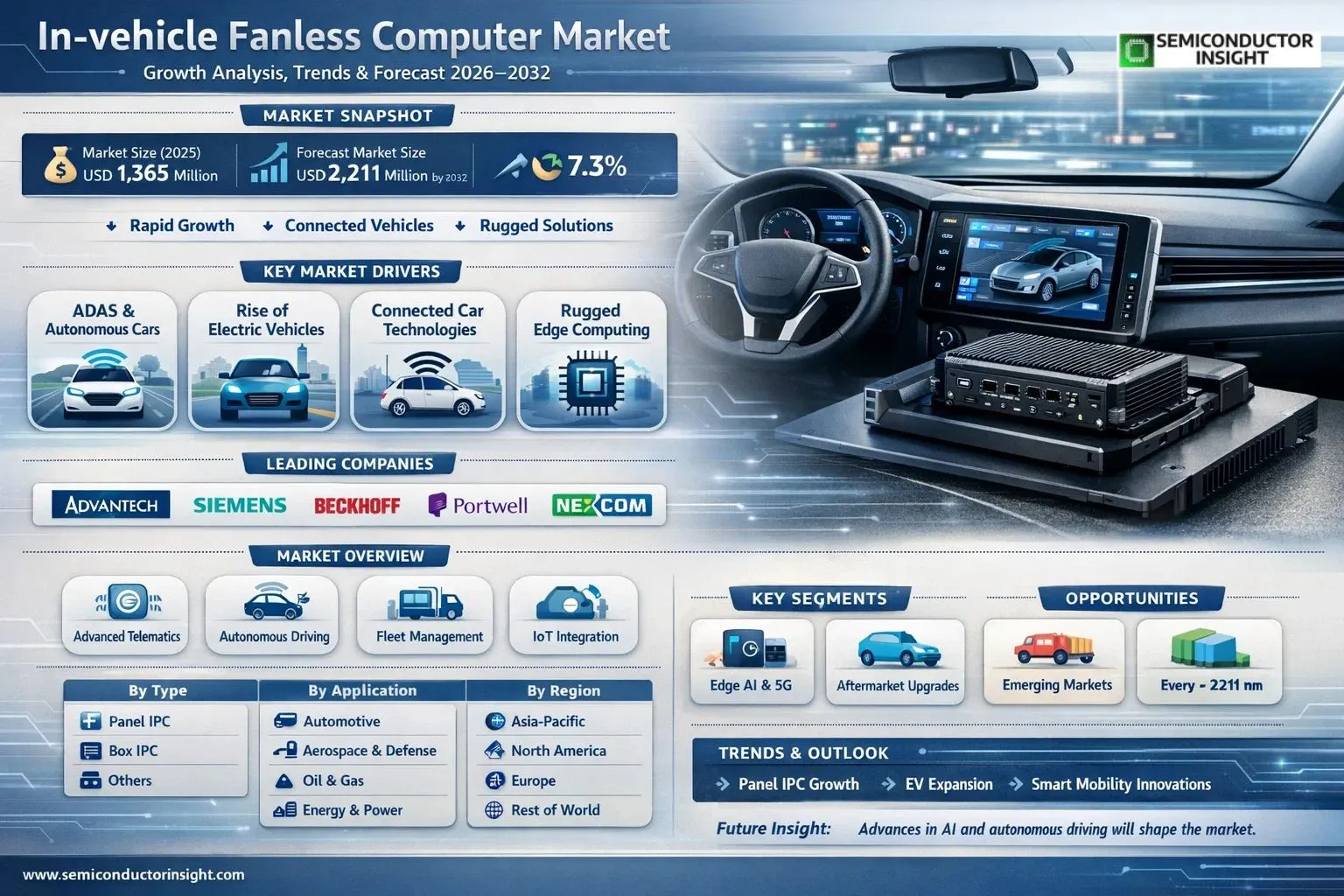
Global In-vehicle Fanless Computer market size was valued at USD 1,365 million in 2025. The market is projected to reach USD 2,211 million by 2032, exhibiting a CAGR of 7.3% during the forecast period.
In-vehicle Fanless Computer is an embedded computer system designed for the vehicle’s internal environment. These systems usually have the characteristics of high performance, low power consumption, fanless design, strong scalability and reliability, enabling them to operate stably in various vehicle environments.
The market is experiencing rapid growth due to several factors, including surging demand for advanced driver-assistance systems (ADAS), autonomous vehicles, and connected car technologies. Additionally, the expansion of electric vehicle fleets and the need for rugged edge computing in harsh automotive conditions are contributing to market expansion. Initiatives by the key players in the market are also expected to fuel the growth. Advantech, Siemens, Beckhoff, Portwell, Nexcom International, IEI Integration, Avalue, Kontron, and Neousys are some of the key players that operate in the market with a wide range of portfolios.
MARKET DRIVERS
Rise of Autonomous Driving Technologies
In-vehicle Fanless Computer Market is propelled by the increasing adoption of advanced driver-assistance systems (ADAS) and autonomous vehicles. These systems require reliable, vibration-resistant computing platforms that operate without moving parts, ensuring durability in harsh automotive environments. Global shipments of such computers reached approximately 1.2 million units in 2023, driven by OEM integrations in passenger cars and commercial fleets.
Expansion of Electric and Connected Vehicles
Electric vehicle (EV) production surged by 35% year-over-year, boosting demand for fanless in-vehicle computers that support battery management and telematics without thermal throttling. Integration with 5G connectivity enhances real-time data processing for fleet management, further accelerating market growth projected at a CAGR of 12% through 2030.
➤ Key enabler: Regulatory mandates for vehicle safety features are compelling automakers to embed high-performance, fanless computing solutions across 40% of new models by 2025.
Overall, the synergy between IoT ecosystems and rugged hardware positions In-vehicle Fanless Computer Market for sustained expansion amid digital transformation in mobility sectors.
MARKET CHALLENGES
Thermal Management in Extreme Conditions
In-vehicle Fanless Computer Market faces hurdles from high ambient temperatures in vehicles, where passive cooling must handle up to 85°C without fans. This limits processor power to mid-range Intel or ARM chips, constraining performance for AI workloads compared to air-cooled alternatives.
Other Challenges
Supply Chain Disruptions
Semiconductor shortages have delayed production by 20-30%, impacting delivery timelines for automotive-grade components essential to In-vehicle Fanless Computer Market.Additionally, achieving IP67 sealing standards increases manufacturing complexity and costs by 15-20%, challenging scalability for mass-market applications.
MARKET RESTRAINTS
High Development and Certification Costs
Stringent automotive standards like AEC-Q100 and ISO 26262 impose rigorous testing, elevating entry barriers for In-vehicle Fanless Computer Market. Development cycles extend to 18-24 months, deterring smaller vendors and consolidating market share among top players holding 60% dominance.Raw material volatility, particularly for aluminum enclosures, adds 10-15% to costs, while customization for diverse vehicle platforms fragments economies of scale.Regulatory compliance across regions, including Europe’s GDPR for data-heavy in-vehicle systems, further restrains innovation pace and market penetration in emerging economies.
MARKET OPPORTUNITIES
Integration with Edge AI and 5G
In-vehicle Fanless Computer Market stands to benefit from edge AI deployments, enabling on-board inference for Level 4 autonomy with NVIDIA Jetson modules. 5G rollout in 70% of new vehicles by 2027 will drive V2X communications, expanding applications in smart logistics.Aftermarket retrofits for legacy fleets present a $300 million opportunity, as operators upgrade for predictive maintenance using fanless rugged units.Emerging markets in Asia-Pacific, with 25% annual EV growth, offer untapped potential for localized manufacturing of in-vehicle fanless computing solutions.
In-vehicle Fanless Computer Market Trends
Increasing Demand in Automotive and Aerospace Applications
In-vehicle Fanless Computer Market is experiencing robust growth driven by the need for reliable embedded computing systems in harsh vehicle environments. These fanless designs offer high performance, low power consumption, and strong scalability, making them ideal for automotive infotainment, navigation, and advanced driver-assistance systems. In the automotive sector, which represents a key application area, manufacturers are integrating these computers to support real-time data processing and connectivity features essential for modern vehicles.
Other Trends
Shift Towards Panel IPC and Box IPC Segments
Within In-vehicle Fanless Computer Market, the Panel IPC segment leads due to its suitability for dashboard-mounted displays and human-machine interfaces in vehicles. Box IPC variants are gaining traction for their compact form factors in engine compartments and rear-seat entertainment systems. Other types, including specialized modules, cater to niche requirements, reflecting a diversification in product offerings to meet varied vehicle integration needs.
Expansion in Key Regional Markets
North America and Asia, particularly China and Japan, dominate In-vehicle Fanless Computer Market trends, fueled by strong automotive production and aerospace investments. Europe follows with emphasis on energy, oil & gas, and defense applications. Leading manufacturers like Advantech, Siemens, Beckhoff, Portwell, Nexcom International, IEI Integration, Avalue, Kontron, and Neousys are enhancing their portfolios through innovations in reliability and scalability. Competitive dynamics show top players focusing on mergers, acquisitions, and development plans to capture shares in pharmaceutical, chemical, and power sectors. This regional expansion underscores the market’s adaptation to global supply chain shifts and regulatory demands for rugged computing solutions.
COMPETITIVE LANDSCAPE
Key Industry Players
Dominant Forces in the Global In-vehicle Fanless Computer Market
In-vehicle Fanless Computer Market is characterized by a concentrated structure dominated by a few leading manufacturers, with Advantech emerging as the frontrunner due to its extensive portfolio of rugged, high-performance embedded systems optimized for vehicular applications. These systems prioritize fanless designs for vibration resistance, low power consumption, and reliability in extreme conditions, aligning with growing demands in automotive and transportation sectors. The top five players, including Siemens, Beckhoff, Portwell, and Nexcom International, collectively hold a significant revenue share, approximately 40-50% based on industry surveys, driving innovation through scalable architectures and integration with IoT and edge computing technologies. This oligopolistic landscape fosters strategic partnerships and R&D investments to capture expanding opportunities in fleet management and autonomous vehicles.
Complementing the market leaders are niche significant players such as IEI Integration, Avalue, Kontron, and Neousys, which specialize in customized box IPC and panel IPC solutions for applications in energy & power, oil & gas, and aerospace & defense. These companies differentiate via specialized features like wide-temperature operation and compact form factors, addressing specific pain points in harsh environments. Emerging competitors further intensify rivalry by focusing on cost-effective alternatives and rapid customization, contributing to market fragmentation while the overall sector projects a 7.3% CAGR from US$1,365 million in 2025 to US$2,211 million by 2032. This dynamic competitive environment underscores the need for continuous advancements in reliability and interoperability to maintain market positions.
List of Key In-vehicle Fanless Computer Companies Profiled
- Advantech
- Siemens
- Beckhoff
- Portwell
- Nexcom International
- IEI Integration
- Avalue
- Kontron
- Neousys
- AAEON Technology
- ARBOR Technology
- Lanner Electronics
- Vecow Co., Ltd.
- DFI
- Cincoze
Segment Analysis:
| Segment Category | Sub-Segments | Key Insights |
| By Type |
|
Panel IPC
|
| By Application |
|
Automotive
|
| By End User |
|
OEMs
|
| By Vehicle Type |
|
Heavy Commercial Vehicles
|
| By Propulsion Type |
|
Electric
|
Regional Analysis: In-vehicle Fanless Computer Market
North America
North America’s tech corridors like Silicon Valley fuel In-vehicle Fanless Computer Market growth through R&D in AI-driven vehicle interfaces. Automakers prioritize fanless systems for their silent operation and energy efficiency in EVs, integrating them with cloud analytics for personalized user experiences and over-the-air updates.
Strict emissions and safety regulations mandate robust computing in vehicles, boosting fanless adoption in In-vehicle Fanless Computer Market. Compliance with standards ensures these systems support cybersecurity features essential for connected cars, reducing downtime in commercial fleets.
Extensive logistics networks drive In-vehicle Fanless Computer Market expansion, with fanless units enabling real-time tracking and diagnostics in trucks. Harsh operational environments favor their rugged builds, improving fuel efficiency and service reliability across North American highways.
Collaborations between OEMs and embedded systems providers strengthen In-vehicle Fanless Computer Market. Custom solutions for autonomous shuttles and delivery vans highlight scalability, with focus on edge computing to handle vast sensor data locally.
Europe
Europe exhibits strong momentum in In-vehicle Fanless Computer Market, propelled by its luxury automotive heritage and rigorous environmental regulations. Premium brands integrate fanless computers for sophisticated human-machine interfaces (HMIs) and Level 4 autonomy trials, emphasizing compact, low-power designs suited to high-speed rail-integrated vehicles. The push for sustainable mobility under EU Green Deal frameworks accelerates deployment in electric fleets and smart city transport. Manufacturing prowess in Germany and France supports precise engineering for vibration-proof systems, vital for premium sedans and commercial vans. Challenges like data privacy under GDPR influence secure edge processing capabilities. Regional focus on circular economy principles encourages modular, upgradeable fanless units, extending lifecycle in public buses and emergency services. Cross-border collaborations enhance standardization, positioning Europe as a hub for high-end In-vehicle Fanless Computer Market applications amid urban electrification trends.
Asia-Pacific
Asia-Pacific emerges as a dynamic force in In-vehicle Fanless Computer Market, fueled by massive vehicle production volumes and rapid urbanization. Countries like China and Japan lead with integrated manufacturing ecosystems, deploying fanless systems in mass-market EVs and high-speed rail networks for seamless navigation and entertainment. Government initiatives for smart highways and 5G-enabled connectivity amplify demand, favoring dust-resistant, wide-temperature units in tropical climates. Ride-hailing giants and logistics firms adopt these for real-time fleet monitoring, optimizing routes in congested megacities. Supply chain localization reduces lead times, while innovation in cost-effective designs caters to diverse vehicle segments from two-wheelers to heavy trucks. Regulatory harmonization supports export growth, though intellectual property concerns spur domestic R&D. Asia-Pacific’s scale drives volume-led advancements in In-vehicle Fanless Computer Market.
South America
South America shows promising growth in In-vehicle Fanless Computer Market, driven by expanding logistics and agribusiness needs. Brazil and Argentina prioritize rugged fanless systems for off-road trucks navigating rough terrains, supporting GPS tracking and yield monitoring in vast farmlands. Urban mobility solutions in cities like São Paulo integrate them into electric buses for traffic management amid infrastructure upgrades. Economic recovery fosters investments in telematics for fuel savings, with local assembly adapting designs to humid, dusty conditions. Challenges include import dependencies, addressed via public-private partnerships for technology transfer. Rising e-commerce boosts last-mile delivery fleets, embedding fanless computers for inventory control. The region leverages resource-rich environments to test durable solutions, carving a niche in practical In-vehicle Fanless Computer Market applications.
Middle East & Africa
The Middle East & Africa region advances in In-vehicle Fanless Computer Market through energy sector demands and harsh climate adaptations. Gulf states deploy fanless units in oilfield vehicles for remote monitoring, withstanding sandstorms and extreme heat. Africa’s mining operations favor vibration-tolerant systems for autonomous haul trucks, enhancing safety in unregulated terrains. Smart city projects in UAE and South Africa integrate them into public transport for digital ticketing and analytics. Infrastructure investments under Vision 2030 initiatives promote EV adoption, requiring reliable computing for battery management. Local content rules encourage joint ventures, building resilience against supply disruptions. Focus on solar-powered vehicles highlights low-power fanless designs. The region’s unique challenges foster specialized innovations in In-vehicle Fanless Computer Market.
Report Scope
This market research report provides a comprehensive analysis of In-vehicle Fanless Computer Market, covering the forecast period 2026–2034. It offers detailed insights into market dynamics, technological advancements, competitive landscape, and key trends shaping the industry.
Key focus areas of the report include:
- Market Overview: The report begins with an overview outlining its current market scenario, key growth indicators, and industry transformation drivers. It discusses macroeconomic factors, demand–supply balance, regulatory landscape, and the strategic role of semiconductors in powering advancements across industries such as automotive, telecommunications, consumer electronics, and industrial automation.
- Market Size & Forecast: Historical data and future projections for revenue, unit shipments, and market value across major regions and segments.
- Segmentation Analysis: Detailed breakdown by product type, technology, application, and end-user industry to identify high-growth segments and investment opportunities.
- Regional Insights: Insights into market performance across North America, Europe, Asia-Pacific, Latin America, and the Middle East & Africa, including country-level analysis where relevant.
- Competitive Landscape: Profiles of leading market participants, including their product offerings, R&D focus, manufacturing capacity, pricing strategies, and recent developments such as mergers, acquisitions, and partnerships.
- Technology Trends & Innovation: Assessment of emerging technologies, integration of AI/IoT, semiconductor design trends, fabrication techniques, and evolving industry standards.
- Market Drivers & Restraints: Evaluation of factors driving market growth along with challenges, supply chain constraints, regulatory issues, and market-entry barriers.
- Stakeholder Insights: Insights for component suppliers, OEMs, system integrators, investors, and policymakers regarding the evolving ecosystem and strategic opportunities.
Primary and secondary research methods are employed, including interviews with industry experts, data from verified sources, and real-time market intelligence to ensure the accuracy and reliability of the insights presented.
FREQUENTLY ASKED QUESTIONS:
What is the current market size of In-vehicle Fanless Computer Market?
-> In-vehicle Fanless Computer Market was valued at USD 1,365 million in 2025 and is expected to reach USD 2,211 million by 2032, at a CAGR of 7.3% during the forecast period.
Which key companies operate in In-vehicle Fanless Computer Market?
-> Key players include Advantech, Siemens, Beckhoff, Portwell, Nexcom International, IEI Integration, Avalue, Kontron, Neousys, among others.
What are the key growth drivers?
-> Key growth drivers include demand for high-performance, low-power, fanless embedded systems in vehicle environments, adoption in automotive, energy & power, oil & gas, and aerospace & defense sectors.
Which region dominates the market?
-> Asia-Pacific is poised for strong growth led by China, while North America holds significant share with the U.S. market.
What are the emerging trends?
-> Emerging trends include growth in Panel IPC and Box IPC segments, enhanced scalability and reliability for harsh environments, and integration in applications like automotive and aerospace & defense.

Get Sample Report PDF for Exclusive Insights
Report Sample Includes
- Table of Contents
- List of Tables & Figures
- Charts, Research Methodology, and more...
 Download Sample Report PDF