

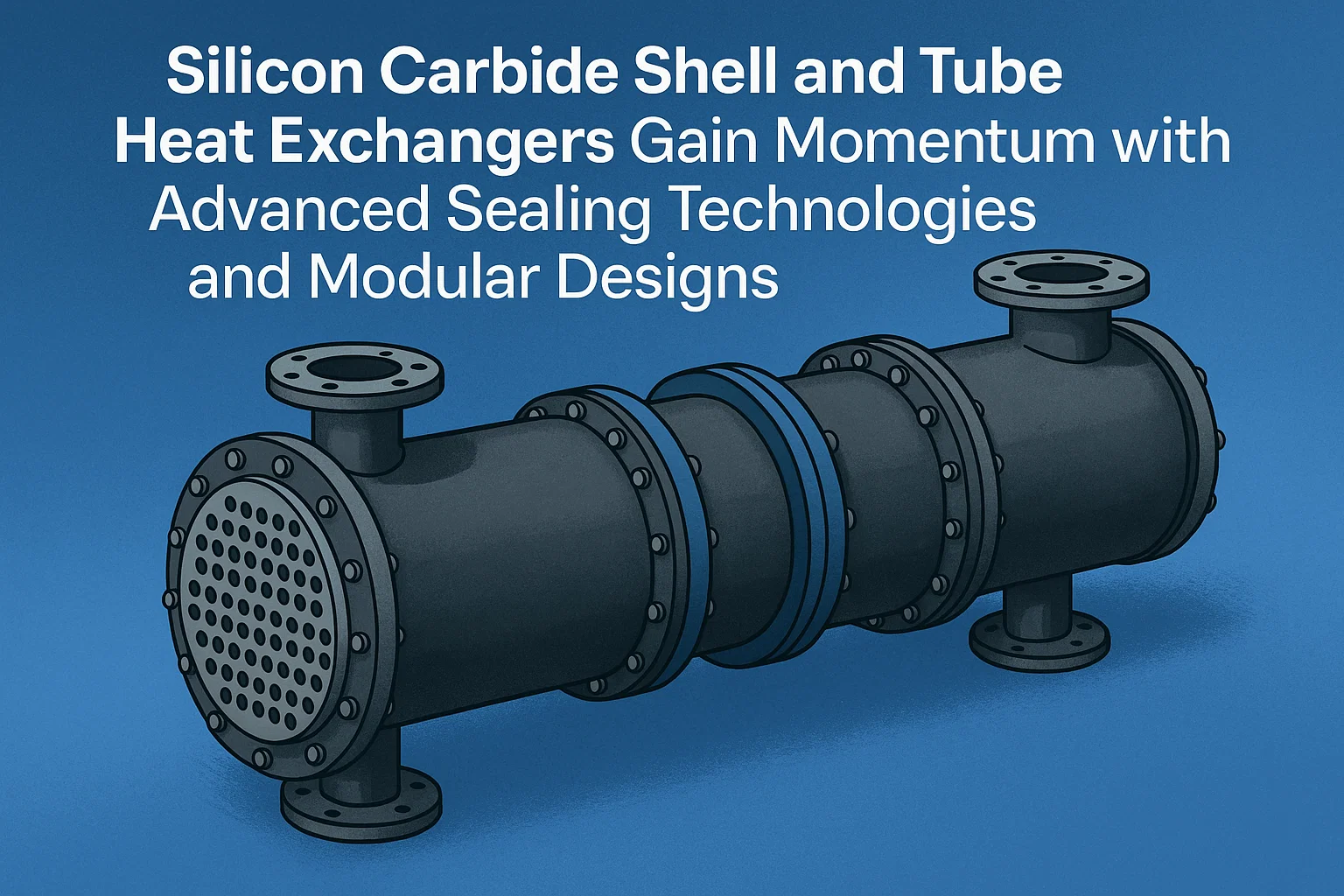
Silicon Carbide Shell and Tube Heat Exchangers Gain Momentum with Advanced Sealing Technologies and Modular Designs
The global industrial landscape is undergoing rapid transformation as sectors such as chemicals, petrochemicals, pharmaceuticals, and advanced materials increasingly demand high-performance equipment capable of withstanding extreme operating environments. Among the innovations meeting this challenge, Silicon Carbide (SiC) Shell and Tube Heat Exchangers are emerging as a game-changing technology. Known for their exceptional thermal conductivity, superior corrosion resistance, and remarkable durability, these systems are revolutionizing heat transfer processes in industries where conventional materials fail to deliver.
According to the latest industry insights, the global Silicon Carbide (SiC) Shell and Tube Heat Exchanger market was valued at USD 721 million in 2024 and is projected to reach USD 1,289 million by 2032, growing at a CAGR of 8.9% during the forecast period. This strong trajectory reflects not only rising demand in traditional end-use industries but also the wave of technological innovations that have made SiC-based heat exchangers more reliable, efficient, and scalable.
Access Your Free Sample Report- Silicon Carbide (SiC) Shell and Tube Heat Exchanger Market
1. Understanding the Role of SiC in Heat Exchangers
Heat exchangers are fundamental to modern industry, enabling the transfer of thermal energy between fluids for heating, cooling, or chemical processing. Traditionally, materials such as stainless steel, titanium, or graphite have dominated heat exchanger construction. However, as industries handle increasingly aggressive media—highly corrosive acids, alkalis, or solvents—the limitations of conventional materials have become apparent.
Silicon Carbide (SiC) stands out as a next-generation material because of:
- High thermal conductivity: Nearly double that of stainless steel, enabling efficient heat transfer.
- Corrosion resistance: Superior resistance to hydrochloric acid, sulfuric acid, nitric acid, and other highly aggressive chemicals.
- Mechanical strength: Robust under high pressure and thermal shocks.
- Durability: Longer service life reduces downtime and replacement costs.
The shell and tube configuration remains the most widely adopted design, offering flexibility in scaling, ease of cleaning, and suitability for both heating and cooling operations. Integrating SiC into this proven format creates a powerful combination of performance and resilience.
2. Market Size and Forecast
The SiC Shell and Tube Heat Exchanger market has witnessed remarkable momentum in recent years.
- 2024 Valuation: USD 721 million
- 2032 Projection: USD 1,289 million
- CAGR: 8.9% (2024–2032)
This robust growth highlights the growing recognition of SiC as a premium material in environments where downtime and equipment failure can lead to significant financial or safety consequences. Industries that traditionally relied on graphite heat exchangers are increasingly turning to SiC due to its longer service life and improved operational reliability.
3. Recent Developments and Industry Innovations
A wave of recent advancements is shaping the evolution of the SiC Shell and Tube Heat Exchanger market. Key developments include:
a. Advanced Sealing Technologies
One of the biggest challenges in shell and tube designs is ensuring leak-free operation under fluctuating pressures and temperatures. Recent innovations include:
- SGL Carbon’s SICABON® exchangers, featuring carbon-fiber reinforcement (CARBOGUARD®) and advanced sealing systems designed to resist pressure shocks and thermal stresses.
- 3V-Tech’s dual tube sheet design, combining a glass-lined carbon steel sheet with stainless steel and PFA lining, improving sealing integrity and extending operational lifetimes in aggressive chemical environments.
b. Enhanced Pressure and Vacuum Capabilities
Manufacturers such as Italprotec have introduced designs capable of operating under full vacuum and pressures up to 10 bar, broadening the applicability of SiC exchangers across pharmaceutical, specialty chemical, and semiconductor industries.
c. Integrated SiC Modules
Chinese innovators like Jiangsu Sanzer New Materials are pioneering SiC bundleblocks, integrating tube sheets, baffles, and heat exchange tubes into a single compact unit. This modular approach reduces installation time and enhances reliability.
d. Durability and Shock Resistance
Advances in composite reinforcement and mechanical stabilization are improving the resilience of SiC exchangers against sudden temperature fluctuations, addressing a common operational risk in high-temperature processes.
Download Sample Report PDF- Silicon Carbide (SiC) Shell and Tube Heat Exchanger Market
4. Key Application Areas Driving Adoption
Chemical Processing
The chemical sector remains the largest consumer of SiC heat exchangers. Processes involving hydrochloric acid, sulfuric acid, and other aggressive agents demand materials that won’t degrade quickly. SiC’s performance advantage translates into reduced maintenance and increased plant uptime.
Petrochemicals and Refining
SiC heat exchangers are increasingly deployed in refining processes where hydrocarbons and corrosive by-products challenge traditional materials. Their ability to withstand fouling and corrosion supports cost efficiency in large-scale operations.
Pharmaceutical Manufacturing
Sterility, precision, and process reliability are paramount in pharmaceuticals. SiC’s inert nature and ability to handle ultra-pure and aggressive solvents make it a preferred choice for drug manufacturing plants.
Semiconductor and Electronics
As semiconductor fabs expand, demand for ultrapure heat transfer solutions is rising. SiC exchangers are gaining traction for cooling high-purity process chemicals in chipmaking facilities.
Environmental Technologies
Waste treatment plants and renewable energy projects (such as biomass processing) are adopting SiC heat exchangers to handle corrosive effluents and aggressive by-products.
5. Regional Market Insights
Asia-Pacific
The fastest-growing market, led by China, India, and South Korea, is fueled by rapid industrialization, chemical production capacity expansions, and the growth of semiconductor industries.
Europe
Europe remains a stronghold due to its advanced chemical and pharmaceutical industries, as well as stringent environmental standards pushing adoption of durable and safer technologies.
North America
The U.S. and Canada are focusing on SiC adoption in pharmaceuticals, refining, and advanced materials. Growth is steady, supported by innovations from global players operating in the region.
Middle East & Africa
Petrochemical hubs in the Middle East are emerging as key markets, particularly as refineries modernize equipment to extend lifetimes and reduce environmental impact.
6. Competitive Landscape
The industry is competitive, with companies focusing on material science innovation, modular designs, and regional expansion. Key players include:
- SGL Carbon (Germany) – SICABON® SiC heat exchangers with reinforced sealing.
- 3V-Tech (Italy) – Pioneering dual tube sheet sealing for chemical industry applications.
- Italprotec (Italy) – SiC exchangers designed for high-pressure and vacuum operations.
- Jiangsu Sanzer New Materials (China) – Developer of integrated SiC bundleblock solutions.
- Carborundum Universal Limited (India) – Expanding SiC production to serve chemical and electronics sectors.
These companies are heavily investing in R&D to make SiC exchangers more scalable, cost-efficient, and suitable for diverse applications.
7. Challenges in Adoption
Despite strong momentum, the SiC Shell and Tube Heat Exchanger market faces certain challenges:
- High initial costs: SiC exchangers are more expensive than graphite or metal alternatives, which can deter smaller manufacturers.
- Fabrication complexity: Machining and bonding SiC components require advanced manufacturing expertise.
- Competition from graphite: Graphite heat exchangers remain cheaper, though less durable.
However, declining costs of SiC due to improved manufacturing techniques and rising demand for long-term cost savings are steadily addressing these barriers.
Click Here To Download Full Sample Report- Silicon Carbide (SiC) Shell and Tube Heat Exchanger Market
8. Future Outlook and Opportunities
Looking ahead, several factors will accelerate market growth:
- Digital integration: Embedding sensors in SiC exchangers for predictive maintenance will enhance adoption in smart plants.
- Green transition: As industries aim for sustainability, SiC’s durability and efficiency align with circular economy goals.
- Expansion in semiconductors: The semiconductor boom will significantly boost demand for ultrapure SiC heat exchangers.
- Localization of production: Asia-Pacific countries are building local SiC production capabilities to reduce reliance on imports and lower costs.
The Silicon Carbide (SiC) Shell and Tube Heat Exchanger market is entering a golden era of adoption and innovation. With a projected growth from USD 721 million in 2024 to USD 1,289 million by 2032 at a CAGR of 8.9%, the sector is poised for remarkable expansion across industries.

Comments (0)