Silicon Carbide (SiC) Shell and Tube Heat Exchanger Market, Trends, Business Strategies 2025-2032

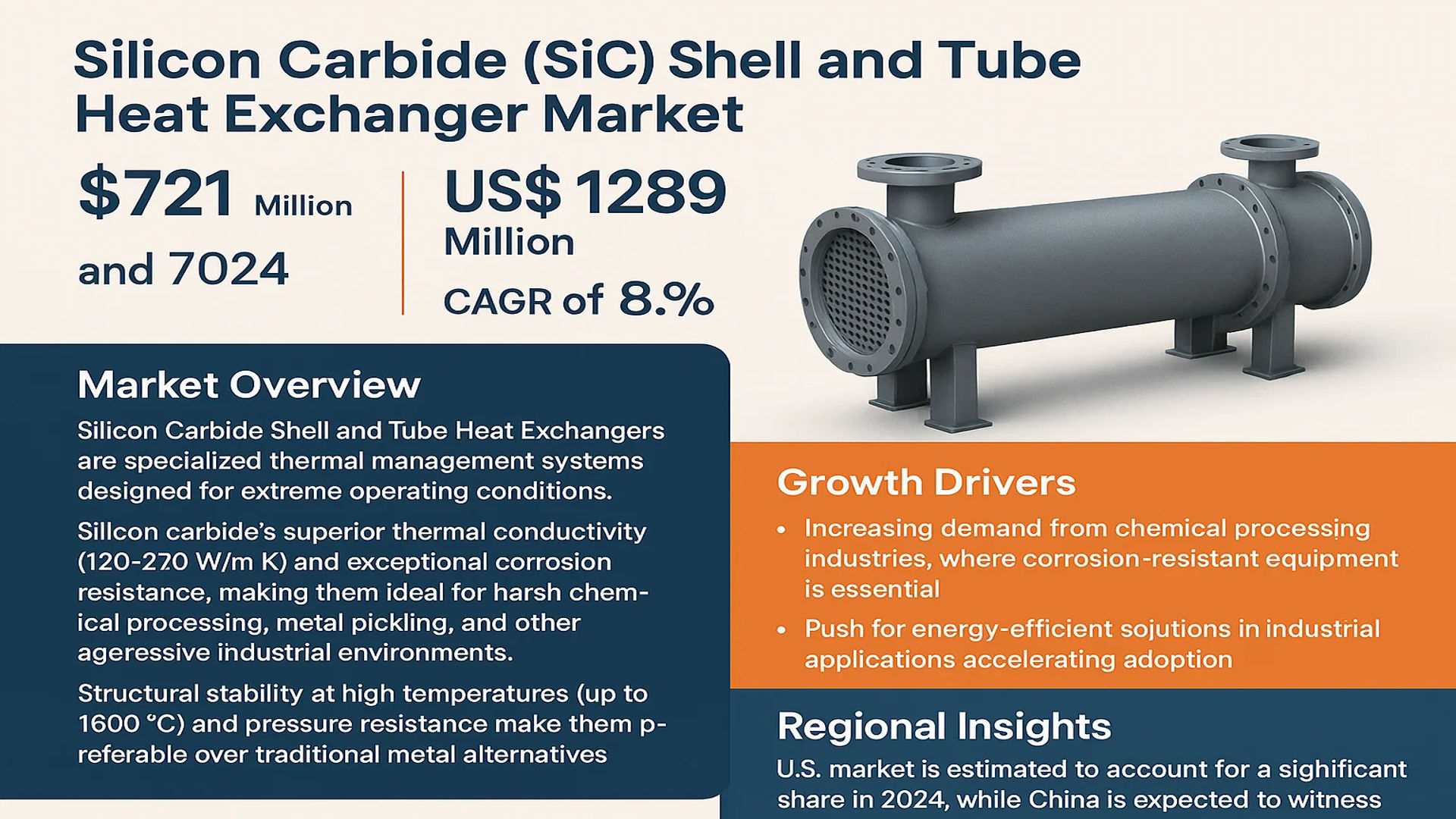
Silicon Carbide (SiC) Shell and Tube Heat Exchanger Market was valued at 721 million in 2024 and is projected to reach US$ 1289 million by 2032, at a CAGR of 8.9% during the forecast period

PDF Icon Download Sample Report PDF
  • Quick Dispatch

    All Orders

  • Secure Payment

    100% Secure Payment

Price range: $1,500.00 through $4,250.00

Clear

MARKET INSIGHTS

The global Silicon Carbide (SiC) Shell and Tube Heat Exchanger Market was valued at 721 million in 2024 and is projected to reach US$ 1289 million by 2032, at a CAGR of 8.9% during the forecast period. The U.S. market is estimated to account for a significant share in 2024, while China is expected to witness accelerated growth due to expanding industrial applications.

Silicon Carbide Shell and Tube Heat Exchangers are specialized thermal management systems designed for extreme operating conditions. These heat exchangers utilize silicon carbide’s superior thermal conductivity (120-270 W/m·K) and exceptional corrosion resistance, making them ideal for harsh chemical processing, metal pickling, and other aggressive industrial environments. Their structural stability at high temperatures (up to 1600°C) and pressure resistance make them preferable over traditional metal alternatives.

The market growth is driven by increasing demand from chemical processing industries, where corrosion-resistant equipment is essential. Furthermore, the push for energy-efficient solutions in industrial applications is accelerating adoption. Key players like Mersen and SGL Group are expanding production capacities to meet rising demand, particularly in Asia-Pacific where industrial expansion is most pronounced. Recent developments include advanced designs offering 30-40% better thermal efficiency compared to conventional models, further propelling market expansion.
Silicon Carbide (SiC) Shell and Tube Heat Exchanger Market

MARKET DYNAMICS

MARKET DRIVERS

Superior Corrosion Resistance and Thermal Conductivity Propel Adoption in Harsh Industrial Environments

Silicon Carbide (SiC) Shell and Tube Heat Exchangers are experiencing significant demand due to their exceptional resistance to corrosive chemicals and high thermal efficiency. In industries such as chemical processing, where aggressive acids and high-temperature fluids are common, traditional metals like stainless steel degrade rapidly, leading to frequent maintenance and downtime. SiC heat exchangers, with corrosion rates 50-100 times lower than metals, offer unmatched longevity, reducing operational costs by up to 30% over a decade. The chemical industry alone contributes over 40% of the market revenue, driven by stringent environmental regulations mandating leak-proof and sustainable solutions.

Rise in Semiconductor Manufacturing Drives Demand for Ultra-Pure Heat Transfer Solutions

With the global semiconductor market projected to exceed $1 trillion by 2030, the need for contamination-free heat exchangers in chip fabrication has surged. SiC’s non-reactive properties prevent metallic ion contamination during wafer production, a critical requirement for advanced nodes below 7nm. Leading foundries in Taiwan, South Korea, and the U.S. are rapidly replacing quartz and graphite heat exchangers with SiC variants, as they withstand hydrofluoric acid baths at 150°C without degradation. This shift is expected to grow the 15 Sqm and Below segment by 11.2% CAGR through 2032, as compact SiC units are ideal for cleanroom installations.

For instance, a leading SiC manufacturer recently secured a $200 million contract to supply heat exchangers for a new semiconductor fab in Arizona, highlighting the technology’s strategic importance.

Additionally, government incentives for domestic semiconductor production are accelerating adoption. The U.S. CHIPS Act alone has allocated $52 billion to bolster local manufacturing, with 18% of funds directed toward ancillary equipment like high-performance heat exchangers.

MARKET RESTRAINTS

High Manufacturing Costs and Limited Production Scaling Capabilities

Despite their advantages, SiC Shell and Tube Heat Exchangers face adoption barriers due to production complexities. The sintering process for reaction-bonded SiC requires temperatures above 2000°C, with energy costs accounting for 35-40% of the final product price. Large-format exchangers (Above 15 Sqm) are particularly challenging, as yield rates drop below 70% due to microcrack formation during cooling. This results in price premiums of 4-6x over equivalent steel units, deterring small and mid-sized enterprises. While demand is growing in Europe and North America, price sensitivity in emerging markets like India and Brazil has limited penetration to under 15% of industrial facilities.

Brittleness and Design Limitations
The inherent brittleness of ceramic materials constrains design flexibility. Tube wall thicknesses must exceed 3mm to prevent fractures, reducing heat transfer efficiency by ~12% compared to thinner metallic tubes. Furthermore, joining techniques for SiC components remain labor-intensive, requiring specialized diffusion bonding that adds 20-25% to assembly costs. These technical hurdles delay ROI calculations, causing some operators to defer investments despite long-term benefits.

MARKET OPPORTUNITIES

Green Hydrogen Economy Presents Untapped Growth Potential

The emerging hydrogen sector offers transformative opportunities, as SiC heat exchangers are ideal for electrolyzer temperature control and ammonia cracking. Proton Exchange Membrane (PEM) electrolyzers operate at 80-160°C with highly corrosive environments, where SiC’s stability outperforms nickel alloys. With over $300 billion pledged globally for hydrogen projects by 2030, manufacturers are developing modular SiC exchangers tailored for 5-10 MW electrolysis units. Early adopters report 40% lower degradation rates compared to metallic alternatives in pilot plants.

Additive Manufacturing Breakthroughs Enable Custom Geometries

New binder jetting and SLA 3D printing techniques allow complex SiC geometries previously unattainable with traditional machining. Industry leaders are collaborating with ceramic 3D printing firms to create topology-optimized tubes with internal fin structures, improving heat transfer coefficients by 25-30%. These advancements are critical for aerospace and nuclear applications, where compact, high-efficiency exchangers are paramount. A major European energy provider recently validated a 3D-printed SiC exchanger for molten salt systems, marking a pivotal shift in design possibilities.

MARKET CHALLENGES

Supply Chain Vulnerabilities for High-Purity Silicon Carbide Powders

Geopolitical tensions have disrupted the supply of semiconductor-grade SiC powders, with China controlling 62% of global abrasive-grade production—a key raw material. Trade restrictions have caused price volatility, with 99.9% pure β-SiC prices fluctuating by ±18% quarterly. Manufacturers are struggling to secure multi-year contracts, forcing some to accept 30-45 day lead times instead of traditional two-week turnovers. This instability complicates production planning, particularly for Japanese and Korean firms reliant on imports.

Certification Bottlenecks in Regulated Industries
Nuclear and pharmaceutical applications demand ASME BPVC Section III certification, a process taking 18-24 months for SiC components due to novel material considerations. Regulatory bodies lack standardized testing protocols for ceramic heat exchangers, causing approval delays. A notable case involved a U.S. nuclear startup waiting 22 months for NRC approval on SiC steam generators, ultimately opting for conventional alloys to meet project timelines.

SILICON CARBIDE (SIC) SHELL AND TUBE HEAT EXCHANGER MARKET TRENDS

Expanding Applications in Harsh Industrial Environments to Drive Market Growth

The Silicon Carbide (SiC) Shell and Tube Heat Exchanger market is witnessing rapid adoption due to its superior performance in corrosive and high-temperature environments. Unlike traditional materials such as stainless steel or titanium, SiC offers exceptional thermal conductivity, corrosion resistance, and mechanical durability, making it indispensable for industries like chemical processing, metal pickling, and semiconductor manufacturing. The market, valued at $721 million in 2024, is projected to grow at a CAGR of 8.9%, reaching $1.29 billion by 2032. This growth is fueled by increasing demand for energy-efficient heat exchangers capable of withstanding aggressive chemical media, reducing maintenance costs, and improving operational longevity.

Other Trends

Electrification and Green Energy Initiatives

The global push toward electrification and renewable energy is accelerating the use of SiC heat exchangers in battery production and hydrogen fuel cell applications. The superior thermal management capabilities of SiC ensure efficiency in energy-intensive processes, aligning with sustainability goals. For instance, many countries are investing in hydrogen infrastructure, which relies on high-performance heat exchangers to optimize production rates while minimizing energy consumption. The growing adoption of electric vehicles (EVs) and energy storage systems further amplifies this demand.

Technological Innovations and Material Advancements

Manufacturers are focusing on innovations to enhance the performance and cost-effectiveness of SiC-based heat exchangers. Recent developments include integrated modular designs that improve heat transfer rates while reducing material wastage. Additionally, advancements in reaction-bonded and sintered SiC have expanded applications, particularly in sectors requiring extreme thermal shock resistance. Leading companies, including Mersen, SGL Group, and Nantong Sunshine, are investing in R&D to capture a larger market share, particularly in Asia-Pacific, where industrial expansion remains robust. These innovations are expected to drive adoption in emerging economies, where infrastructure development is rapidly progressing.

COMPETITIVE LANDSCAPE

Key Industry Players

Manufacturers Focus on Material Innovation to Gain Competitive Edge

The global silicon carbide (SiC) shell and tube heat exchanger market features a mix of established manufacturers and emerging players racing to capitalize on the material’s superior thermal conductivity and corrosion resistance. Mersen leads the market with its extensive portfolio of high-performance heat exchangers tailored for extreme chemical environments, while SGL Group follows closely with its specialized SiC solutions for the metal pickling industry.

Chinese manufacturers are making significant strides in the market, with Nantong Sunshine and Wuxi Innovation capturing substantial market share through cost-competitive offerings. Their growth is further fueled by government initiatives supporting domestic semiconductor and chemical industries, creating strong local demand.

While European players maintain dominance in high-end applications, Asian manufacturers are gradually closing the technology gap through strategic partnerships and increased R&D spending. ITALPROTEC INDUSTRIES remains the preferred supplier for European chemical plants, leveraging its decades of experience in corrosive fluid handling applications.

The market is witnessing increased vertical integration as companies like Qingdao Xin Boao develop proprietary SiC manufacturing processes to ensure supply chain reliability. This trend is particularly pronounced in Asia where manufacturers are establishing complete in-house production from raw material processing to finished heat exchangers.

List of Key Silicon Carbide Heat Exchanger Manufacturers

Segment Analysis:

By Type

15 Sqm and Below Segment Leads Due to Widespread Industrial Applications

The Silicon Carbide (SiC) Shell and Tube Heat Exchanger market is segmented by type into:

  • 15 Sqm and Below
  • Above 15 Sqm

By Application

Chemical Industry Segment Dominates Market Share Due to High Corrosion Resistance Demand

The market is segmented by application into:

  • Chemical Industry
  • Metal Pickling
  • Others (including pharmaceutical and power generation)

By Material Type

Reaction-Bonded Silicon Carbide Gains Traction for Cost-Effectiveness

The market is segmented by material type into:

  • Sintered Silicon Carbide
  • Reaction-Bonded Silicon Carbide
  • Chemical Vapor Deposition Silicon Carbide

By End-User Industry

Process Industries Drive Growth Due to Harsh Operating Conditions

The market is segmented by end-user industry into:

  • Oil & Gas
  • Chemicals & Petrochemicals
  • Power Generation
  • Pharmaceutical
  • Others (including food processing and semiconductor)

Regional Analysis: Silicon Carbide (SiC) Shell and Tube Heat Exchanger Market

Asia-Pacific
The Asia-Pacific region dominates the global Silicon Carbide (SiC) Shell and Tube Heat Exchanger market, driven by rapid industrialization and the expansion of chemical manufacturing sectors in China and India. Countries like Japan and South Korea are also significant contributors due to their advanced technological adoption in industrial applications. China’s burgeoning semiconductor and electronics industries, coupled with government incentives for sustainable manufacturing, are accelerating the adoption of SiC-based heat exchangers. The region benefits from cost-effective production capabilities and a growing focus on energy-efficient solutions, making it a hotspot for both supply and demand. Furthermore, increasing investments in infrastructure and metal processing plants are fueling market growth, positioning Asia-Pacific as the leader in this sector.

North America
North America holds a strong position in the SiC Shell and Tube Heat Exchanger market due to stringent regulatory standards and a mature industrial base. The U.S. leads the region, with applications in chemical processing, metal pickling, and semiconductor manufacturing driving demand. The emphasis on reducing operational costs and enhancing thermal efficiency in harsh environments supports the adoption of advanced SiC-based heat exchangers. The presence of key players and continuous R&D investments further strengthen the market. Additionally, the shift toward renewable energy projects and stringent environmental guidelines ensure sustained demand for corrosion-resistant and high-performance heat exchange solutions.

Europe
Europe’s market is characterized by a strong focus on sustainability and industrial modernization. The EU’s stringent environmental policies encourage the adoption of SiC heat exchangers due to their durability and resistance to corrosive chemicals. Germany, France, and the U.K. are the primary contributors, driven by robust chemical and automotive industries. The emphasis on energy efficiency and carbon footprint reduction aligns well with the long-term benefits of SiC solutions. However, high manufacturing costs and competition from alternative materials pose challenges, though innovation remains a key driver for market expansion.

South America
The South American market is gradually evolving, with Brazil and Argentina showing increasing interest in SiC Shell and Tube Heat Exchangers for industrial applications. The region’s mining and chemical industries create a niche demand for durable, corrosion-resistant equipment. However, economic volatility and limited industrial infrastructure slow down widespread adoption. Despite these challenges, investments in petrochemical plants and pulp & paper industries present growth opportunities, provided stability in manufacturing policies improves.

Middle East & Africa
This region exhibits emerging potential for SiC heat exchanger adoption, primarily in oil & gas and desalination applications. Countries like Saudi Arabia and the UAE, with their focus on industrial diversification, are gradually incorporating advanced thermal management solutions. However, high costs and limited technical expertise restrict rapid market growth. Long-term prospects remain promising as infrastructure development accelerates and industries seek more efficient processing technologies.

Report Scope

This market research report provides a comprehensive analysis of the Global Silicon Carbide (SiC) Shell and Tube Heat Exchanger Market, covering the forecast period 2024–2032. It offers detailed insights into market dynamics, technological advancements, competitive landscape, and key trends shaping the industry.

Key focus areas of the report include:

  • Market Size & Forecast: Historical data and future projections for revenue, unit shipments, and market value across major regions and segments. The global market was valued at USD 721 million in 2024 and is projected to reach USD 1,289 million by 2032, growing at a CAGR of 8.9%.
  • Segmentation Analysis: Detailed breakdown by product type (15 Sqm and Below, Above 15 Sqm), application (Chemical Industry, Metal Pickling, Others), and end-user industry to identify high-growth segments.
  • Regional Outlook: Insights into market performance across North America, Europe, Asia-Pacific, Latin America, and the Middle East & Africa, with country-level analysis for key markets like the U.S., China, Germany, and Japan.
  • Competitive Landscape: Profiles of leading market participants including Mersen, SGL Group, Nantong Sunshine, Wuxi Innovation, and Jiangsu Zhunxin, covering their product portfolios, market shares, and strategic initiatives.
  • Technology Trends & Innovation: Assessment of material advancements, manufacturing processes, and integration of SiC heat exchangers in high-temperature applications.
  • Market Drivers & Restraints: Evaluation of factors such as demand from chemical processing industries, corrosion resistance requirements, alongside challenges like high production costs.
  • Stakeholder Analysis: Strategic insights for manufacturers, suppliers, end-users, and investors regarding market opportunities and competitive positioning.

The report employs both primary and secondary research methodologies, including interviews with industry experts and analysis of verified market data, to ensure accuracy and reliability.

FREQUENTLY ASKED QUESTIONS:

What is the current market size of Global Silicon Carbide (SiC) Shell and Tube Heat Exchanger Market?

-> Silicon Carbide (SiC) Shell and Tube Heat Exchanger Market was valued at 721 million in 2024 and is projected to reach US$ 1289 million by 2032, at a CAGR of 8.9% during the forecast period.

Which key companies operate in this market?

-> Key players include Mersen, SGL Group, Nantong Sunshine, Wuxi Innovation, Jiangsu Zhunxin, Qingdao Xin Boao, and ITALPROTEC INDUSTRIES.

What are the key growth drivers?

-> Growth is driven by increasing demand from chemical processing industries, superior corrosion resistance of SiC, and expansion of high-temperature industrial applications.

Which region dominates the market?

-> Asia-Pacific leads in market share due to rapid industrialization, while North America and Europe show strong adoption in advanced manufacturing sectors.

What are the emerging trends?

-> Emerging trends include development of larger capacity SiC heat exchangers, integration in renewable energy systems, and advancements in joining technologies for complex geometries.

Silicon Carbide (SiC) Shell and Tube Heat Exchanger Market, Trends, Business Strategies 2025-2032

Get Sample Report PDF for Exclusive Insights

Report Sample Includes

  • Table of Contents
  • List of Tables & Figures
  • Charts, Research Methodology, and more...

PDF Icon Download Sample Report PDF

Download Sample Report

Table of Content

1 Introduction to Research & Analysis Reports
1.1 Silicon Carbide (SiC) Shell and Tube Heat Exchanger Market Definition
1.2 Market Segments
1.2.1 Segment by Type
1.2.2 Segment by Application
1.3 Global Silicon Carbide (SiC) Shell and Tube Heat Exchanger Market Overview
1.4 Features & Benefits of This Report
1.5 Methodology & Sources of Information
1.5.1 Research Methodology
1.5.2 Research Process
1.5.3 Base Year
1.5.4 Report Assumptions & Caveats
2 Global Silicon Carbide (SiC) Shell and Tube Heat Exchanger Overall Market Size
2.1 Global Silicon Carbide (SiC) Shell and Tube Heat Exchanger Market Size: 2024 VS 2032
2.2 Global Silicon Carbide (SiC) Shell and Tube Heat Exchanger Market Size, Prospects & Forecasts: 2020-2032
2.3 Global Silicon Carbide (SiC) Shell and Tube Heat Exchanger Sales: 2020-2032
3 Company Landscape
3.1 Top Silicon Carbide (SiC) Shell and Tube Heat Exchanger Players in Global Market
3.2 Top Global Silicon Carbide (SiC) Shell and Tube Heat Exchanger Companies Ranked by Revenue
3.3 Global Silicon Carbide (SiC) Shell and Tube Heat Exchanger Revenue by Companies
3.4 Global Silicon Carbide (SiC) Shell and Tube Heat Exchanger Sales by Companies
3.5 Global Silicon Carbide (SiC) Shell and Tube Heat Exchanger Price by Manufacturer (2020-2025)
3.6 Top 3 and Top 5 Silicon Carbide (SiC) Shell and Tube Heat Exchanger Companies in Global Market, by Revenue in 2024
3.7 Global Manufacturers Silicon Carbide (SiC) Shell and Tube Heat Exchanger Product Type
3.8 Tier 1, Tier 2, and Tier 3 Silicon Carbide (SiC) Shell and Tube Heat Exchanger Players in Global Market
3.8.1 List of Global Tier 1 Silicon Carbide (SiC) Shell and Tube Heat Exchanger Companies
3.8.2 List of Global Tier 2 and Tier 3 Silicon Carbide (SiC) Shell and Tube Heat Exchanger Companies
4 Sights by Product
4.1 Overview
4.1.1 Segment by Type – Global Silicon Carbide (SiC) Shell and Tube Heat Exchanger Market Size Markets, 2024 & 2032
4.1.2 15 Sqm and Below 15 Sqm
4.1.3 Above 15 Sqm
4.2 Segment by Type – Global Silicon Carbide (SiC) Shell and Tube Heat Exchanger Revenue & Forecasts
4.2.1 Segment by Type – Global Silicon Carbide (SiC) Shell and Tube Heat Exchanger Revenue, 2020-2025
4.2.2 Segment by Type – Global Silicon Carbide (SiC) Shell and Tube Heat Exchanger Revenue, 2026-2032
4.2.3 Segment by Type – Global Silicon Carbide (SiC) Shell and Tube Heat Exchanger Revenue Market Share, 2020-2032
4.3 Segment by Type – Global Silicon Carbide (SiC) Shell and Tube Heat Exchanger Sales & Forecasts
4.3.1 Segment by Type – Global Silicon Carbide (SiC) Shell and Tube Heat Exchanger Sales, 2020-2025
4.3.2 Segment by Type – Global Silicon Carbide (SiC) Shell and Tube Heat Exchanger Sales, 2026-2032
4.3.3 Segment by Type – Global Silicon Carbide (SiC) Shell and Tube Heat Exchanger Sales Market Share, 2020-2032
4.4 Segment by Type – Global Silicon Carbide (SiC) Shell and Tube Heat Exchanger Price (Manufacturers Selling Prices), 2020-2032
5 Sights by Application
5.1 Overview
5.1.1 Segment by Application – Global Silicon Carbide (SiC) Shell and Tube Heat Exchanger Market Size, 2024 & 2032
5.1.2 Chemical Industry
5.1.3 Metal Pickling
5.1.4 Others
5.2 Segment by Application – Global Silicon Carbide (SiC) Shell and Tube Heat Exchanger Revenue & Forecasts
5.2.1 Segment by Application – Global Silicon Carbide (SiC) Shell and Tube Heat Exchanger Revenue, 2020-2025
5.2.2 Segment by Application – Global Silicon Carbide (SiC) Shell and Tube Heat Exchanger Revenue, 2026-2032
5.2.3 Segment by Application – Global Silicon Carbide (SiC) Shell and Tube Heat Exchanger Revenue Market Share, 2020-2032
5.3 Segment by Application – Global Silicon Carbide (SiC) Shell and Tube Heat Exchanger Sales & Forecasts
5.3.1 Segment by Application – Global Silicon Carbide (SiC) Shell and Tube Heat Exchanger Sales, 2020-2025
5.3.2 Segment by Application – Global Silicon Carbide (SiC) Shell and Tube Heat Exchanger Sales, 2026-2032
5.3.3 Segment by Application – Global Silicon Carbide (SiC) Shell and Tube Heat Exchanger Sales Market Share, 2020-2032
5.4 Segment by Application – Global Silicon Carbide (SiC) Shell and Tube Heat Exchanger Price (Manufacturers Selling Prices), 2020-2032
6 Sights by Region
6.1 By Region – Global Silicon Carbide (SiC) Shell and Tube Heat Exchanger Market Size, 2024 & 2032
6.2 By Region – Global Silicon Carbide (SiC) Shell and Tube Heat Exchanger Revenue & Forecasts
6.2.1 By Region – Global Silicon Carbide (SiC) Shell and Tube Heat Exchanger Revenue, 2020-2025
6.2.2 By Region – Global Silicon Carbide (SiC) Shell and Tube Heat Exchanger Revenue, 2026-2032
6.2.3 By Region – Global Silicon Carbide (SiC) Shell and Tube Heat Exchanger Revenue Market Share, 2020-2032
6.3 By Region – Global Silicon Carbide (SiC) Shell and Tube Heat Exchanger Sales & Forecasts
6.3.1 By Region – Global Silicon Carbide (SiC) Shell and Tube Heat Exchanger Sales, 2020-2025
6.3.2 By Region – Global Silicon Carbide (SiC) Shell and Tube Heat Exchanger Sales, 2026-2032
6.3.3 By Region – Global Silicon Carbide (SiC) Shell and Tube Heat Exchanger Sales Market Share, 2020-2032
6.4 North America
6.4.1 By Country – North America Silicon Carbide (SiC) Shell and Tube Heat Exchanger Revenue, 2020-2032
6.4.2 By Country – North America Silicon Carbide (SiC) Shell and Tube Heat Exchanger Sales, 2020-2032
6.4.3 United States Silicon Carbide (SiC) Shell and Tube Heat Exchanger Market Size, 2020-2032
6.4.4 Canada Silicon Carbide (SiC) Shell and Tube Heat Exchanger Market Size, 2020-2032
6.4.5 Mexico Silicon Carbide (SiC) Shell and Tube Heat Exchanger Market Size, 2020-2032
6.5 Europe
6.5.1 By Country – Europe Silicon Carbide (SiC) Shell and Tube Heat Exchanger Revenue, 2020-2032
6.5.2 By Country – Europe Silicon Carbide (SiC) Shell and Tube Heat Exchanger Sales, 2020-2032
6.5.3 Germany Silicon Carbide (SiC) Shell and Tube Heat Exchanger Market Size, 2020-2032
6.5.4 France Silicon Carbide (SiC) Shell and Tube Heat Exchanger Market Size, 2020-2032
6.5.5 U.K. Silicon Carbide (SiC) Shell and Tube Heat Exchanger Market Size, 2020-2032
6.5.6 Italy Silicon Carbide (SiC) Shell and Tube Heat Exchanger Market Size, 2020-2032
6.5.7 Russia Silicon Carbide (SiC) Shell and Tube Heat Exchanger Market Size, 2020-2032
6.5.8 Nordic Countries Silicon Carbide (SiC) Shell and Tube Heat Exchanger Market Size, 2020-2032
6.5.9 Benelux Silicon Carbide (SiC) Shell and Tube Heat Exchanger Market Size, 2020-2032
6.6 Asia
6.6.1 By Region – Asia Silicon Carbide (SiC) Shell and Tube Heat Exchanger Revenue, 2020-2032
6.6.2 By Region – Asia Silicon Carbide (SiC) Shell and Tube Heat Exchanger Sales, 2020-2032
6.6.3 China Silicon Carbide (SiC) Shell and Tube Heat Exchanger Market Size, 2020-2032
6.6.4 Japan Silicon Carbide (SiC) Shell and Tube Heat Exchanger Market Size, 2020-2032
6.6.5 South Korea Silicon Carbide (SiC) Shell and Tube Heat Exchanger Market Size, 2020-2032
6.6.6 Southeast Asia Silicon Carbide (SiC) Shell and Tube Heat Exchanger Market Size, 2020-2032
6.6.7 India Silicon Carbide (SiC) Shell and Tube Heat Exchanger Market Size, 2020-2032
6.7 South America
6.7.1 By Country – South America Silicon Carbide (SiC) Shell and Tube Heat Exchanger Revenue, 2020-2032
6.7.2 By Country – South America Silicon Carbide (SiC) Shell and Tube Heat Exchanger Sales, 2020-2032
6.7.3 Brazil Silicon Carbide (SiC) Shell and Tube Heat Exchanger Market Size, 2020-2032
6.7.4 Argentina Silicon Carbide (SiC) Shell and Tube Heat Exchanger Market Size, 2020-2032
6.8 Middle East & Africa
6.8.1 By Country – Middle East & Africa Silicon Carbide (SiC) Shell and Tube Heat Exchanger Revenue, 2020-2032
6.8.2 By Country – Middle East & Africa Silicon Carbide (SiC) Shell and Tube Heat Exchanger Sales, 2020-2032
6.8.3 Turkey Silicon Carbide (SiC) Shell and Tube Heat Exchanger Market Size, 2020-2032
6.8.4 Israel Silicon Carbide (SiC) Shell and Tube Heat Exchanger Market Size, 2020-2032
6.8.5 Saudi Arabia Silicon Carbide (SiC) Shell and Tube Heat Exchanger Market Size, 2020-2032
6.8.6 UAE Silicon Carbide (SiC) Shell and Tube Heat Exchanger Market Size, 2020-2032
7 Manufacturers & Brands Profiles
7.1 Mersen
7.1.1 Mersen Company Summary
7.1.2 Mersen Business Overview
7.1.3 Mersen Silicon Carbide (SiC) Shell and Tube Heat Exchanger Major Product Offerings
7.1.4 Mersen Silicon Carbide (SiC) Shell and Tube Heat Exchanger Sales and Revenue in Global (2020-2025)
7.1.5 Mersen Key News & Latest Developments
7.2 SGL Group
7.2.1 SGL Group Company Summary
7.2.2 SGL Group Business Overview
7.2.3 SGL Group Silicon Carbide (SiC) Shell and Tube Heat Exchanger Major Product Offerings
7.2.4 SGL Group Silicon Carbide (SiC) Shell and Tube Heat Exchanger Sales and Revenue in Global (2020-2025)
7.2.5 SGL Group Key News & Latest Developments
7.3 Nantong Sunshine
7.3.1 Nantong Sunshine Company Summary
7.3.2 Nantong Sunshine Business Overview
7.3.3 Nantong Sunshine Silicon Carbide (SiC) Shell and Tube Heat Exchanger Major Product Offerings
7.3.4 Nantong Sunshine Silicon Carbide (SiC) Shell and Tube Heat Exchanger Sales and Revenue in Global (2020-2025)
7.3.5 Nantong Sunshine Key News & Latest Developments
7.4 Wuxi Innovation
7.4.1 Wuxi Innovation Company Summary
7.4.2 Wuxi Innovation Business Overview
7.4.3 Wuxi Innovation Silicon Carbide (SiC) Shell and Tube Heat Exchanger Major Product Offerings
7.4.4 Wuxi Innovation Silicon Carbide (SiC) Shell and Tube Heat Exchanger Sales and Revenue in Global (2020-2025)
7.4.5 Wuxi Innovation Key News & Latest Developments
7.5 Jiangsu Zhunxin
7.5.1 Jiangsu Zhunxin Company Summary
7.5.2 Jiangsu Zhunxin Business Overview
7.5.3 Jiangsu Zhunxin Silicon Carbide (SiC) Shell and Tube Heat Exchanger Major Product Offerings
7.5.4 Jiangsu Zhunxin Silicon Carbide (SiC) Shell and Tube Heat Exchanger Sales and Revenue in Global (2020-2025)
7.5.5 Jiangsu Zhunxin Key News & Latest Developments
7.6 Qingdao Xin Boao
7.6.1 Qingdao Xin Boao Company Summary
7.6.2 Qingdao Xin Boao Business Overview
7.6.3 Qingdao Xin Boao Silicon Carbide (SiC) Shell and Tube Heat Exchanger Major Product Offerings
7.6.4 Qingdao Xin Boao Silicon Carbide (SiC) Shell and Tube Heat Exchanger Sales and Revenue in Global (2020-2025)
7.6.5 Qingdao Xin Boao Key News & Latest Developments
7.7 ITALPROTEC INDUSTRIES
7.7.1 ITALPROTEC INDUSTRIES Company Summary
7.7.2 ITALPROTEC INDUSTRIES Business Overview
7.7.3 ITALPROTEC INDUSTRIES Silicon Carbide (SiC) Shell and Tube Heat Exchanger Major Product Offerings
7.7.4 ITALPROTEC INDUSTRIES Silicon Carbide (SiC) Shell and Tube Heat Exchanger Sales and Revenue in Global (2020-2025)
7.7.5 ITALPROTEC INDUSTRIES Key News & Latest Developments
8 Global Silicon Carbide (SiC) Shell and Tube Heat Exchanger Production Capacity, Analysis
8.1 Global Silicon Carbide (SiC) Shell and Tube Heat Exchanger Production Capacity, 2020-2032
8.2 Silicon Carbide (SiC) Shell and Tube Heat Exchanger Production Capacity of Key Manufacturers in Global Market
8.3 Global Silicon Carbide (SiC) Shell and Tube Heat Exchanger Production by Region
9 Key Market Trends, Opportunity, Drivers and Restraints
9.1 Market Opportunities & Trends
9.2 Market Drivers
9.3 Market Restraints
10 Silicon Carbide (SiC) Shell and Tube Heat Exchanger Supply Chain Analysis
10.1 Silicon Carbide (SiC) Shell and Tube Heat Exchanger Industry Value Chain
10.2 Silicon Carbide (SiC) Shell and Tube Heat Exchanger Upstream Market
10.3 Silicon Carbide (SiC) Shell and Tube Heat Exchanger Downstream and Clients
10.4 Marketing Channels Analysis
10.4.1 Marketing Channels
10.4.2 Silicon Carbide (SiC) Shell and Tube Heat Exchanger Distributors and Sales Agents in Global
11 Conclusion
12 Appendix
12.1 Note
12.2 Examples of Clients
12.3 DisclaimerList of Tables
Table 1. Key Players of Silicon Carbide (SiC) Shell and Tube Heat Exchanger in Global Market
Table 2. Top Silicon Carbide (SiC) Shell and Tube Heat Exchanger Players in Global Market, Ranking by Revenue (2024)
Table 3. Global Silicon Carbide (SiC) Shell and Tube Heat Exchanger Revenue by Companies, (US$, Mn), 2020-2025
Table 4. Global Silicon Carbide (SiC) Shell and Tube Heat Exchanger Revenue Share by Companies, 2020-2025
Table 5. Global Silicon Carbide (SiC) Shell and Tube Heat Exchanger Sales by Companies, (K Units), 2020-2025
Table 6. Global Silicon Carbide (SiC) Shell and Tube Heat Exchanger Sales Share by Companies, 2020-2025
Table 7. Key Manufacturers Silicon Carbide (SiC) Shell and Tube Heat Exchanger Price (2020-2025) & (US$/Unit)
Table 8. Global Manufacturers Silicon Carbide (SiC) Shell and Tube Heat Exchanger Product Type
Table 9. List of Global Tier 1 Silicon Carbide (SiC) Shell and Tube Heat Exchanger Companies, Revenue (US$, Mn) in 2024 and Market Share
Table 10. List of Global Tier 2 and Tier 3 Silicon Carbide (SiC) Shell and Tube Heat Exchanger Companies, Revenue (US$, Mn) in 2024 and Market Share
Table 11. Segment by Type – Global Silicon Carbide (SiC) Shell and Tube Heat Exchanger Revenue, (US$, Mn), 2024 & 2032
Table 12. Segment by Type – Global Silicon Carbide (SiC) Shell and Tube Heat Exchanger Revenue (US$, Mn), 2020-2025
Table 13. Segment by Type – Global Silicon Carbide (SiC) Shell and Tube Heat Exchanger Revenue (US$, Mn), 2026-2032
Table 14. Segment by Type – Global Silicon Carbide (SiC) Shell and Tube Heat Exchanger Sales (K Units), 2020-2025
Table 15. Segment by Type – Global Silicon Carbide (SiC) Shell and Tube Heat Exchanger Sales (K Units), 2026-2032
Table 16. Segment by Application – Global Silicon Carbide (SiC) Shell and Tube Heat Exchanger Revenue, (US$, Mn), 2024 & 2032
Table 17. Segment by Application – Global Silicon Carbide (SiC) Shell and Tube Heat Exchanger Revenue, (US$, Mn), 2020-2025
Table 18. Segment by Application – Global Silicon Carbide (SiC) Shell and Tube Heat Exchanger Revenue, (US$, Mn), 2026-2032
Table 19. Segment by Application – Global Silicon Carbide (SiC) Shell and Tube Heat Exchanger Sales, (K Units), 2020-2025
Table 20. Segment by Application – Global Silicon Carbide (SiC) Shell and Tube Heat Exchanger Sales, (K Units), 2026-2032
Table 21. By Region – Global Silicon Carbide (SiC) Shell and Tube Heat Exchanger Revenue, (US$, Mn), 2025-2032
Table 22. By Region – Global Silicon Carbide (SiC) Shell and Tube Heat Exchanger Revenue, (US$, Mn), 2020-2025
Table 23. By Region – Global Silicon Carbide (SiC) Shell and Tube Heat Exchanger Revenue, (US$, Mn), 2026-2032
Table 24. By Region – Global Silicon Carbide (SiC) Shell and Tube Heat Exchanger Sales, (K Units), 2020-2025
Table 25. By Region – Global Silicon Carbide (SiC) Shell and Tube Heat Exchanger Sales, (K Units), 2026-2032
Table 26. By Country – North America Silicon Carbide (SiC) Shell and Tube Heat Exchanger Revenue, (US$, Mn), 2020-2025
Table 27. By Country – North America Silicon Carbide (SiC) Shell and Tube Heat Exchanger Revenue, (US$, Mn), 2026-2032
Table 28. By Country – North America Silicon Carbide (SiC) Shell and Tube Heat Exchanger Sales, (K Units), 2020-2025
Table 29. By Country – North America Silicon Carbide (SiC) Shell and Tube Heat Exchanger Sales, (K Units), 2026-2032
Table 30. By Country – Europe Silicon Carbide (SiC) Shell and Tube Heat Exchanger Revenue, (US$, Mn), 2020-2025
Table 31. By Country – Europe Silicon Carbide (SiC) Shell and Tube Heat Exchanger Revenue, (US$, Mn), 2026-2032
Table 32. By Country – Europe Silicon Carbide (SiC) Shell and Tube Heat Exchanger Sales, (K Units), 2020-2025
Table 33. By Country – Europe Silicon Carbide (SiC) Shell and Tube Heat Exchanger Sales, (K Units), 2026-2032
Table 34. By Region – Asia Silicon Carbide (SiC) Shell and Tube Heat Exchanger Revenue, (US$, Mn), 2020-2025
Table 35. By Region – Asia Silicon Carbide (SiC) Shell and Tube Heat Exchanger Revenue, (US$, Mn), 2026-2032
Table 36. By Region – Asia Silicon Carbide (SiC) Shell and Tube Heat Exchanger Sales, (K Units), 2020-2025
Table 37. By Region – Asia Silicon Carbide (SiC) Shell and Tube Heat Exchanger Sales, (K Units), 2026-2032
Table 38. By Country – South America Silicon Carbide (SiC) Shell and Tube Heat Exchanger Revenue, (US$, Mn), 2020-2025
Table 39. By Country – South America Silicon Carbide (SiC) Shell and Tube Heat Exchanger Revenue, (US$, Mn), 2026-2032
Table 40. By Country – South America Silicon Carbide (SiC) Shell and Tube Heat Exchanger Sales, (K Units), 2020-2025
Table 41. By Country – South America Silicon Carbide (SiC) Shell and Tube Heat Exchanger Sales, (K Units), 2026-2032
Table 42. By Country – Middle East & Africa Silicon Carbide (SiC) Shell and Tube Heat Exchanger Revenue, (US$, Mn), 2020-2025
Table 43. By Country – Middle East & Africa Silicon Carbide (SiC) Shell and Tube Heat Exchanger Revenue, (US$, Mn), 2026-2032
Table 44. By Country – Middle East & Africa Silicon Carbide (SiC) Shell and Tube Heat Exchanger Sales, (K Units), 2020-2025
Table 45. By Country – Middle East & Africa Silicon Carbide (SiC) Shell and Tube Heat Exchanger Sales, (K Units), 2026-2032
Table 46. Mersen Company Summary
Table 47. Mersen Silicon Carbide (SiC) Shell and Tube Heat Exchanger Product Offerings
Table 48. Mersen Silicon Carbide (SiC) Shell and Tube Heat Exchanger Sales (K Units), Revenue (US$, Mn) and Average Price (US$/Unit) & (2020-2025)
Table 49. Mersen Key News & Latest Developments
Table 50. SGL Group Company Summary
Table 51. SGL Group Silicon Carbide (SiC) Shell and Tube Heat Exchanger Product Offerings
Table 52. SGL Group Silicon Carbide (SiC) Shell and Tube Heat Exchanger Sales (K Units), Revenue (US$, Mn) and Average Price (US$/Unit) & (2020-2025)
Table 53. SGL Group Key News & Latest Developments
Table 54. Nantong Sunshine Company Summary
Table 55. Nantong Sunshine Silicon Carbide (SiC) Shell and Tube Heat Exchanger Product Offerings
Table 56. Nantong Sunshine Silicon Carbide (SiC) Shell and Tube Heat Exchanger Sales (K Units), Revenue (US$, Mn) and Average Price (US$/Unit) & (2020-2025)
Table 57. Nantong Sunshine Key News & Latest Developments
Table 58. Wuxi Innovation Company Summary
Table 59. Wuxi Innovation Silicon Carbide (SiC) Shell and Tube Heat Exchanger Product Offerings
Table 60. Wuxi Innovation Silicon Carbide (SiC) Shell and Tube Heat Exchanger Sales (K Units), Revenue (US$, Mn) and Average Price (US$/Unit) & (2020-2025)
Table 61. Wuxi Innovation Key News & Latest Developments
Table 62. Jiangsu Zhunxin Company Summary
Table 63. Jiangsu Zhunxin Silicon Carbide (SiC) Shell and Tube Heat Exchanger Product Offerings
Table 64. Jiangsu Zhunxin Silicon Carbide (SiC) Shell and Tube Heat Exchanger Sales (K Units), Revenue (US$, Mn) and Average Price (US$/Unit) & (2020-2025)
Table 65. Jiangsu Zhunxin Key News & Latest Developments
Table 66. Qingdao Xin Boao Company Summary
Table 67. Qingdao Xin Boao Silicon Carbide (SiC) Shell and Tube Heat Exchanger Product Offerings
Table 68. Qingdao Xin Boao Silicon Carbide (SiC) Shell and Tube Heat Exchanger Sales (K Units), Revenue (US$, Mn) and Average Price (US$/Unit) & (2020-2025)
Table 69. Qingdao Xin Boao Key News & Latest Developments
Table 70. ITALPROTEC INDUSTRIES Company Summary
Table 71. ITALPROTEC INDUSTRIES Silicon Carbide (SiC) Shell and Tube Heat Exchanger Product Offerings
Table 72. ITALPROTEC INDUSTRIES Silicon Carbide (SiC) Shell and Tube Heat Exchanger Sales (K Units), Revenue (US$, Mn) and Average Price (US$/Unit) & (2020-2025)
Table 73. ITALPROTEC INDUSTRIES Key News & Latest Developments
Table 74. Silicon Carbide (SiC) Shell and Tube Heat Exchanger Capacity of Key Manufacturers in Global Market, 2023-2025 (K Units)
Table 75. Global Silicon Carbide (SiC) Shell and Tube Heat Exchanger Capacity Market Share of Key Manufacturers, 2023-2025
Table 76. Global Silicon Carbide (SiC) Shell and Tube Heat Exchanger Production by Region, 2020-2025 (K Units)
Table 77. Global Silicon Carbide (SiC) Shell and Tube Heat Exchanger Production by Region, 2026-2032 (K Units)
Table 78. Silicon Carbide (SiC) Shell and Tube Heat Exchanger Market Opportunities & Trends in Global Market
Table 79. Silicon Carbide (SiC) Shell and Tube Heat Exchanger Market Drivers in Global Market
Table 80. Silicon Carbide (SiC) Shell and Tube Heat Exchanger Market Restraints in Global Market
Table 81. Silicon Carbide (SiC) Shell and Tube Heat Exchanger Raw Materials
Table 82. Silicon Carbide (SiC) Shell and Tube Heat Exchanger Raw Materials Suppliers in Global Market
Table 83. Typical Silicon Carbide (SiC) Shell and Tube Heat Exchanger Downstream
Table 84. Silicon Carbide (SiC) Shell and Tube Heat Exchanger Downstream Clients in Global Market
Table 85. Silicon Carbide (SiC) Shell and Tube Heat Exchanger Distributors and Sales Agents in Global Market

List of Figures
Figure 1. Silicon Carbide (SiC) Shell and Tube Heat Exchanger Product Picture
Figure 2. Silicon Carbide (SiC) Shell and Tube Heat Exchanger Segment by Type in 2024
Figure 3. Silicon Carbide (SiC) Shell and Tube Heat Exchanger Segment by Application in 2024
Figure 4. Global Silicon Carbide (SiC) Shell and Tube Heat Exchanger Market Overview: 2024
Figure 5. Key Caveats
Figure 6. Global Silicon Carbide (SiC) Shell and Tube Heat Exchanger Market Size: 2024 VS 2032 (US$, Mn)
Figure 7. Global Silicon Carbide (SiC) Shell and Tube Heat Exchanger Revenue: 2020-2032 (US$, Mn)
Figure 8. Silicon Carbide (SiC) Shell and Tube Heat Exchanger Sales in Global Market: 2020-2032 (K Units)
Figure 9. The Top 3 and 5 Players Market Share by Silicon Carbide (SiC) Shell and Tube Heat Exchanger Revenue in 2024
Figure 10. Segment by Type – Global Silicon Carbide (SiC) Shell and Tube Heat Exchanger Revenue, (US$, Mn), 2024 & 2032
Figure 11. Segment by Type – Global Silicon Carbide (SiC) Shell and Tube Heat Exchanger Revenue Market Share, 2020-2032
Figure 12. Segment by Type – Global Silicon Carbide (SiC) Shell and Tube Heat Exchanger Sales Market Share, 2020-2032
Figure 13. Segment by Type – Global Silicon Carbide (SiC) Shell and Tube Heat Exchanger Price (US$/Unit), 2020-2032
Figure 14. Segment by Application – Global Silicon Carbide (SiC) Shell and Tube Heat Exchanger Revenue, (US$, Mn), 2024 & 2032
Figure 15. Segment by Application – Global Silicon Carbide (SiC) Shell and Tube Heat Exchanger Revenue Market Share, 2020-2032
Figure 16. Segment by Application – Global Silicon Carbide (SiC) Shell and Tube Heat Exchanger Sales Market Share, 2020-2032
Figure 17. Segment by Application -Global Silicon Carbide (SiC) Shell and Tube Heat Exchanger Price (US$/Unit), 2020-2032
Figure 18. By Region – Global Silicon Carbide (SiC) Shell and Tube Heat Exchanger Revenue, (US$, Mn), 2025 & 2032
Figure 19. By Region – Global Silicon Carbide (SiC) Shell and Tube Heat Exchanger Revenue Market Share, 2020 VS 2024 VS 2032
Figure 20. By Region – Global Silicon Carbide (SiC) Shell and Tube Heat Exchanger Revenue Market Share, 2020-2032
Figure 21. By Region – Global Silicon Carbide (SiC) Shell and Tube Heat Exchanger Sales Market Share, 2020-2032
Figure 22. By Country – North America Silicon Carbide (SiC) Shell and Tube Heat Exchanger Revenue Market Share, 2020-2032
Figure 23. By Country – North America Silicon Carbide (SiC) Shell and Tube Heat Exchanger Sales Market Share, 2020-2032
Figure 24. United States Silicon Carbide (SiC) Shell and Tube Heat Exchanger Revenue, (US$, Mn), 2020-2032
Figure 25. Canada Silicon Carbide (SiC) Shell and Tube Heat Exchanger Revenue, (US$, Mn), 2020-2032
Figure 26. Mexico Silicon Carbide (SiC) Shell and Tube Heat Exchanger Revenue, (US$, Mn), 2020-2032
Figure 27. By Country – Europe Silicon Carbide (SiC) Shell and Tube Heat Exchanger Revenue Market Share, 2020-2032
Figure 28. By Country – Europe Silicon Carbide (SiC) Shell and Tube Heat Exchanger Sales Market Share, 2020-2032
Figure 29. Germany Silicon Carbide (SiC) Shell and Tube Heat Exchanger Revenue, (US$, Mn), 2020-2032
Figure 30. France Silicon Carbide (SiC) Shell and Tube Heat Exchanger Revenue, (US$, Mn), 2020-2032
Figure 31. U.K. Silicon Carbide (SiC) Shell and Tube Heat Exchanger Revenue, (US$, Mn), 2020-2032
Figure 32. Italy Silicon Carbide (SiC) Shell and Tube Heat Exchanger Revenue, (US$, Mn), 2020-2032
Figure 33. Russia Silicon Carbide (SiC) Shell and Tube Heat Exchanger Revenue, (US$, Mn), 2020-2032
Figure 34. Nordic Countries Silicon Carbide (SiC) Shell and Tube Heat Exchanger Revenue, (US$, Mn), 2020-2032
Figure 35. Benelux Silicon Carbide (SiC) Shell and Tube Heat Exchanger Revenue, (US$, Mn), 2020-2032
Figure 36. By Region – Asia Silicon Carbide (SiC) Shell and Tube Heat Exchanger Revenue Market Share, 2020-2032
Figure 37. By Region – Asia Silicon Carbide (SiC) Shell and Tube Heat Exchanger Sales Market Share, 2020-2032
Figure 38. China Silicon Carbide (SiC) Shell and Tube Heat Exchanger Revenue, (US$, Mn), 2020-2032
Figure 39. Japan Silicon Carbide (SiC) Shell and Tube Heat Exchanger Revenue, (US$, Mn), 2020-2032
Figure 40. South Korea Silicon Carbide (SiC) Shell and Tube Heat Exchanger Revenue, (US$, Mn), 2020-2032
Figure 41. Southeast Asia Silicon Carbide (SiC) Shell and Tube Heat Exchanger Revenue, (US$, Mn), 2020-2032
Figure 42. India Silicon Carbide (SiC) Shell and Tube Heat Exchanger Revenue, (US$, Mn), 2020-2032
Figure 43. By Country – South America Silicon Carbide (SiC) Shell and Tube Heat Exchanger Revenue Market Share, 2020-2032
Figure 44. By Country – South America Silicon Carbide (SiC) Shell and Tube Heat Exchanger Sales, Market Share, 2020-2032
Figure 45. Brazil Silicon Carbide (SiC) Shell and Tube Heat Exchanger Revenue, (US$, Mn), 2020-2032
Figure 46. Argentina Silicon Carbide (SiC) Shell and Tube Heat Exchanger Revenue, (US$, Mn), 2020-2032
Figure 47. By Country – Middle East & Africa Silicon Carbide (SiC) Shell and Tube Heat Exchanger Revenue, Market Share, 2020-2032
Figure 48. By Country – Middle East & Africa Silicon Carbide (SiC) Shell and Tube Heat Exchanger Sales, Market Share, 2020-2032
Figure 49. Turkey Silicon Carbide (SiC) Shell and Tube Heat Exchanger Revenue, (US$, Mn), 2020-2032
Figure 50. Israel Silicon Carbide (SiC) Shell and Tube Heat Exchanger Revenue, (US$, Mn), 2020-2032
Figure 51. Saudi Arabia Silicon Carbide (SiC) Shell and Tube Heat Exchanger Revenue, (US$, Mn), 2020-2032
Figure 52. UAE Silicon Carbide (SiC) Shell and Tube Heat Exchanger Revenue, (US$, Mn), 2020-2032
Figure 53. Global Silicon Carbide (SiC) Shell and Tube Heat Exchanger Production Capacity (K Units), 2020-2032
Figure 54. The Percentage of Production Silicon Carbide (SiC) Shell and Tube Heat Exchanger by Region, 2024 VS 2032
Figure 55. Silicon Carbide (SiC) Shell and Tube Heat Exchanger Industry Value Chain
Figure 56. Marketing Channels