
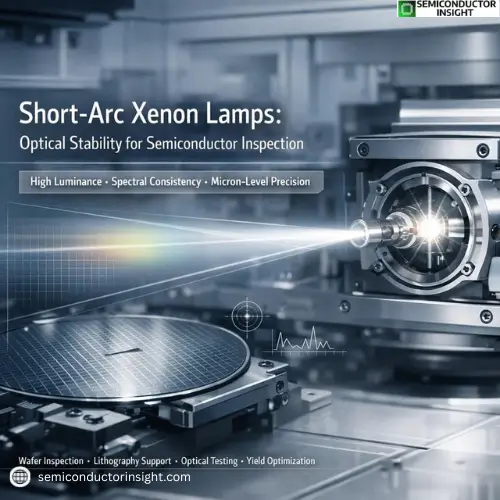
Short-Arc Xenon Lamps Market: Precision Light Sources Powering Advanced Semiconductor Systems
Short-arc xenon lamps are high-intensity discharge light sources that generate a concentrated, continuous spectrum closely resembling natural daylight. Within semiconductor manufacturing environments, these lamps are valued not for illumination alone, but for their optical stability, brightness uniformity, and spectral consistency.
In semiconductor equipment, where micron-level precision defines yield, short-arc xenon lamps function as core components in inspection systems, lithography support tools, wafer analysis equipment, and advanced optical testing platforms.
Why Light Quality Matters in Semiconductor Operations?
Semiconductor fabrication is increasingly dependent on optical systems that can detect defects invisible to the human eye. The light source powering these systems directly impacts detection accuracy, contrast resolution, and repeatability.
Short-arc xenon lamps deliver extremely high luminance from a compact arc gap, enabling focused beam control without spectral distortion. This makes them particularly effective in environments where consistent photon output directly influences measurement reliability.
Engineering Characteristics That Define Market Adoption
Short-arc xenon lamps, in contrast to traditional industrial lamps, are designed for controlled conditions. Their design prioritizes arc stability, electrode durability, and thermal balance.
Manufacturers continuously refine lamp geometry and gas pressure calibration to extend operational life while maintaining constant intensity. In semiconductor fabrications, where downtime is costly, these performance refinements translate directly into operational efficiency and cost optimization.
Integration across Semiconductor Equipment Platforms
The application footprint of short-arc xenon lamps spans multiple stages of semiconductor production. They are commonly integrated into optical inspection tools used during wafer fabrication and post-processing validation.
Their role is equally significant in research and development environments, where process tuning and failure analysis require dependable light sources that can operate under prolonged cycles without spectral drift.
Supply Chain Precision and Manufacturing Control
Producing short-arc xenon lamps is a specialized process involving high-purity xenon gas, precision electrode alignment, and stringent vacuum sealing standards. Any deviation in manufacturing tolerances can affect lamp lifespan and optical performance.
As a result, the supplier base remains relatively concentrated, with established manufacturers holding long-term relationships with semiconductor equipment OEMs. This structure reinforces quality assurance while limiting rapid market entry by new players.
Trade Dynamics and Global Equipment Movement
Short-arc xenon lamps market is closely linked to global semiconductor equipment trade. Lamps are often supplied alongside capital equipment or as part of aftermarket replacement programs.
Regions with high semiconductor fabrication activity particularly Asia Pacific represent major demand centres. However, design expertise and high-precision manufacturing capabilities are often concentrated in technologically mature markets, creating a cross-regional value chain.
Regulatory and Operational Compliance Landscape
In semiconductor facilities, equipment components must comply with strict safety and environmental standards. Short-arc xenon lamps are subject to regulations related to pressure containment, electrical safety, and hazardous material handling.
Manufacturers align product designs with international compliance frameworks to ensure seamless integration into fab environments, minimizing certification delays and installation risks.
Technology Evolution and Competitive Differentiation
Competition within the short-arc xenon lamps market is driven less by pricing and more by performance consistency. Vendors differentiate through improved arc stability, longer replacement intervals, and enhanced thermal management.
Ongoing innovation also focuses on compatibility with automated tool calibration systems, supporting the semiconductor industry’s shift toward smart manufacturing and reduced manual intervention.
Take a Quick Glance at Our In-Depth Analysis Report:
https://semiconductorinsight.com/report/short-arc-xenon-lamps-market/
Operational Advantages and Limitations
From an operational standpoint, short-arc xenon lamps offer several benefits, including high brightness and broad spectral output. However, they also require careful handling and controlled operating conditions due to internal pressure and heat generation.
This balance between performance advantage and operational discipline makes them best suited for high-value semiconductor applications, rather than general industrial lighting.
Strategic Importance in the Semiconductor Ecosystem
As device geometries continue to shrink and inspection tolerances tighten, the importance of dependable optical components grows. Short-arc xenon lamps, though often overlooked, play a foundational role in ensuring process visibility and quality control.
Their continued relevance is supported by the semiconductor industry’s focus on yield optimization, advanced inspection, and precision engineering.
Market Direction and Industry Outlook
The short-arc xenon lamps market is expected to maintain stable growth, aligned with semiconductor equipment upgrades and fab expansion projects. While alternative light technologies are emerging, xenon lamps remain deeply embedded in existing system architectures.
Their reliability, spectral characteristics, and proven performance ensure they will remain a critical optical solution within semiconductor manufacturing for the foreseeable future.

Comments (0)