

Semiconductor Surface Perfection through Rare Earth Chemistry Boosting Ceria CMP Slurry Market
In the vast and intricate world of semiconductor manufacturing, certain materials operate behind the scenes yet play a decisive role in determining performance outcomes. Ceria CMP slurry, built around cerium oxide particles, is one such unsung contributor. While chips often grab attention for their transistor counts or processing speed, the surface quality of wafers is equally critical.
Without an atomically smooth and defect-free surface, even the most advanced chip designs would fail during fabrication. Ceria slurry steps into this gap, acting as both a chemical and mechanical agent that enables ultra-precise polishing during chemical mechanical planarization (CMP).
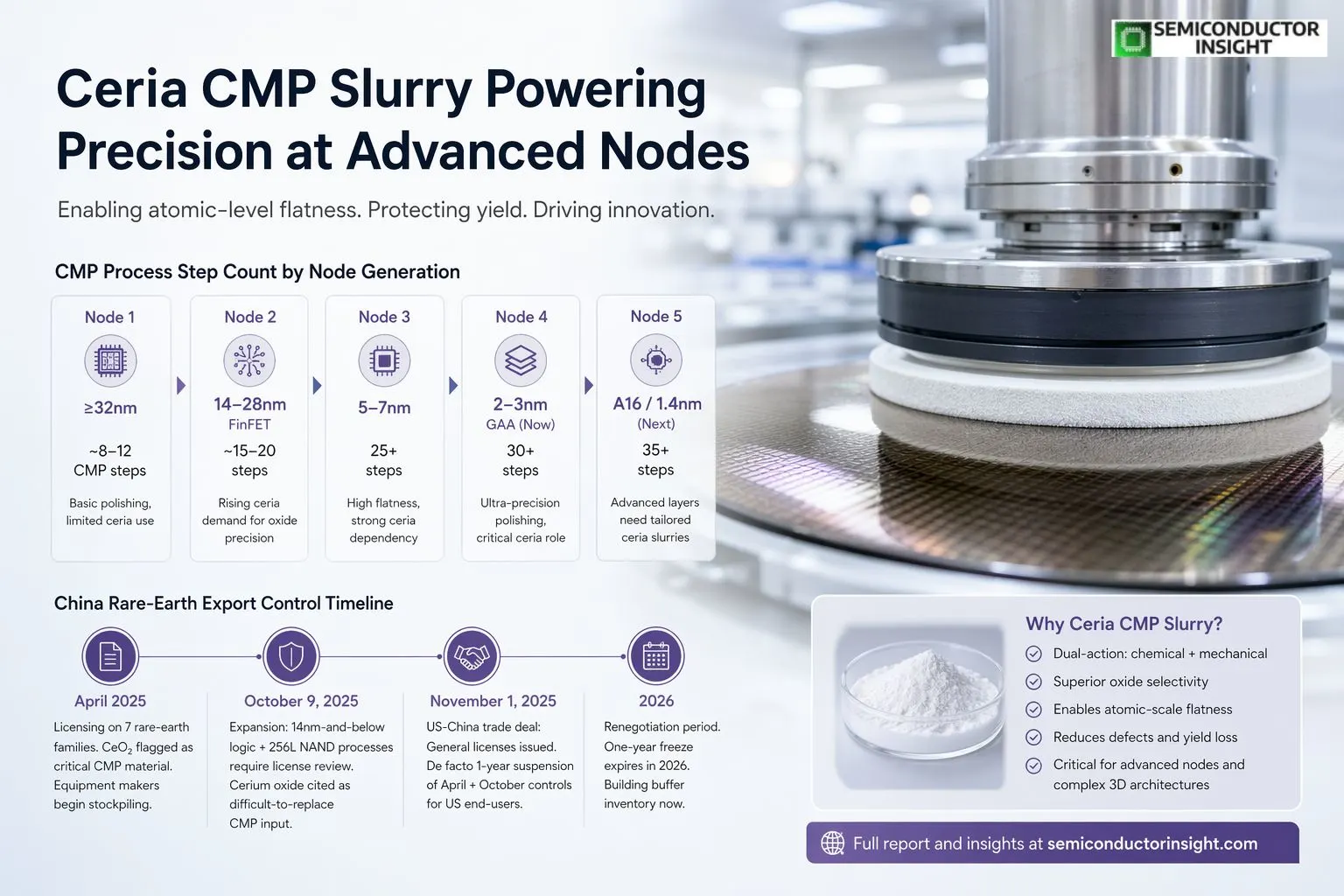
CMP Process Step Count by Node Generation;
Node 1:
- ≥32nm
- ~8-12 CMP steps
- Basic polishing, limited ceria use
Node 2:
- 14-28nm FinFET
- ~15-20 steps
- Rising ceria demand for oxide precision
Node 3:
- 5-7nm
- 25+ steps
- High flatness, strong ceria dependency
Node 4:
- 2-3nm GAA (Now)
- 30+ steps
- Ultra-precision polishing, critical ceria role
Node 5:
- A16 / 1.4nm (Next)
- 35+ steps
- Advanced layers need tailored ceria slurries
Cerium oxide has a special dual-action capability that sets it apart from other abrasives. It improves control over the polishing process by chemically interacting with silicon dioxide surfaces in addition to physically removing material. Because of this hybrid mechanism, ceria slurry is now essential, particularly in procedures that require maintaining homogeneity within a few nanometres across a 300 mm wafer.
Explore the full report details in our recently refreshed edition anytime: https://semiconductorinsight.com/report/ceria-cmp-slurry-market/
When atomic scale imperfections become billion dollar problems
At advanced nodes such as 5 nm and below, even the slightest variation in wafer flatness can cascade into massive yield losses. A single wafer can hold over 100,000 individual chips depending on design complexity, and defects introduced during polishing can render large sections unusable. This is where ceria slurry demonstrates its economic value.
For instance, modern fabrication facilities process thousands of wafers per day. If polishing inconsistencies affect just 2% of output, it could translate into millions of dollars in losses weekly. Ceria-based slurries reduce such risks by offering superior selectivity, especially in oxide polishing, ensuring that delicate structures are preserved while unwanted layers are removed efficiently. This precision has become even more vital with the rise of 3D NAND and FinFET architectures, where vertical and layered structures demand flawless surface transitions.
The shift from brute force polishing to intelligent surfaces
Earlier generations of CMP relied more on mechanical abrasion, often leading to micro-scratches and uneven surfaces. Ceria slurry has enabled a shift toward intelligent polishing, where chemical interactions guide the removal process. This evolution aligns with broader semiconductor trends where precision outweighs speed.
A notable example can be seen in advanced logic chip production, where multiple CMP steps are required across different layers. Each layer may involve distinct materials such as copper, tungsten, or dielectric oxides. Ceria slurry formulations are now being tailored at a granular level, adjusting particle size distributions, pH levels, and additives to match specific process requirements. This customization ensures compatibility with increasingly complex fabrication workflows.
China Rare-Earth Export Control Timeline
- April 2025:
China imposes licensing on 7 rare-earth families. CeO₂ flagged as critical CMP polishing material by MOFCOM. Equipment makers begin stockpiling.
- October 9, 2025:
Sweeping expansion: 14nm-and-below logic + 256L NAND processes require case-by-case license review for rare-earth inputs. TSMC, ASML, Samsung on alert. Cerium oxide explicitly cited by Commercial Times as difficult-to-replace CMP input.
- November 1, 2025:
US-China trade deal: China issues general licenses de facto 1-year suspension of April + October 2025 controls for US end-users. CMP supply chain breathes brief relief.
- 2026 Renegotiation Period:
Both sides understand the one-year freeze expires in 2026. Supply chain strategists are building buffer inventory now. TSMC stockpiles can support 12-24 months of operations.
A balancing act between innovation and supply resilience
Ceria CMP slurry market sits at an intersection of chemistry, engineering, and geopolitics. While technological advancements are driving demand, supply chain considerations are shaping strategic decisions. Companies are investing in research to develop alternative polishing materials, but ceria remains difficult to replace due to its unique properties.
At the same time, collaborations between semiconductor firms and material suppliers are becoming more integrated. Instead of off-the-shelf solutions, slurry formulations are increasingly co-developed to match specific fabrication nodes and architectures. This collaborative approach reflects a broader shift in the semiconductor industry, where materials science is no longer a supporting function but a core driver of innovation.
In this evolving landscape, ceria CMP slurry continues to prove that even the most subtle components can have an outsized impact on the future of technology.

Comments (0)