
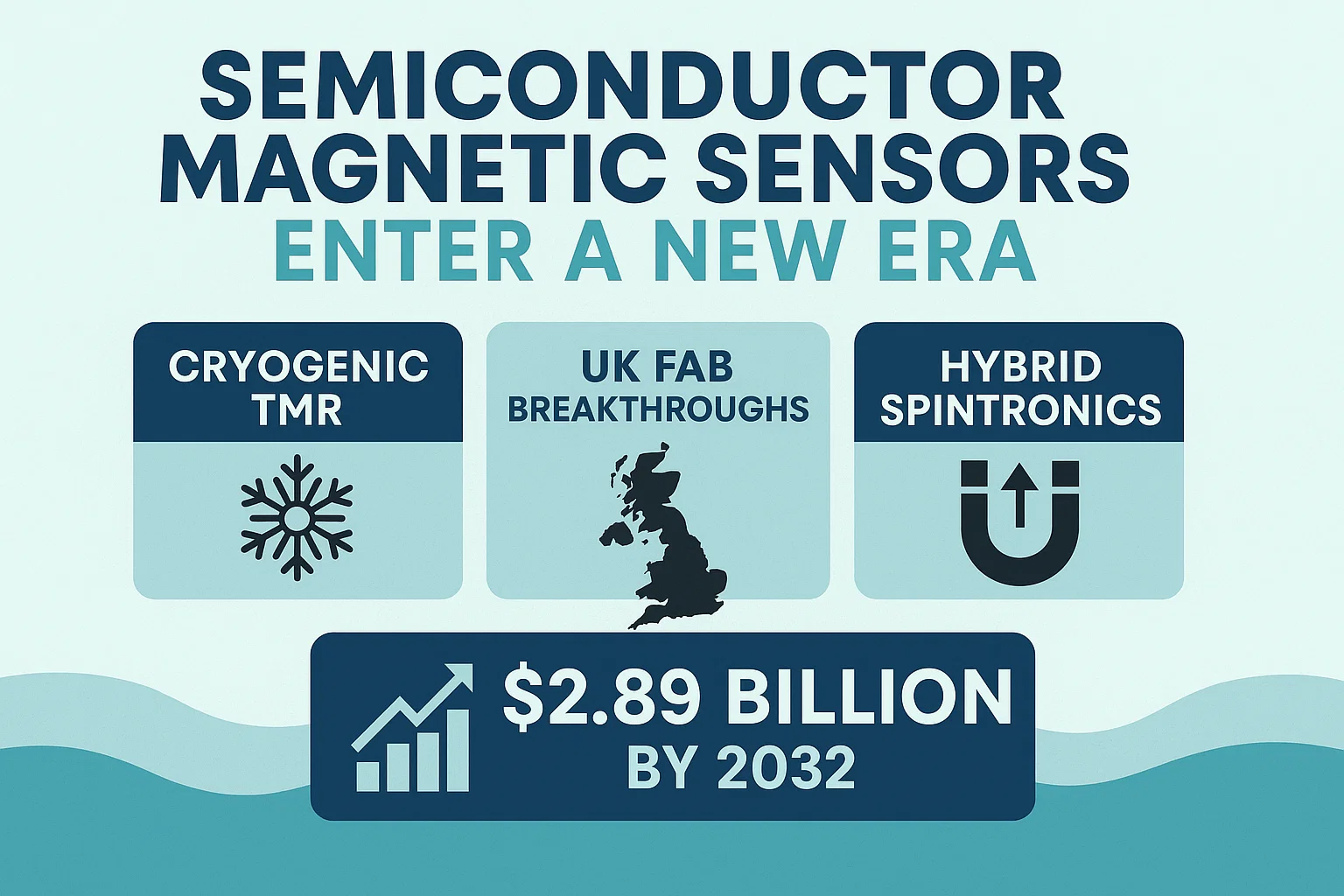
Semiconductor Magnetic Sensors Enter a New Era: Cryogenic TMR, UK Fab Breakthroughs, and Hybrid Spintronics Propel Market to $2.89 Billion by 2032
In the evolving realm of electronics and digital intelligence, semiconductor magnetic sensors have emerged as one of the most promising technologies for precise, real-time, and contactless measurement of magnetic fields. Used across sectors such as automotive, consumer electronics, healthcare, industrial automation, and quantum computing, these sensors are pivotal in improving device intelligence, accuracy, and power efficiency.
The global Semiconductor Magnetic Sensor Market, valued at US$ 1.78 billion in 2024, is now projected to reach US$ 2.89 billion by 2032, registering a healthy CAGR of 7.3% from 2025 to 2032. This growth is underpinned by several game-changing advancements in tunneling magnetoresistance (TMR), cryogenic applications, full-stack fabrication capabilities, and hybrid opto-magnetic integration.
Access Your Free Sample Report- Semiconductor Magnetic Sensor Market
Magnetic Sensor Basics – A Quick Primer
Before diving into industry news, it’s essential to understand what makes semiconductor magnetic sensors unique. These sensors detect magnetic fields and translate them into electrical signals, commonly used in rotation sensing, speed measurement, current detection, and position tracking. There are several main types:
- Hall Effect Sensors – Cost-effective and widely used in automotive and industrial systems.
- Anisotropic Magnetoresistance (AMR) Sensors – Higher sensitivity than Hall sensors.
- Tunneling Magnetoresistance (TMR) Sensors – Ultra-sensitive, suitable for advanced electronics and wearables.
- Giant Magnetoresistance (GMR) Sensors – Employed in data storage and high-precision sensing.
While Hall effect sensors still dominate in volume, TMR is gaining fast due to its incredible sensitivity and growing relevance to high-tech and emerging markets.
Key Market Drivers
- Automotive Transformation
EVs and autonomous vehicles rely heavily on precise, robust magnetic sensors for steering angle detection, gear position sensing, and battery monitoring. With EV adoption accelerating globally, magnetic sensors have become indispensable. - Consumer Tech Expansion
From smartphone compasses to advanced AR/VR gesture control, magnetic sensors have found growing applications in wearables and mobile devices. - Healthcare Monitoring
Wearable medical devices increasingly use TMR sensors for muscle signal monitoring, magnetocardiography, and non-invasive diagnostics. - Quantum and AI Technologies
As quantum computing and AI datacenters demand highly sensitive, fast-response sensors, the integration of magnetic elements into hybrid chips and cryogenic systems is paving the way for the next wave of innovation.
Archer’s Breakthrough in Cryogenic TMR Sensors for Quantum Systems
One of the most notable recent developments comes from Archer Materials, which demonstrated the use of TMR sensors in cryogenic environments, an essential step for quantum computing. Traditional sensors falter in such low-temperature scenarios due to instability and signal degradation. Archer’s innovation paves the way for reliable, scalable magnetic field detection inside quantum hardware systems.
By operating effectively at cryogenic temperatures, these TMR sensors can monitor environmental magnetic noise in real-time—enhancing qubit performance and system coherence. This breakthrough aligns closely with the growing investment in quantum computing infrastructure across North America, Europe, and Asia-Pacific.
Why It Matters:
Quantum computing hinges on coherence, and minimizing magnetic noise is key to maintaining qubit fidelity. These sensors will likely become core components in future quantum platforms.
Neuranics and the UK’s First Magnetic Sensor Foundry
In a bold move that reflects the geopolitical push for semiconductor sovereignty, Neuranics, a University of Glasgow spin-out, announced a partnership to develop the UK’s first full-stack magnetic sensor facility. Backed by a £160 million investment as part of Glasgow’s High-Tech Investment Zone, the fab will manufacture TMR-based sensors from substrate to system level.
Target applications include:
- Gesture-control systems in consumer electronics
- Wearable biomedical monitoring
- Electromagnetic field detection in industrial machinery
This facility is expected to create over 100 high-tech jobs and reduce dependency on overseas foundries. For the UK, it represents a major leap toward localizing sensor R&D and mass production.
Why It Matters:
Vertical integration of sensor development and fabrication will allow for faster innovation, cost efficiency, and regional resilience in supply chains.
Download Sample Report PDF- Semiconductor Magnetic Sensor Market
TDK’s Spin Photo Detector – A Hybrid Marvel
TDK Corporation introduced a revolutionary hybrid sensor: the spin photo detector. Built on magnetic tunnel junction (MTJ) principles, it offers ultra-fast data transmission—20 picoseconds per pulse—and is poised to tackle the data transfer bottlenecks plaguing AI datacenters.
Unlike conventional magnetic sensors, this device merges magnetic and optical technologies, delivering ten times the transmission speed while consuming less energy. While it is still in the prototype stage, TDK plans to begin sampling by March 2026, with mass production expected within five years.
Why It Matters:
This innovation could shift the landscape of magnetic sensing from pure physical measurement to high-speed logic and communication roles within AI and neuromorphic systems.
Altermagnetism – A New Physical Frontier
Scientists from the University of Nottingham, in collaboration with international researchers, have successfully demonstrated a previously unknown magnetic behavior: altermagnetism. This state combines the properties of ferromagnets and antiferromagnets—allowing electrical control of spin without the associated power losses.
Though still in the academic phase, this discovery is expected to influence magnetic sensor design by reducing energy consumption and increasing processing speeds. Potential use cases range from quantum chips to low-power IoT sensors.
Why It Matters:
If commercially viable, altermagnetic materials could drastically reduce the power consumption of magnetic sensor arrays, particularly in edge AI applications.
Regional Trends and Competitive Landscape
North America and Europe are leading in research and high-end sensor integration, while Asia-Pacific, led by Japan, China, and South Korea, dominates in mass production.
Key companies include:
- TDK Corporation – Advancing MTJ-based components for AI and datacenters.
- Allegro Microsystems – Known for automotive-grade Hall and TMR sensors.
- Infineon Technologies – Offers a broad sensor portfolio across EVs and industrial automation.
- Honeywell – Integrates sensors into complex aerospace and defense systems.
- Neuranics – Emerging innovator in biomedical and wearable magnetic sensors.
Opportunities and Challenges Ahead
Opportunities:
- Quantum Readiness: Cryogenic-compatible sensors can unlock new commercial use cases.
- AI and Datacenter Integration: Hybrid magnetic-optical sensors address speed bottlenecks.
- Healthcare & Wearables: Increasing miniaturization and sensitivity support next-gen diagnostics.
Challenges:
- High Fabrication Costs: TMR and MTJ sensors are still costly to produce at scale.
- Material Limitations: Discoveries like altermagnetism are promising but need years to mature.
- Global Supply Chain Risks: Geopolitical tensions may impact component availability and investment flow.
Market Forecast (2025–2032)
| Year | Market Size (US$ Billion) | Key Milestone |
| 2024 | 1.78 | Baseline |
| 2025 | 1.91 | Early TMR adoption |
| 2027 | 2.21 | Rise of hybrid spin sensors |
| 2030 | 2.60 | Medical & automotive boom |
| 2032 | 2.89 | Mass AI and quantum integration |
The forecast reflects a CAGR of 7.3%, supported by innovations in quantum sensing, healthcare wearables, and spintronics.
Click Here To Download Full Sample Report- Semiconductor Magnetic Sensor Market
Magnetic Sensing is the New Frontier
The semiconductor magnetic sensor industry is in the midst of a fundamental transformation. Moving beyond traditional Hall sensors, the field is now embracing quantum-capable TMR, AI-ready hybrid detectors, and next-gen fabrication strategies.
Backed by solid market fundamentals and world-changing innovations, this sector is not only on track for robust growth but is also set to shape the future of sensing across industries.
Whether you’re a technologist, investor, or innovator, magnetic sensors are becoming an indispensable pillar of the new semiconductor era.

Comments (0)