
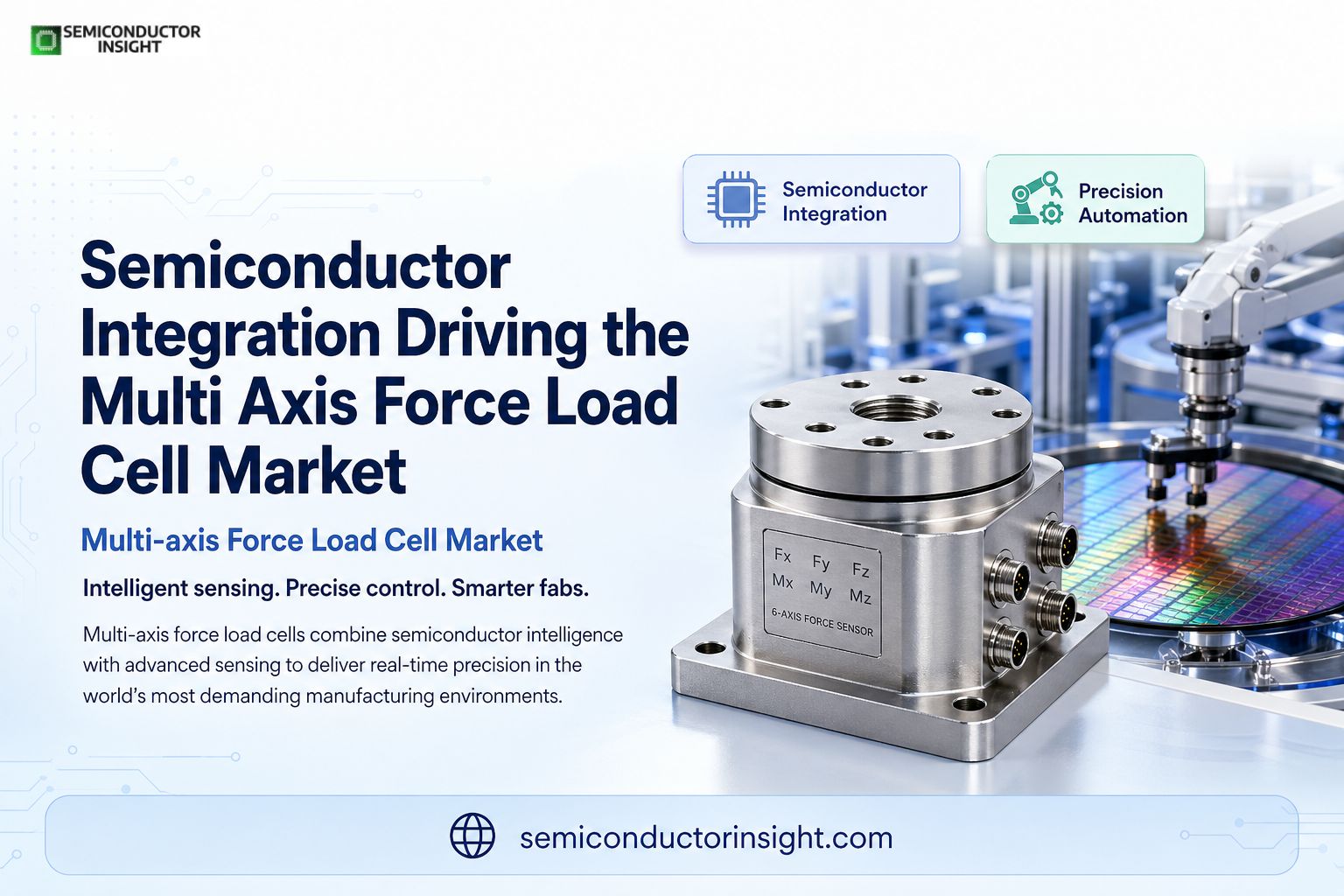
Semiconductor Integration Driving the Multi Axis Force Load Cell Market
Multi-axis force load cells are no longer just mechanical measurement devices; they have evolved into intelligent sensing systems deeply embedded in semiconductor-driven environments. These sensors measure forces along multiple axes simultaneously, enabling real-time insights into complex mechanical interactions.
In semiconductor manufacturing, where nanometer-level precision matters, even minor force variations can influence wafer integrity, making these sensors critical in maintaining yield and quality.
Global semiconductor fabrication facilities now process more than 8 million wafers per month, according to industry and government-backed semiconductor associations. Within such high-throughput environments, force sensors play a silent yet vital role in handling, alignment, and packaging processes.
Stay connected for additional in-depth information right here: https://semiconductorinsight.com/report/multi-axis-force-load-cell-market/
The Shift from Single Axis to Multi-Dimensional Sensing
Traditional load cells measured force along a single direction, sufficient for basic industrial applications. However, as robotics and semiconductor equipment became more sophisticated, the need to measure forces across multiple directions simultaneously became essential.
Modern multi-axis systems can detect force and torque across three to six degrees of freedom, enabling precise control in robotic arms, wafer handlers, and micro-assembly systems. This transition has significantly improved process stability in semiconductor fabs, where even a deviation of a few microns can lead to defects.
Embedded Systems and Sensor Intelligence
The real transformation lies in how these load cells integrate with semiconductor electronics. Today’s systems combine strain gauge technology with embedded microcontrollers and signal processing units.
Key capabilities now include
- Real-time data acquisition at frequencies exceeding 1 kHz, enabling rapid response
- Digital signal conditioning that minimizes noise in high-interference environments
- Integration with industrial communication protocols such as EtherCAT and CAN
This convergence allows seamless interaction between sensing hardware and automated control systems, especially in advanced packaging and chip assembly lines.
Role inside Semiconductor Fabrication Environments
Force sensing is particularly relevant in wafer handling and inspection stages. Silicon wafers, often less than 1 mm thick, are extremely fragile. Multi-axis load cells ensure that robotic systems apply consistent and minimal force during transfer operations.
Wafer Loading → Robotic Handling → Alignment and Placement → Bonding or Etching → Inspection
At each stage, force monitoring ensures that stress levels remain within safe limits, reducing breakage rates and improving overall production efficiency.
Expanding Use Cases beyond Fabrication Floors
While semiconductor fabs remain a core application area, the use of multi-axis force load cells is expanding into adjacent sectors influenced by semiconductor technologies.
In robotics, these sensors enable delicate operations such as micro-soldering and component placement. In consumer electronics manufacturing, they ensure precision assembly of compact devices. Meanwhile, in electric vehicle production, force sensors assist in battery assembly processes where alignment accuracy is critical.
Industrial automation systems equipped with such sensors can improve operational accuracy by up to 30-40%, based on engineering performance studies.
Material and Design Innovations Enhancing Sensitivity
Recent developments in sensor materials are pushing performance boundaries. High-strength alloys and advanced composites are being used to improve durability without compromising sensitivity.
Additionally, miniaturization is becoming a defining trend. Compact multi-axis sensors are now being designed to fit into tight spaces within semiconductor equipment, supporting the industry’s push toward smaller and more efficient systems.
Some advanced models can measure forces as low as 0.01 Newtons, enabling ultra-sensitive applications such as microelectronics assembly and biomedical device manufacturing.
Ground Level Industrial Expansion
- Countries investing heavily in semiconductor manufacturing, such as the United States, Japan, South Korea, and India, are indirectly driving demand for precision sensing technologies.
- Government initiatives supporting domestic chip production have led to the construction of new fabrication facilities, each requiring advanced measurement systems.
- In India, the push toward semiconductor self-reliance has accelerated investments in fabrication and assembly units, creating opportunities for high-precision sensor integration.
- Similarly, global chipmakers are upgrading existing fabs with smarter automation systems, further embedding multi-axis force load cells into production ecosystems.
Multi-axis force load cells represent a convergence of mechanical engineering, materials science, and semiconductor technology. Their ability to provide accurate, multi-directional force data makes them indispensable in environments where precision is non-negotiable.
As semiconductor devices become smaller and manufacturing processes more complex, the reliance on such intelligent sensing systems will only deepen, reinforcing their role as a foundational element in the future of advanced industrial automation.

Comments (0)