Multi-Axis Force Load Cell Market Insights
The global Multi-Axis Force Load Cell market size was valued at USD 766 million in 2025. The market is projected to grow from USD 821 million in 2026 to USD 1,237 million by 2034, exhibiting a CAGR of 7.3% during the forecast period.
A Multi-Axis Force Load Cell is a specialized sensor designed to measure force simultaneously across multiple directions or axes. Unlike conventional single-axis load cells that capture force along one plane, multi-axis load cells can measure forces across two or three dimensions , typically along the X, Y, and Z axes , and frequently incorporate torque measurement capabilities around one or more axes. This makes them particularly valuable in complex force analysis environments where understanding load distribution across directions is essential to operational accuracy and safety.
The market is witnessing robust growth driven by the rapid expansion of industrial robotics, increasing automation across manufacturing sectors, and growing demand for precision measurement in aerospace and medical device testing. The widespread adoption of collaborative robots (cobots) has significantly elevated the requirement for highly sensitive, multi-directional force feedback systems. Furthermore, advancements in sensor miniaturization and signal processing technologies continue to enhance the performance and versatility of these devices. Key players operating in the global Multi-Axis Force Load Cell market include HBM, ATI Industrial Automation, FUTEK, Kistler, TE Connectivity, OnRobot, Robotiq, FANUC, Bota Systems, and Mitsubishi Electric, among others, each offering a broad range of solutions tailored to industrial, medical, and research applications.
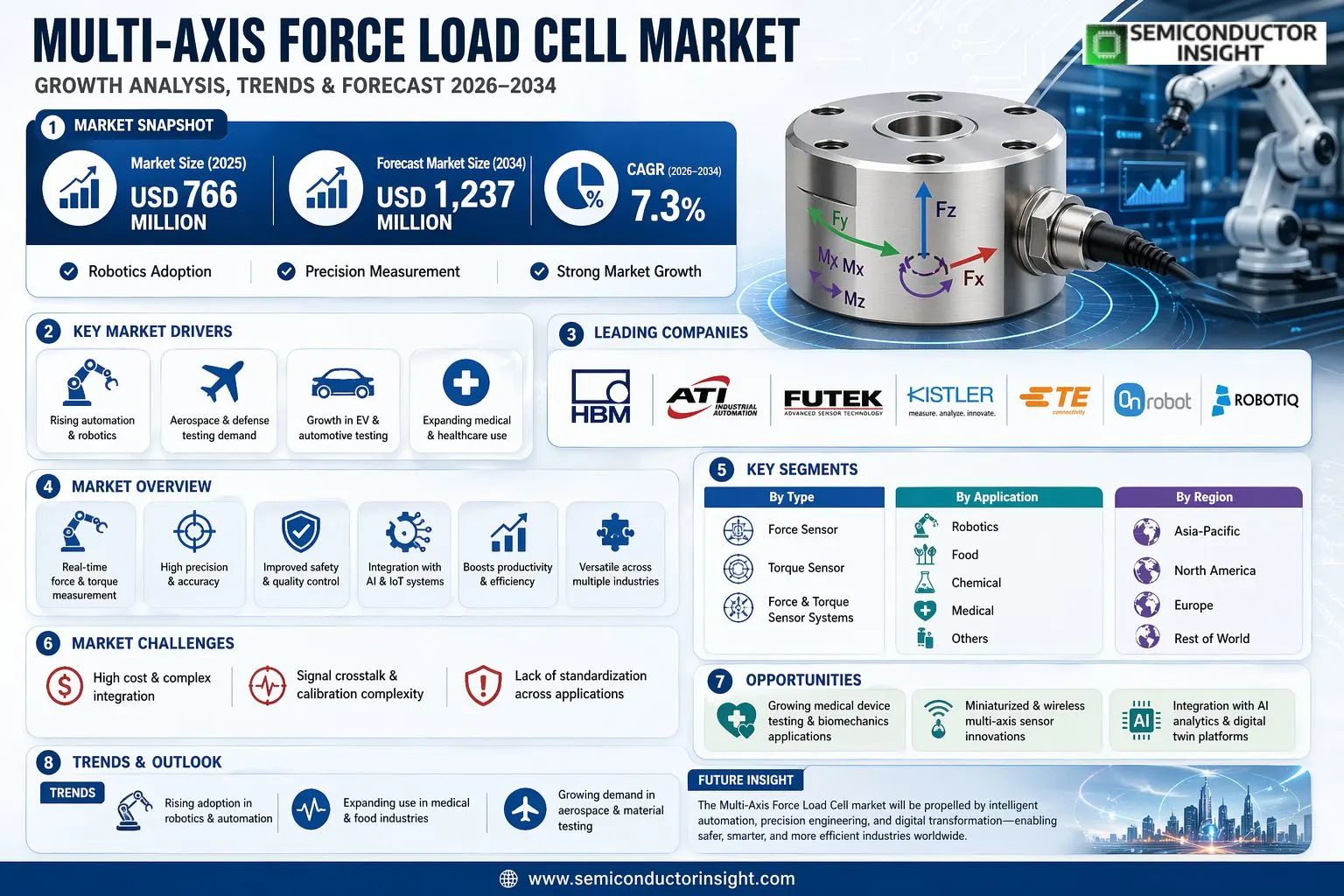
MARKET DRIVERS
Rising Demand from Industrial Automation and Robotics
Multi-Axis Force Load Cell Market is experiencing robust growth driven by the accelerating adoption of industrial automation across manufacturing sectors worldwide. As factories integrate collaborative robots and advanced assembly systems, the need for precise, real-time force and torque measurement across multiple axes has become operationally critical. Multi-axis force load cells enable robotic end-effectors to detect contact forces with high accuracy, making them indispensable in assembly, welding, and material handling applications. The push toward Industry 4.0 frameworks has further amplified procurement of these sensors as manufacturers seek tighter process control and reduced waste.
Expanding Applications in Aerospace, Automotive, and Medical Testing
Beyond automation, the multi-axis force load cell sector is being propelled by stringent testing requirements in aerospace, automotive crash analysis, and biomedical device validation. Automotive OEMs rely on six-axis load cells to simulate complex real-world load scenarios during component fatigue testing, while aerospace manufacturers use them to validate structural integrity under combined loading conditions. In the medical device industry, multi-axis sensors are increasingly employed in prosthetics research, surgical robotics, and rehabilitation equipment, where simultaneous measurement of forces and moments is essential for patient safety and performance optimization.
➤ The convergence of precision manufacturing requirements and the rapid scaling of collaborative robotics globally is positioning multi-axis force load cells as a foundational sensing technology across high-value industries, sustaining long-term demand momentum.
Government investments in smart manufacturing infrastructure, particularly across North America, Europe, and East Asia, are also reinforcing demand. National initiatives supporting domestic semiconductor and electronics manufacturing have created downstream requirements for advanced metrology equipment, including multi-axis force measurement systems. As production tolerances tighten and quality assurance standards evolve, end-users are prioritizing load cell solutions that deliver simultaneous multi-directional force data with minimal cross-talk and high signal integrity.
MARKET CHALLENGES
High Complexity of Calibration and Signal Crosstalk Management
One of the most significant technical challenges facing Multi-Axis Force Load Cell Market is the complexity involved in accurate calibration across multiple measurement axes simultaneously. Unlike single-axis load cells, multi-axis variants must account for interference between force and torque components , commonly referred to as crosstalk , which can introduce measurement errors if not properly compensated. Achieving low crosstalk levels requires sophisticated mechanical design, precision manufacturing tolerances, and complex mathematical compensation matrices. This technical barrier raises both production costs and the skill requirements for end-users during integration and routine recalibration procedures.
Other Challenges
Integration Complexity with Legacy Systems
Many industrial facilities operating older control infrastructure face significant integration challenges when adopting multi-axis force load cell technology. These sensors typically require specialized signal conditioning electronics, digital interfaces such as EtherCAT or CANopen, and customized software libraries, all of which may be incompatible with legacy PLCs or data acquisition systems. The resulting need for system upgrades increases total cost of ownership and extends deployment timelines, particularly for small and mid-sized manufacturers with constrained capital budgets.
Skilled Workforce Shortage
The effective deployment and maintenance of multi-axis force measurement systems requires engineers with interdisciplinary expertise spanning mechanical sensing principles, electronics, and data processing. A shortage of such specialized talent, especially in emerging industrial markets, limits the pace of adoption and increases reliance on vendor support services, which can elevate operational costs and create supply chain dependencies for end-users.
MARKET RESTRAINTS
Elevated Unit Costs Limiting Adoption Among Cost-Sensitive End-Users
The relatively high unit cost of multi-axis force load cells compared to conventional single-axis alternatives remains a meaningful restraint on broader market penetration. Precision machining of sensor bodies from high-grade stainless steel or aluminum, combined with the integration of multiple strain gauge bridges, temperature compensation circuits, and ASIC-based signal processing, contributes to manufacturing costs that are substantially higher than simpler load measurement solutions. For price-sensitive end markets such as small-scale academic research institutions or light-industrial applications, this cost differential continues to limit widespread deployment.
Environmental Sensitivity and Durability Constraints in Harsh Operating Conditions
Multi-axis force load cells are inherently sensitive instruments, and their performance can be adversely affected by extreme temperatures, humidity, vibration, and electromagnetic interference , conditions commonly encountered in heavy industrial environments. While sealed and ruggedized variants exist, these address only a portion of harsh-environment use cases, and their design compromises can reduce measurement bandwidth or accuracy. The susceptibility of high-precision multi-axis force sensors to environmental degradation constrains their applicability in industries such as mining, offshore energy, and heavy construction, where robust and low-maintenance instrumentation is prioritized over measurement precision.
MARKET OPPORTUNITIES
Growth Potential in Surgical Robotics and Minimally Invasive Medical Devices
The rapid expansion of surgical robotics platforms and the growing clinical adoption of haptic-feedback-enabled minimally invasive instruments represent a high-value growth frontier for Multi-Axis Force Load Cell Market. Surgical robotic systems require miniaturized, high-sensitivity multi-axis force sensors integrated into instrument tips to provide surgeons with tactile feedback during delicate procedures. As regulatory approvals for next-generation robotic surgery platforms increase globally, demand for application-specific multi-axis force measurement components engineered for medical-grade cleanliness, biocompatibility, and compact form factors is expected to grow substantially.
Emergence of Human-Robot Collaboration Driving Next-Generation Sensor Requirements
The proliferation of collaborative robots operating in shared human workspaces is creating compelling new demand for advanced multi-axis force load cell solutions capable of enabling safe, compliant robot motion. Unlike traditional industrial robots that operate in caged environments, cobots must detect and respond to unintended contact forces in real time to prevent injury. This safety imperative is driving cobot manufacturers and integrators to specify six-axis force-torque sensors as standard components, opening a scalable volume opportunity for market participants. As cobot installations continue to grow across electronics manufacturing, logistics, and healthcare sectors, the installed base for multi-axis force sensors is poised to expand significantly over the coming years.
Digitalization and IIoT Integration Enabling Smart Force Measurement Ecosystems
The integration of multi-axis force load cells with Industrial Internet of Things platforms presents a compelling commercial opportunity as manufacturers transition toward data-driven production environments. Modern multi-axis sensors equipped with embedded digital signal processors, wireless communication modules, and edge analytics capabilities can transmit real-time force data to cloud-based monitoring dashboards, enabling predictive maintenance and process optimization. Vendors that develop IIoT-ready multi-axis force measurement solutions with open-protocol connectivity and compatibility with leading industrial automation software platforms are well-positioned to capture premium pricing and build recurring software and service revenue streams alongside traditional hardware sales.
Trends
Rising Adoption of Multi-Axis Force Load Cells in Robotics and Automation
Multi-Axis Force Load Cell Market is witnessing significant momentum driven by the rapid expansion of industrial robotics and automation across manufacturing sectors globally. As robotic systems become more sophisticated, the demand for sensors capable of measuring force across multiple axes simultaneously has grown considerably. Multi-axis force load cells, which measure forces along the X, Y, and Z axes while also capturing torque data, are increasingly being integrated into robotic end-effectors to enable precise force-controlled assembly, collaborative robot (cobot) operations, and real-time feedback systems. Leading manufacturers such as FANUC, OnRobot, Robotiq, and Mitsubishi Electric are actively incorporating these sensors into their robotic platforms, reflecting the technology’s growing importance in modern production environments.
Other Trends
Expanding Applications in Medical and Aerospace Testing
Beyond robotics, Multi-Axis Force Load Cell Market is experiencing growing traction in medical device testing and aerospace structural analysis. In medical applications, multi-axis load cells are used for prosthetics testing, surgical robotics calibration, and biomechanical research, where accurate multi-directional force measurement is critical for safety and performance validation. In aerospace, these sensors support fatigue testing, wind tunnel measurements, and component stress analysis, where understanding force distribution across multiple axes is essential to ensuring structural integrity. This diversification of end-use applications is broadening the addressable market for multi-axis force sensing solutions.
Technological Advancements Driving Miniaturization and Higher Sensitivity
Ongoing R&D investments by key players such as HBM, Kistler, FUTEK, ATI Industrial Automation, and Bota Systems are driving notable improvements in sensor miniaturization, signal accuracy, and overload protection. Modern multi-axis force load cells are being engineered with higher resolution and lower cross-talk between axes, making them suitable for precision applications in the food processing, chemical, and medical industries. The integration of digital output interfaces and wireless communication capabilities is also gaining traction, enabling seamless connectivity with Industry 4.0 infrastructure and real-time data acquisition systems.
Asia-Pacific Emerging as a High-Growth Region for Multi-Axis Force Load Cell Adoption
The Asia-Pacific region, led by China, Japan, South Korea, and Southeast Asia, is emerging as a key growth frontier for Multi-Axis Force Load Cell Market. Rapid industrialization, government-backed robotics initiatives, and the expansion of electronics and automotive manufacturing are collectively driving regional demand. China in particular is investing heavily in smart manufacturing infrastructure, creating substantial opportunities for multi-axis force sensing technology. Meanwhile, North America and Europe continue to represent mature but innovation-driven markets, with strong demand from aerospace, automotive testing, and advanced manufacturing sectors. The competitive landscape remains dynamic, with global players including TE Connectivity, Epson, Sunrise Instruments, and Nordbo Robotics actively pursuing product development and strategic partnerships to strengthen their market positions.
COMPETITIVE LANDSCAPE
Key Industry Players
Global Multi-Axis Force Load Cell Market , Competitive Intelligence and Leading Manufacturer Profiles
The global Multi-Axis Force Load Cell market, valued at approximately USD 766 million in 2025 and projected to reach USD 1,237 million by 2034 at a CAGR of 7.3%, is characterized by a moderately consolidated competitive landscape. HBM (Hottinger Baldwin Messtechnik) stands out as a dominant force in the market, leveraging its decades-long expertise in precision measurement technology, broad product portfolio spanning force sensors and torque sensors, and a well-established global distribution network. Alongside HBM, companies such as FANUC, Mitsubishi Electric, and TE Connectivity command significant market share by integrating multi-axis force load cell solutions into their broader automation and industrial control ecosystems. These tier-one players benefit from substantial R&D investment, strategic partnerships with robotics and aerospace OEMs, and strong footholds across key geographies including North America, Europe, and Asia-Pacific , regions that collectively account for the majority of global revenue.
Beyond the dominant players, a robust tier of specialized and emerging manufacturers is intensifying competition across niche application segments such as collaborative robotics, medical device testing, and food processing automation. Companies like OnRobot, Robotiq, and Bota Systems have carved out competitive positions by developing purpose-built multi-axis force and torque sensing solutions optimized for collaborative robot (cobot) integration. Meanwhile, precision-focused firms such as ATI Industrial Automation, Kistler, and FUTEK continue to differentiate through high-accuracy, application-specific sensor designs catering to aerospace testing, material characterization, and surgical robotics. Emerging players including Nordbo Robotics, Forsentek, Robotous, and Sunrise Instruments are expanding their global footprints by offering competitively priced solutions with increasingly capable multi-axis measurement performance, challenging incumbents particularly in price-sensitive markets across Southeast Asia and South America.
List of Key Multi-Axis Force Load Cell Companies Profiled
- HBM (Hottinger Baldwin Messtechnik)
- Althen Sensors and Controls
- FANUC
- OnRobot
- Robotiq
- Epson
- Forsentek
- Bota Systems
- TE Connectivity
- Mitsubishi Electric
- ATI Industrial Automation
- Kistler
- Nordbo Robotics
- ME Systeme
- NCTE
- FUTEK Advanced Sensor Technology
- Robotous
- SINTOKOGIO
- Sunrise Instruments
Segment Analysis:
| Segment Category | Sub-Segments | Key Insights |
| By Type |
|
Force Sensor is the leading segment in Multi-Axis Force Load Cell Market, driven by its broad applicability across diverse industrial and research environments.
Torque Sensors, while a complementary segment, are gaining traction in applications requiring rotational force measurement, particularly in automotive powertrain testing and precision manufacturing equipment where understanding torsional loads is critical to product performance and longevity. |
| By Application |
|
Robotics stands as the dominant application segment, propelled by the global acceleration of industrial automation and the widespread deployment of intelligent robotic systems across manufacturing sectors.
Chemical industry applications leverage these sensors for process equipment monitoring and safety compliance, where accurate multi-directional load measurement helps prevent structural failures in high-pressure or hazardous environments. |
| By End User |
|
Industrial Manufacturing is the leading end-user segment, as modern production facilities increasingly rely on multi-axis force load cells to maintain quality, optimize processes, and enable smart factory capabilities.
Aerospace and defense end users demand the highest-performance multi-axis sensors for structural testing, wind tunnel experiments, and flight simulation platforms, where extreme environmental conditions and stringent accuracy requirements drive continuous product innovation among key manufacturers. |
| By Number of Axes |
|
6-Axis Force/Torque Load Cell is the leading and fastest-growing sub-segment, owing to its unparalleled ability to simultaneously capture all translational and rotational force components in a single compact unit.
|
| By Technology |
|
Strain Gauge-Based technology dominates Multi-Axis Force Load Cell Market, owing to its proven reliability, cost-effectiveness, and adaptability to a wide range of industrial measurement environments.
Capacitive sensors, though currently a niche technology in this market, are attracting research interest for applications requiring exceptional sensitivity at low force ranges, including microelectronics assembly and biomedical device testing, signaling a potential avenue for future market differentiation. |
Regional Analysis: Multi-Axis Force Load Cell Market
North America’s aerospace and defense sector is among the most significant end-users of multi-axis force load cell technology. Rigorous fatigue testing, structural load analysis, and component validation requirements mandate the use of high-precision multi-axis sensing instruments. As next-generation aircraft and defense platforms undergo accelerated development cycles, demand for advanced force measurement solutions within this corridor remains consistently strong and growing.
The region’s automotive industry, spanning traditional OEMs and emerging electric vehicle manufacturers, relies heavily on multi-axis force load cells for powertrain testing, crash simulation, and chassis evaluation. As vehicle electrification intensifies and safety standards tighten, automotive test facilities across the United States and Canada are scaling their investments in sophisticated multi-axis measurement systems to ensure regulatory compliance and performance benchmarking.
North America’s thriving robotics ecosystem, encompassing industrial automation, collaborative robots, and surgical robotics, is a key growth driver for Multi-Axis Force Load Cell Market. These devices are integral to force-torque sensing in robotic end-effectors, enabling precision manipulation and real-time feedback control. As robotic deployment across manufacturing and healthcare accelerates, the demand for compact, high-resolution multi-axis force sensing solutions is rising substantially across the region.
A well-funded research and development environment, supported by federal agencies, private venture capital, and leading universities, positions North America as a continuous innovator in multi-axis force measurement technology. Collaborative programs between national laboratories and technology firms are advancing miniaturization, wireless connectivity, and digital output capabilities, ensuring that the region’s offerings remain globally competitive and aligned with the evolving requirements of end-use industries through 2034.
Europe
Europe represents a highly mature and technically sophisticated segment of the global Multi-Axis Force Load Cell Market. Countries such as Germany, the United Kingdom, France, and Switzerland are recognized as engineering powerhouses, where precision instrumentation is deeply embedded across industrial manufacturing, automotive research, and medical device development. Germany’s formidable mechanical engineering sector and its emphasis on Industry 4.0 adoption create a fertile environment for multi-axis force sensing solutions. European manufacturers are particularly focused on integrating these load cells into advanced test benches, material testing machines, and smart assembly lines. The region’s stringent quality and safety standards, upheld by bodies such as the European Committee for Standardization, compel manufacturers to deploy reliable force measurement systems. Growing investment in renewable energy infrastructure, including wind turbine blade testing, also presents a distinct and expanding application avenue for multi-axis force load cells across Europe through the forecast horizon.
Asia-Pacific
Asia-Pacific is emerging as the fastest-growing region in Multi-Axis Force Load Cell Market, underpinned by rapid industrialization, expanding manufacturing capabilities, and significant government-led investments in automation and advanced technologies. China leads the regional landscape, driven by its colossal manufacturing output, burgeoning robotics industry, and growing emphasis on domestic precision instrument development. Japan and South Korea contribute substantially through their world-renowned automotive and electronics manufacturing sectors, where multi-axis force measurement is integral to quality control and product validation processes. India is steadily gaining traction as industrial modernization accelerates across sectors including automotive components, aerospace MRO, and defense manufacturing. The proliferation of smart factories and the increasing adoption of collaborative robots across Southeast Asia further amplify regional demand, positioning Asia-Pacific as a critical growth engine for Multi-Axis Force Load Cell Market between 2026 and 2034.
South America
South America holds a developing but steadily progressing position within the global Multi-Axis Force Load Cell Market. Brazil anchors regional activity, with its established automotive manufacturing base, expanding aerospace sector, and growing industrial automation initiatives creating incremental demand for precision force measurement technologies. Argentina and Chile contribute through mining and energy-related applications where structural load monitoring is increasingly important. While the region has historically depended on imported instrumentation, local investments in industrial upgrading and a gradual shift toward domestic capability building are beginning to shape a more self-reliant market environment. Economic variability and infrastructure constraints continue to moderate the pace of adoption; however, the long-term trajectory for multi-axis force load cell deployment across South America remains positive as industrial diversification and foreign direct investment in manufacturing continue to advance through the forecast period.
Middle East & Africa
The Middle East and Africa represent an emerging frontier for Multi-Axis Force Load Cell Market, characterized by selective but strategically significant demand growth. Gulf Cooperation Council nations, particularly the United Arab Emirates and Saudi Arabia, are investing heavily in industrial diversification, advanced manufacturing, and smart infrastructure as part of their broader economic transformation agendas. These initiatives are creating new application opportunities for precision force measurement solutions in construction load monitoring, oil and gas equipment testing, and nascent aerospace development programs. Africa’s market remains at an early stage of development, with demand concentrated in South Africa’s mining and heavy industry sectors. As regional governments prioritize technological self-sufficiency and industrial capability expansion, gradual yet consistent growth in the adoption of multi-axis force load cell technologies is anticipated across the Middle East and Africa through 2034.
Report Scope
This market research report provides a comprehensive analysis of Multi-Axis Force Load Cell Market, covering the forecast period 2026–2034. It offers detailed insights into market dynamics, technological advancements, competitive landscape, and key trends shaping the industry.
Key focus areas of the report include:
- Market Overview: The report begins with an overview outlining its current market scenario, key growth indicators, and industry transformation drivers. It discusses macroeconomic factors, demand–supply balance, regulatory landscape, and the strategic role of multi-axis force load cells in powering advancements across industries such as robotics, aerospace, medical devices, and industrial automation.
- Market Size & Forecast: Historical data and future projections for revenue, unit shipments, and market value across major regions and segments.
- Segmentation Analysis: Detailed breakdown by product type (Force Sensor, Torque Sensor), application (Robotics, Food, Chemical, Medical, Other), and end-user industry to identify high-growth segments and investment opportunities.
- Regional Insights: Insights into market performance across North America, Europe, Asia-Pacific, Latin America, and the Middle East & Africa, including country-level analysis where relevant.
- Competitive Landscape: Profiles of leading market participants, including their product offerings, R&D focus, manufacturing capacity, pricing strategies, and recent developments such as mergers, acquisitions, and partnerships.
- Technology Trends & Innovation: Assessment of emerging technologies, integration of AI/IoT, sensor design trends, fabrication techniques, and evolving industry standards.
- Market Drivers & Restraints: Evaluation of factors driving market growth along with challenges, supply chain constraints, regulatory issues, and market-entry barriers.
- Stakeholder Insights: Insights for component suppliers, OEMs, system integrators, investors, and policymakers regarding the evolving ecosystem and strategic opportunities.
Primary and secondary research methods are employed, including interviews with industry experts, data from verified sources, and real-time market intelligence to ensure the accuracy and reliability of the insights presented.
FREQUENTLY ASKED QUESTIONS:
What is the current market size of Multi-Axis Force Load Cell Market?
-> Global Multi-Axis Force Load Cell Market was valued at USD 766 million in 2025 and is expected to reach USD 1,237 million by 2034, growing at a CAGR of 7.3% during the forecast period.
Which key companies operate in Multi-Axis Force Load Cell Market?
-> Key players include HBM, Althen Sensors and Controls, FANUC, OnRobot, Robotiq, Epson, Forsentek, Bota Systems, TE Connectivity, Mitsubishi Electric, ATI Industrial Automation, Kistler, FUTEK, and Sunrise Instruments, among others.
What are the key growth drivers?
-> Key growth drivers include rising adoption of robotics and automation, increasing demand for precision force measurement in aerospace and medical testing, and growing need for multi-directional force sensing in industrial and research applications.
Which region dominates the market?
-> Asia-Pacific is among the fastest-growing regions driven by rapid industrialization and robotics adoption, while North America and Europe remain significant markets with established aerospace, automotive, and medical testing industries.
What are the emerging trends?
-> Emerging trends include integration of AI and IoT with force sensing systems, miniaturization of multi-axis load cells, increased use in collaborative robotics, and expanding applications in medical devices and food processing industries.
Need proxies cheaper than the market?
https://op.wtf

Get Sample Report PDF for Exclusive Insights
Report Sample Includes
- Table of Contents
- List of Tables & Figures
- Charts, Research Methodology, and more...
 Download Sample Report PDF