
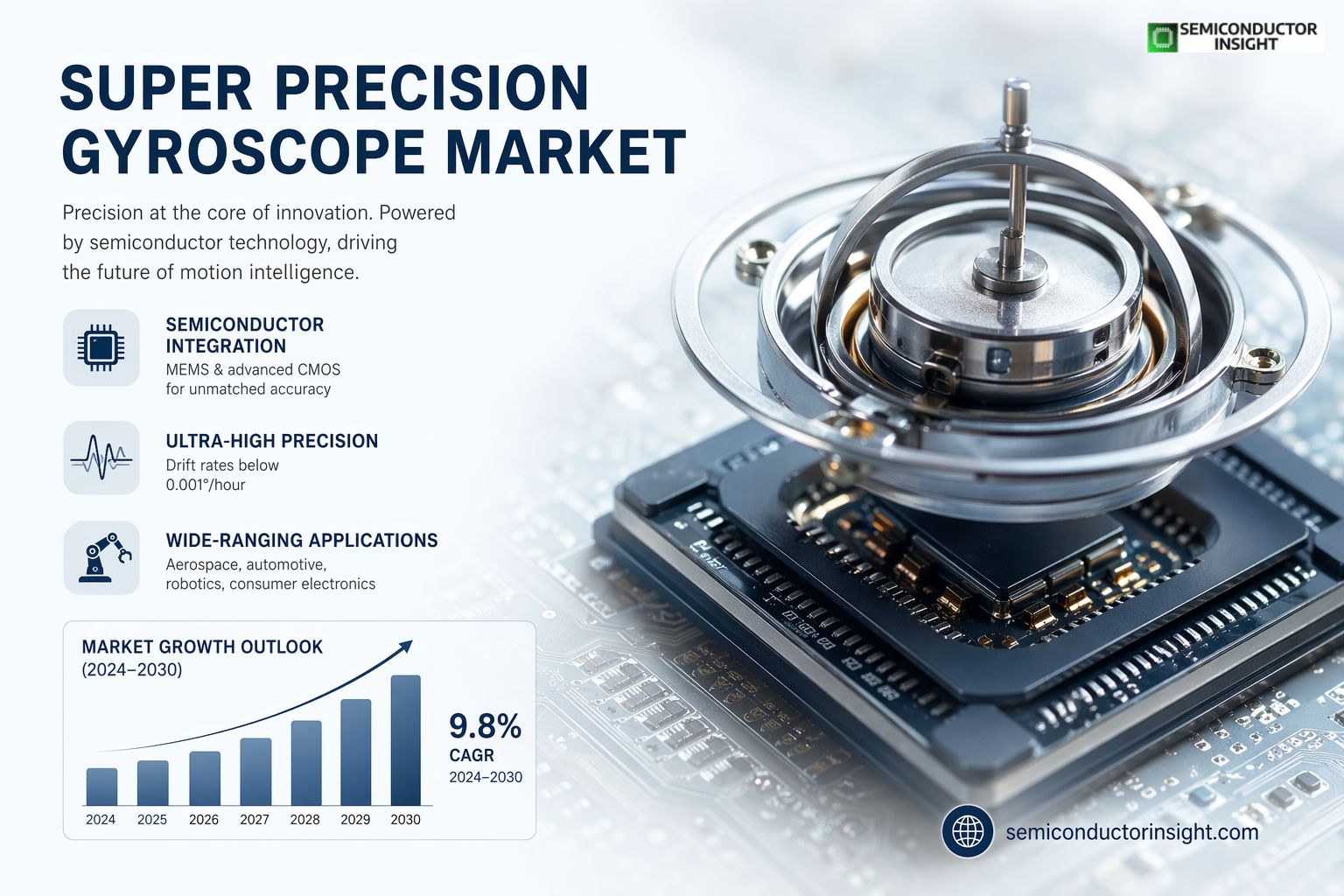
Top Semiconductor Fabrication Trends Reshaping Super Precision Gyroscope Market
Super precision gyroscope market has become a cornerstone of modern motion sensing systems, deeply rooted in semiconductor fabrication technologies. Despite conventional gyroscopes, today’s precision devices rely heavily on microelectromechanical systems (MEMS) and advanced silicon processing to achieve angular rate sensitivity at levels below 0.001°/hour in high-end applications.
Semiconductor foundries have enabled this transformation by introducing deep reactive-ion etching (DRIE) and wafer-level packaging, allowing gyroscopes to shrink to chip-scale dimensions while maintaining exceptional stability. In sectors such as aerospace and autonomous navigation, these devices are no longer optional components but critical subsystems embedded directly onto integrated circuits.
Silicon Architecture behind High Precision Motion Sensing
Modern super precision gyroscopes are built on silicon substrates using fabrication nodes typically ranging between 180 nm and 65 nm for MEMS integration. The architecture involves vibrating structures such as tuning forks or ring resonators, which detect Coriolis forces with extreme sensitivity. Semiconductor processes ensure structural symmetry at the nanometre scale, reducing bias drift and improving thermal stability.
For instance, wafer bonding techniques allow vacuum-sealed cavities with pressures below 10⁻³ Torr, significantly enhancing quality factors (Q-factors) beyond 100,000. This level of precision is essential for inertial navigation systems used in aircraft, submarines, and space exploration modules where GPS signals are unavailable.
Stay connected for additional in-depth information right here: https://semiconductorinsight.com/report/super-precision-gyroscope-market/
Integration with Semiconductor Systems and On Chip Intelligence
- A defining shift in super precision gyroscope market is the integration of sensing elements with on-chip signal processing units.
- Advanced CMOS circuits are co-fabricated with MEMS structures, enabling real-time error correction and digital filtering directly within the chip.
- This reduces latency to microsecond levels and improves signal-to-noise ratios beyond 60 dB in high-performance devices.
- Semiconductor companies are also embedding AI-based calibration algorithms at the edge, allowing gyroscopes to self-correct for temperature variations ranging from -40°C to 125°C.
- This fusion of sensing and computation represents a major leap from earlier discrete sensor systems.
Volume Manufacturing and Yield Optimization in Foundries
The transition from niche aerospace components to high-volume semiconductor products has significantly influenced the market. Modern fabs are capable of producing millions of MEMS gyroscope units per month with yields exceeding 85%, thanks to process standardization and defect density control below 0.1 defects/cm².
Countries with strong semiconductor ecosystems such as Taiwan, South Korea, and the United States have scaled production using 200 mm and 300 mm wafer lines. This has reduced per-unit costs from hundreds of dollars in legacy systems to under $5 for consumer-grade precision gyroscopes, while maintaining accuracy levels suitable for advanced robotics and industrial automation.
Quantum and Photonic Gyroscopes Emerging from Semiconductor Research
Beyond MEMS, semiconductor research labs are pushing the boundaries with quantum and photonic gyroscopes. These devices utilize principles such as the Sagnac effect in optical waveguides fabricated on silicon photonics platforms.
Current prototypes demonstrate drift rates as low as 0.0001°/hour, making them highly suitable for deep-space missions and military-grade navigation. Silicon photonics allows integration of lasers, modulators, and detectors on a single chip, reducing system size while improving precision. Although still in early commercialization stages, these technologies highlight how semiconductor innovation continues to redefine the limits of gyroscopic sensing.
Cross Domain Applications Expanding Market Scope
- The influence of semiconductor-based gyroscopes extends across multiple domains.
- In automotive systems, they are integral to electronic stability control and advanced driver assistance systems (ADAS), with millions of units deployed annually.
- Industrial robotics relies on these sensors for precision motion control, often requiring repeatability within microradian levels.
- In consumer electronics, smartphones and wearable devices incorporate gyroscopes fabricated on shared semiconductor platforms, achieving compact form factors under 5 mm².
- The convergence of these applications demonstrates how semiconductor scalability is driving widespread adoption.
Significant Industry Trends Gaining Momentum
One notable shift is the move toward heterogeneous integration, where gyroscopes are combined with accelerometers, magnetometers, and processors in a single system-in-package (SiP). Another emerging trend is the use of digital twins in semiconductor design, allowing virtual testing of gyroscope performance under real-world conditions before fabrication. Additionally, open-source hardware initiatives are beginning to influence MEMS design, fostering innovation beyond traditional semiconductor giants.
Super precision gyroscope market is no longer just about motion sensing; it represents a convergence of semiconductor physics, materials science, and intelligent system design. As fabrication technologies continue to evolve, the precision, scalability, and integration capabilities of these devices will expand, reinforcing their role as essential components in next-generation electronic systems.

Comments (0)