
Flexible Gyroscope Market MARKET INSIGHTS
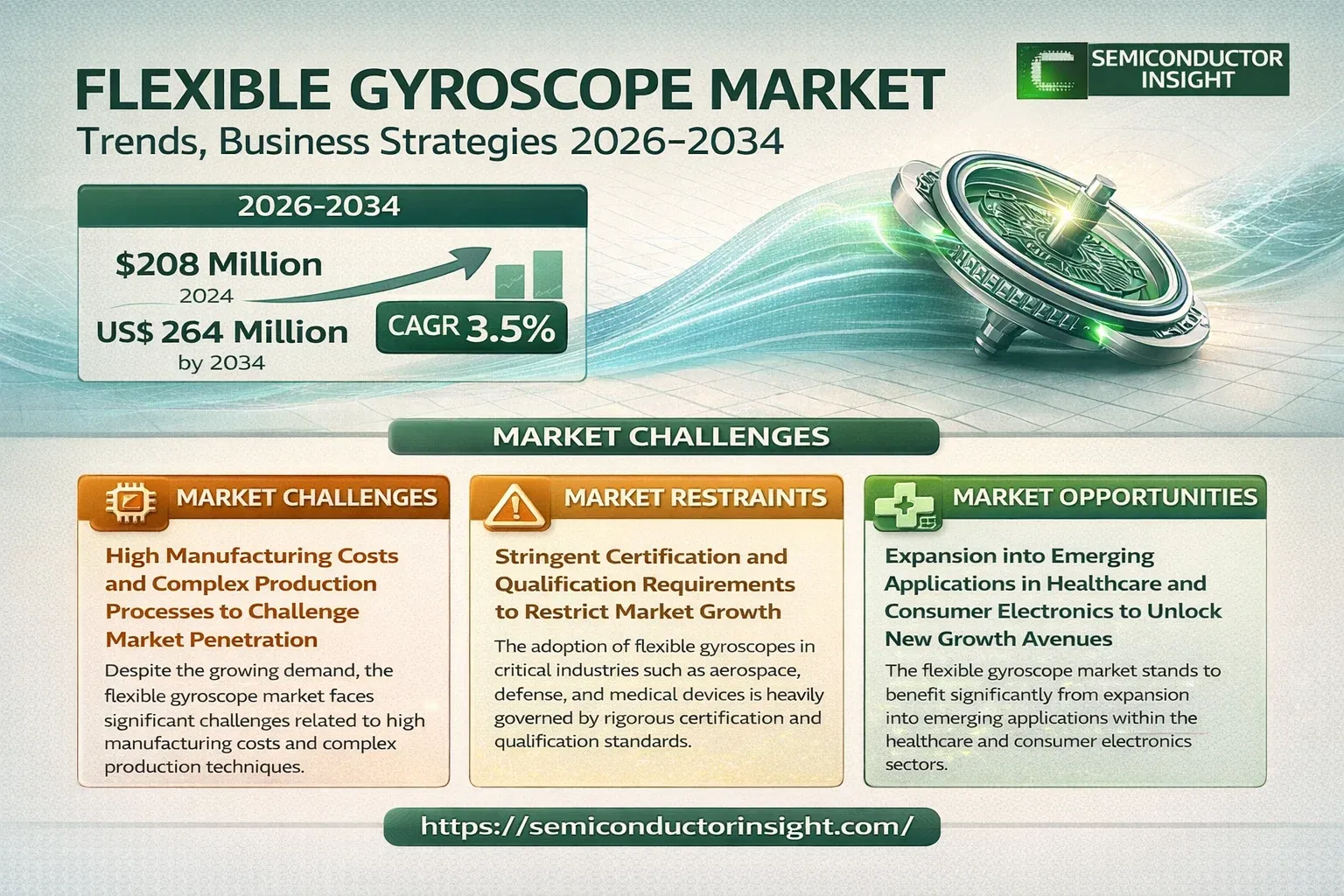
Global Flexible Gyroscope Market was valued at 208 million in 2024 and is projected to reach USD 264 million by 2032, at a CAGR of 3.5% during the forecast period.
Flexible Gyroscope Market is a precision instrument that uses a flexible element, such as a slender metal rod or sheet, to support the gyro rotor and enable it to rotate freely. This innovative design provides superior impact resistance, reduced size and weight, and enhanced integration capabilities while preserving the fundamental performance characteristics of a traditional gyroscope.
The market growth is primarily driven by increasing demand from the aerospace and automotive industries, where these sensors are critical for navigation, stabilization, and control systems. Furthermore, advancements in MEMS (Micro-Electro-Mechanical Systems) technology and the rising adoption of IoT devices are creating new opportunities. However, the market faces challenges such as high manufacturing costs and technical complexities associated with miniaturization. Key players like Honeywell International, Northrop Grumman Corporation, and Safran Electronics & Defense dominate the market with extensive product portfolios and significant R&D investments.
Flexible Gyroscope Market MARKET DYNAMICS
Flexible Gyroscope Market MARKET DRIVERS
Robust Growth in Aerospace and Defense Applications to Drive Market Expansion
Global Flexible Gyroscope Market is experiencing significant momentum due to escalating demand from the aerospace and defense sectors. These industries require highly reliable, compact, and shock-resistant inertial navigation systems for applications including unmanned aerial vehicles (UAVs), missile guidance systems, and aircraft stabilization. Flexible gyroscopes, with their superior impact resistance and miniaturized form factors, are becoming critical components in next-generation navigation systems. Defense spending has been increasing globally, with several nations modernizing their military equipment, which directly fuels the adoption of advanced gyroscopic technologies. The inherent advantages of flexible designs over traditional mechanical gyroscopes, including reduced maintenance requirements and longer operational life, make them particularly suitable for demanding defense environments where reliability is paramount.
Proliferation of Autonomous Vehicles and Robotics to Accelerate Market Growth
Another major driver is the rapid advancement in autonomous vehicles and industrial robotics, where precise orientation and motion sensing are fundamental. The automotive industry’s shift toward autonomous driving systems requires high-accuracy inertial measurement units (IMUs) that can perform reliably under various environmental conditions. Flexible gyroscopes offer the necessary performance characteristics while meeting the stringent size and weight constraints of modern vehicle designs. Similarly, the robotics sector utilizes these sensors for navigation, stabilization, and precise movement control in manufacturing, logistics, and service robots. As investments in automation and smart transportation infrastructure increase globally, the demand for sophisticated motion sensors like flexible gyroscopes is expected to grow substantially, supporting market expansion through the forecast period.
Technological Advancements and Miniaturization Trends to Fuel Adoption
Continuous innovation in microfabrication and materials science is enabling the production of more efficient and cost-effective flexible gyroscopes. Recent developments focus on enhancing performance metrics such as bias stability, angle random walk, and temperature compensation while reducing the physical footprint. These improvements are critical for applications in consumer electronics, wearable devices, and medical equipment, where space is limited and performance cannot be compromised. The trend toward miniaturization across multiple industries is pushing manufacturers to develop smaller, more integrated sensor solutions. Furthermore, advancements in manufacturing processes are gradually reducing production costs, making these high-precision instruments more accessible to a broader range of applications and driving market penetration across diverse sectors.
Flexible Gyroscope Market MARKET CHALLENGES
High Manufacturing Costs and Complex Production Processes to Challenge Market Penetration
Despite the growing demand, the Flexible Gyroscope Market faces significant challenges related to high manufacturing costs and complex production techniques. The precision required in fabricating the flexible elements and ensuring consistent performance demands specialized equipment and stringent quality control measures, which contribute to elevated production expenses. These costs are often passed on to end-users, making the technology less accessible for price-sensitive applications and potentially limiting adoption in cost-conscious markets. The intricate nature of assembling and calibrating these devices requires highly skilled technicians and advanced facilities, further adding to the overall expense. While the market is expanding, these economic barriers remain a considerable challenge for widespread commercialization, particularly in industries where budget constraints are a primary concern.
Other Challenges
Performance Limitations Under Extreme Conditions
Flexible gyroscopes, while offering advantages in shock resistance and size, can face performance degradation under extreme environmental conditions such as very high temperatures, intense vibrations, or strong magnetic fields. These limitations can restrict their use in certain industrial, aerospace, or military applications where operational environments are harsh and unpredictable. Ensuring consistent accuracy and reliability across a wide range of conditions requires additional engineering solutions and protective measures, which can increase complexity and cost.
Intense Competition from Alternative Technologies
The market faces strong competition from other types of gyroscopes and motion sensing technologies, including fiber optic gyroscopes (FOGs), ring laser gyroscopes (RLGs), and emerging MEMS-based solutions. These alternatives often have established track records, mature manufacturing processes, and in some cases, superior performance characteristics for specific applications. Competing against these well-entrenched technologies requires continuous innovation and demonstration of clear advantages, which can be a significant challenge for flexible gyroscope manufacturers trying to gain market share.
Flexible Gyroscope Market MARKET RESTRAINTS
Stringent Certification and Qualification Requirements to Restrict Market Growth
The adoption of flexible gyroscopes in critical industries such as aerospace, defense, and medical devices is heavily governed by rigorous certification and qualification standards. These regulations ensure that components meet strict reliability, safety, and performance criteria before they can be integrated into systems. The process of obtaining necessary certifications can be time-consuming and costly, often requiring extensive testing and documentation. For manufacturers, navigating these complex regulatory landscapes across different regions and industries can delay product launches and increase development expenses. This regulatory burden can act as a significant restraint, particularly for smaller companies or new entrants that may lack the resources to manage prolonged qualification processes, thereby limiting the pace of market growth and innovation.
Technical Complexities in Integration and Calibration to Hinder Adoption
Integrating flexible gyroscopes into existing systems presents technical challenges that can restrain market growth. These sensors often require sophisticated calibration procedures to achieve the high levels of accuracy demanded by applications in navigation and stabilization. The calibration process must account for various environmental factors and operational conditions, which can be complex and time-intensive. Additionally, system designers may face difficulties in interfacing these gyroscopes with other components and ensuring seamless data fusion from multiple sensors. These integration hurdles can discourage adoption, especially in applications where simplicity and quick deployment are prioritized. The need for specialized expertise to properly implement and maintain these systems further compounds the challenge, potentially limiting their use to applications where their advantages clearly outweigh the integration complexities.
Supply Chain Vulnerabilities and Material Sourcing Issues to Impede Production
The production of flexible gyroscopes relies on specialized materials and components, some of which may be subject to supply chain constraints or geopolitical tensions. Certain high-performance alloys, rare earth elements, or advanced composites used in these sensors might have limited sourcing options or be susceptible to price volatility. Disruptions in the supply of these critical materials can lead to production delays, increased costs, and reduced manufacturing capacity. Furthermore, the global nature of the electronics supply chain means that events in one region can impact manufacturers worldwide. These vulnerabilities can restrain market growth by creating uncertainty for both producers and customers, potentially leading to longer lead times and higher prices that discourage adoption in cost-sensitive applications.
Flexible Gyroscope Market MARKET OPPORTUNITIES
Expansion into Emerging Applications in Healthcare and Consumer Electronics to Unlock New Growth Avenues
Flexible Gyroscope Market stands to benefit significantly from expansion into emerging applications within the healthcare and consumer electronics sectors. In medical technology, these sensors are increasingly used in surgical instruments, diagnostic equipment, and wearable health monitors that require precise motion tracking and stability. The growing emphasis on minimally invasive procedures and portable medical devices creates substantial opportunities for compact, high-performance motion sensors. Similarly, in consumer electronics, the proliferation of augmented reality (AR) and virtual reality (VR) devices, advanced gaming controllers, and image stabilization systems in smartphones and cameras presents a vast potential market. The unique combination of small size, durability, and precision offered by flexible gyroscopes makes them ideally suited for these applications, opening up new revenue streams beyond traditional industrial and defense uses.
Advancements in IoT and Smart Infrastructure to Create Substantial Market Opportunities
The rapid development of Internet of Things (IoT) technologies and smart infrastructure projects worldwide offers considerable growth opportunities for flexible gyroscope manufacturers. These sensors can play a crucial role in structural health monitoring systems for bridges, buildings, and other critical infrastructure, where they detect subtle movements and vibrations that might indicate potential issues. In industrial IoT applications, they contribute to predictive maintenance by monitoring equipment orientation and vibration patterns. The expansion of smart city initiatives and the increasing integration of sensor networks into urban environments further amplify this opportunity. As connectivity and data analytics capabilities continue to advance, the demand for reliable, low-power motion sensors that can operate in diverse environments is expected to grow, positioning flexible gyroscopes as key components in the evolving ecosystem of connected devices and intelligent systems.
Strategic Collaborations and Technological Partnerships to Enhance Market Position
Opportunities abound for market players through strategic collaborations and technological partnerships that can accelerate innovation and expand market reach. Partnerships between gyroscope manufacturers and system integrators can lead to optimized solutions tailored for specific applications, enhancing performance and reducing integration barriers. Collaborations with research institutions and universities can drive advancements in materials science and fabrication techniques, leading to next-generation products with improved characteristics. Additionally, joint ventures or technology licensing agreements can facilitate entry into new geographic markets or application segments. The evolving landscape of autonomous systems, electric vehicles, and advanced robotics presents numerous possibilities for synergistic partnerships that combine motion sensing expertise with other technological capabilities, creating comprehensive solutions that address complex market needs and drive future growth.
FLEXIBLE GYROSCOPE MARKET TRENDS
Miniaturization and Integration in Consumer Electronics to Emerge as a Trend in the Market
The relentless drive towards smaller, more powerful, and more feature-rich consumer electronics is a primary catalyst for the Flexible Gyroscope Market. These devices are critical for enabling advanced functionalities like image stabilization in smartphone cameras, motion sensing in gaming controllers, and precise navigation in wearable devices. Global smartphone market, which exceeded 1.4 billion units shipped in 2023, continues to be a massive driver, with high-end models increasingly incorporating multiple inertial measurement units (IMUs) that include flexible gyroscopes for enhanced performance. Furthermore, the integration of these components into augmented reality (AR) and virtual reality (VR) headsets is accelerating, with the AR/VR headset market projected to grow significantly, demanding ever-higher levels of precision and durability from internal sensors. This trend towards miniaturization forces manufacturers to innovate in materials science and microfabrication techniques to produce gyroscopes that are not only smaller and lighter but also robust enough to withstand the rigors of daily consumer use.
Other Trends
Expansion in Autonomous and Electric Vehicles
The automotive industry’s rapid shift towards autonomous driving systems and electric vehicles (EVs) is creating substantial new demand for high-reliability inertial sensors. Flexible gyroscopes are integral to advanced driver-assistance systems (ADAS) and inertial navigation systems (INS), providing critical data for vehicle stability control, rollover detection, and dead reckoning when GPS signals are lost. Global ADAS market is anticipated to grow at a compound annual growth rate of over 11%, directly correlating to increased sensor adoption. This application demands sensors that offer exceptional performance under harsh environmental conditions, including extreme temperatures and constant vibration, which aligns perfectly with the inherent ruggedness of flexible gyroscope designs. The evolution towards higher levels of autonomy (Level 3 and above) will further necessitate sensor fusion with redundant systems, potentially doubling or tripling the number of gyroscopes used per vehicle.
Advancements in Defense and Aerospace Applications
Defense and aerospace remain cornerstone applications for flexible gyroscope technology, where performance and reliability are non-negotiable. These sectors require navigation systems for missiles, unmanned aerial vehicles (UAVs), aircraft, and spacecraft that can perform accurately in high-vibration, high-G, and electromagnetically hostile environments. Recent developments have focused on enhancing the performance of these sensors, particularly in reducing bias instability and angle random walk to improve long-term navigation accuracy without external aids. Global military UAV market, for instance, is experiencing robust growth, with annual investments exceeding several billion dollars, all of which rely on precise inertial guidance systems. Concurrently, the rise of commercial spaceflight and small satellite (SmallSat) constellations is opening a new frontier, creating demand for radiation-hardened, cost-effective, yet highly accurate gyroscopes for attitude control and determination in low-earth orbit.
COMPETITIVE LANDSCAPE
Key Industry Players
Technological Innovation and Strategic Positioning Drive Market Leadership
Global Flexible Gyroscope Market exhibits a moderately consolidated competitive structure, characterized by the dominance of a few large defense and technology conglomerates alongside several specialized, innovative manufacturers. This landscape is shaped by high barriers to entry, including significant R&D investment requirements and stringent performance certifications, particularly for aerospace and defense applications. Honeywell International and Northrop Grumman Corporation are universally recognized as market leaders, a position cemented by their decades of experience, extensive patent portfolios, and deep integration into global defense supply chains. Their products are often considered the industry benchmark for reliability and precision in demanding environments.
While the top-tier players command a substantial revenue share, the market also features strong contenders like Safran Electronics & Defense and L3Harris Technologies, who leverage their expertise in avionics and navigation systems to capture significant value. These companies compete not only on performance but also on the miniaturization, power efficiency, and cost-effectiveness of their flexible gyroscope solutions, which are critical for modern commercial aerospace and emerging automotive applications such as advanced driver-assistance systems (ADAS).
Furthermore, the competitive dynamics are increasingly influenced by a wave of innovation from specialized firms and companies based in the Asia-Pacific region. Japan Aviation Electronics Industry and STMicroelectronics, for instance, are strengthening their market presence through the development of MEMS-based flexible gyroscopes, which offer advantages in size, weight, and power consumption (SWaP). Their growth is propelled by the booming consumer electronics and automotive sectors in the region. Similarly, Chinese players like China Shipbuilding Industry and Xi’an Precision Measurement and Control are expanding their capabilities, supported by national industrial policies aimed at achieving technological self-sufficiency in critical navigation components.
Consequently, the strategic focus for all players has shifted towards continuous product development and strategic partnerships. Key manufacturers are investing heavily in R&D to enhance the performance and reduce the cost of their offerings. Recent developments include the introduction of gyroscopes with improved bias stability and better resistance to shock and vibration, catering to the needs of unmanned aerial vehicles (UAVs) and industrial robotics. Mergers, acquisitions, and long-term supply agreements with major OEMs are also common tactics employed to secure market position and ensure growth over the forecast period.
List of Key Flexible Gyroscope Companies Profiled
- Honeywell International Inc. (U.S.)
- Northrop Grumman Corporation (U.S.)
- Safran Electronics & Defense (France)
- Kearfott Corporation (U.S.)
- L3Harris Technologies, Inc. (U.S.)
- Japan Aviation Electronics Industry, Ltd. (Japan)
- China Shipbuilding Industry Corporation (CSIC) (China)
- KVH Industries, Inc. (U.S.)
- STMicroelectronics N.V. (Switzerland)
- iXblue SAS (France)
- Colibrys Ltd. (Switzerland)
- Xi’an Precision Measurement and Control Technology Co., Ltd. (China)
- Delta (Beijing) Technology Co., Ltd. (China)
- Anhui Xindonglianke Microsystems Co., Ltd. (China)
Segment Analysis:
By Type
Neck Style Segment Commands Market Leadership Due to Superior Stability and High-Precision Performance
The market is segmented based on type into:
- Neck Style
- Power Tuning Style
By Application
Aerospace Industry Segment Leads Owing to Critical Demands for Navigation, Stabilization, and Guidance Systems
The market is segmented based on application into:
- Aerospace Industry
- Automotive Industry
- Medical Industry
- Communication Industry
- Other
Regional Analysis: Flexible Gyroscope Market
North America
North America, particularly the United States, represents a mature and technologically advanced market for flexible gyroscopes. The region’s leadership is driven by substantial defense and aerospace expenditures, with the U.S. Department of Defense’s FY2024 budget request allocating over D 145 billion for research, development, and procurement. This fuels demand for high-precision inertial navigation systems where flexible gyroscopes are critical components. Key manufacturers like Honeywell International, Northrop Grumman Corporation, and L3Harris Technologies are headquartered here, fostering a robust ecosystem for innovation. Furthermore, the growing adoption of autonomous vehicles and advanced robotics in industrial and consumer applications provides additional growth vectors. However, the market is characterized by stringent export controls and high manufacturing costs, which can limit broader commercial expansion.
Europe
Europe maintains a strong position in the Flexible Gyroscope Market, underpinned by a sophisticated aerospace sector and a concerted push towards industrial automation. The region benefits from collaborative programs like the European Defence Fund and Horizon Europe, which fund next-generation sensor technologies. Companies such as Safran Electronics & Defense and STMicroelectronics are pivotal, focusing on developing miniaturized, low-power, and high-reliability gyroscopes for applications ranging from commercial aviation to satellite systems. Strict EU regulations on product quality and safety act as a key driver, ensuring high-performance standards. However, market growth is sometimes tempered by complex supply chains and the high cost of compliance with regional directives.
Asia-Pacific
The Asia-Pacific region is the fastest-growing and largest volume market for flexible gyroscopes globally, dominated by China’s massive manufacturing and infrastructure development. The country’s “Made in China 2025” initiative heavily prioritizes advanced sensors and semiconductors, creating immense domestic demand. Japan, with established players like Japan Aviation Electronics Industry, remains a leader in high-quality, precision components for the automotive and consumer electronics industries. Meanwhile, India and South Korea are emerging as significant consumers, driven by expanding defense modernization programs and thriving electronics manufacturing sectors. While cost-competitive manufacturing is a key advantage, the region also faces challenges related to intellectual property protection and varying quality standards across different countries.
South America
Flexible Gyroscope Market in South America is nascent and developing. Demand is primarily driven by limited defense modernization initiatives and a slowly growing industrial automation sector in countries like Brazil and Argentina. The region largely depends on imports from North American, European, and Asian manufacturers, as local manufacturing capabilities for such high-precision components are extremely limited. Economic volatility and political instability in some countries often lead to constrained budgets for advanced technological procurement, hindering market growth. Nonetheless, long-term potential exists as infrastructure projects and natural resource exploration activities, which require precise navigation and control systems, gradually increase.
Middle East & Africa
This region presents an emerging market opportunity, primarily fueled by defense procurement and infrastructure development in Gulf Cooperation Council (GCC) nations like Israel, Saudi Arabia, and the UAE. These countries are investing significantly in modernizing their military and aerospace capabilities, creating a steady demand for advanced navigation systems. Israel, in particular, is a hub for aerospace technology and innovation. However, across the broader region, market development is uneven. Many African nations have minimal local demand due to limited industrial base and funding constraints. The market’s progression is therefore largely dependent on government-led initiatives and foreign investment in specific high-growth economies.
Report Scope
This market research report provides a comprehensive analysis of the global and regional Flexible Gyroscope Market, covering the forecast period 2025–2032. It offers detailed insights into market dynamics, technological advancements, competitive landscape, and key trends shaping the industry.
Key focus areas of the report include:
- Market Size & Forecast: Historical data and future projections for revenue, unit shipments, and market value across major regions and segments.
- Segmentation Analysis: Detailed breakdown by product type, technology, application, and end-user industry to identify high-growth segments and investment opportunities.
- Regional Outlook: Insights into market performance across North America, Europe, Asia-Pacific, Latin America, and the Middle East & Africa, including country-level analysis where relevant.
- Competitive Landscape: Profiles of leading market participants, including their product offerings, R&D focus, manufacturing capacity, pricing strategies, and recent developments such as mergers, acquisitions, and partnerships.
- Technology Trends & Innovation: Assessment of emerging technologies, integration of AI/IoT, semiconductor design trends, fabrication techniques, and evolving industry standards.
- Market Drivers & Restraints: Evaluation of factors driving market growth along with challenges, supply chain constraints, regulatory issues, and market-entry barriers.
- Stakeholder Analysis: Insights for component suppliers, OEMs, system integrators, investors, and policymakers regarding the evolving ecosystem and strategic opportunities.
Primary and secondary research methods are employed, including interviews with industry experts, data from verified sources, and real-time market intelligence to ensure the accuracy and reliability of the insights presented.
FREQUENTLY ASKED QUESTIONS:
What is the current market size of Global Flexible Gyroscope Market?
-> Flexible Gyroscope Market was valued at 208 million in 2024 and is projected to reach USD 264 million by 2032, at a CAGR of 3.5% during the forecast period.
Which key companies operate in Global Flexible Gyroscope Market?
-> Key players include Honeywell International, Northrop Grumman Corporation, Safran Electronics & Defense, Kearfott Corporation, and L3Harris Technologies, among others.
What are the key growth drivers?
-> Key growth drivers include increasing demand for precision navigation systems, growth in aerospace and defense sectors, and advancements in autonomous vehicle technology.
Which region dominates the market?
-> North America currently holds the largest market share, while Asia-Pacific is expected to witness the highest growth rate during the forecast period.
What are the emerging trends?
-> Emerging trends include miniaturization of gyroscopic components, integration with IoT systems, development of MEMS-based flexible gyroscopes, and increasing adoption in medical devices.
Get Sample Report PDF for Exclusive Insights
Report Sample Includes
- Table of Contents
- List of Tables & Figures
- Charts, Research Methodology, and more...
 Download Sample Report PDF


