
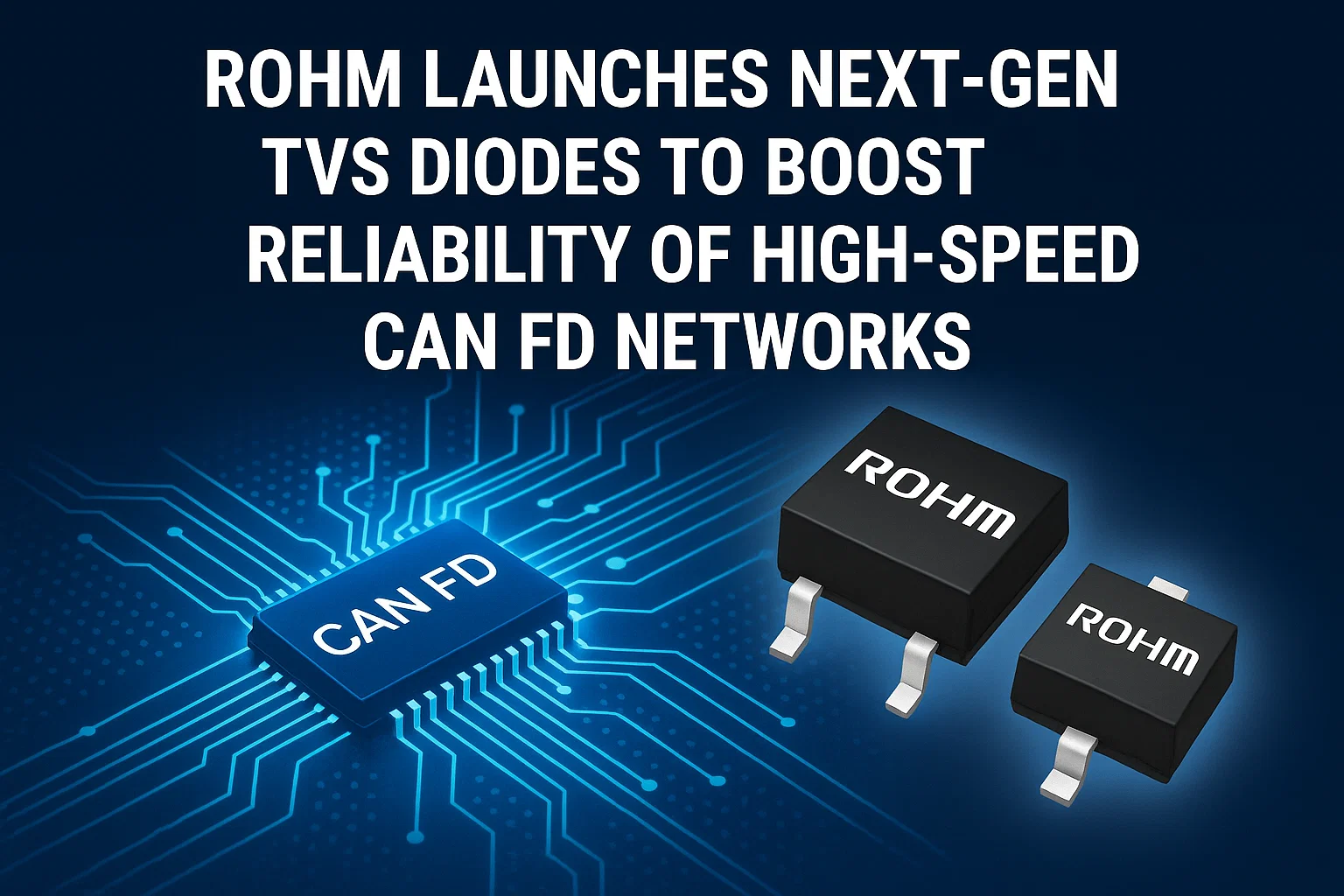
Rohm Launches Next-Gen TVS Diodes to Boost Reliability of High-Speed CAN FD Networks
The automotive industry is undergoing its most significant transformation in over a century. From the rise of autonomous driving systems to the shift toward software-defined vehicles (SDVs), the way cars are built, operated, and upgraded has fundamentally changed.
At the heart of this evolution lies one key element: data communication within vehicles. Modern cars can contain over 100 electronic control units (ECUs), handling everything from braking and infotainment to advanced driver-assistance systems (ADAS). To manage the ever-growing data exchange between these ECUs, the industry relies on Controller Area Network with Flexible Data-Rate (CAN FD) transceivers.
The traditional CAN protocol, introduced by Bosch in the 1980s, revolutionized in-vehicle communication. But as demands for bandwidth and reliability surged, CAN FD emerged as the next-generation solution, enabling higher data rates (up to 8 Mbps) and longer message frames.
Access Your Free Sample Report- Automotive CAN FD Transceivers Market
The Growing Need for CAN FD in the Automotive Ecosystem
From Traditional CAN to CAN FD
For decades, the classic CAN protocol handled most in-vehicle communication. However, as ADAS, EV battery management, and infotainment became more complex, its limitations surfaced:
- Max speed: Limited to 1 Mbps.
- Message length: Capped at 8 bytes per frame.
- Scalability issues: Couldn’t handle high-volume sensor data in real time.
CAN FD, introduced in 2012, addressed these issues:
- Higher throughput: Data rates up to 8 Mbps.
- Extended frame length: Up to 64 bytes.
- Backward compatibility: Works alongside traditional CAN systems.
This balance of higher performance and reliability, without completely replacing existing infrastructure, made CAN FD the natural evolution path for automakers.
Key Drivers of CAN FD Adoption
- Autonomous Driving & ADAS – Real-time data exchange between LiDAR, radar, and cameras requires faster communication.
- Electric Vehicles (EVs) – Battery management systems rely on high-speed, error-free communication.
- Cybersecurity & Reliability – CAN FD supports stronger error detection, critical for safety.
- Scalability – Enables automakers to build modular ECU systems without massive hardware redesigns.
The Market Landscape for CAN FD Transceivers
The Automotive CAN FD Transceivers Market is witnessing rapid growth:
- 2024 Valuation: US$567 million
- 2032 Projection: US$1.24 billion
- CAGR (2025–2032): 11.9%
Key Market Segments
- By Vehicle Type:
- Passenger cars (dominant due to ADAS integration)
- Commercial vehicles (increasing use in fleet telematics & logistics)
- By Application:
- Powertrain systems
- Infotainment & connectivity
- ADAS & autonomous driving
- EV battery management
- By Geography:
- Asia-Pacific leads (China, Japan, South Korea are EV leaders).
- Europe follows, driven by strict safety regulations.
- North America growing, boosted by autonomous driving R&D.
Download Sample Report PDF- Automotive CAN FD Transceivers Market
Recent Industry Developments
Rohm’s Game-Changing ESDCANxx TVS Diodes
In February 2025, Rohm Semiconductor introduced the ESDCANxx series of TVS (Transient Voltage Suppression) diodes, specifically designed for high-speed CAN FD systems.
Key Features
- Ultra-low capacitance: Just ~3.5 pF (ensures signal integrity at high speeds).
- Superior surge current tolerance: DFN1010 27V variant offers ~3.2× higher rating than conventional solutions.
- Lower clamping voltage: About 16% improvement, reducing the risk of ECU damage.
- Package options: SOT-23 (2.9 × 2.4 mm) and DFN1010 (1 × 1 mm).
Why It Matters
- Protection for ECUs: CAN FD lines are more vulnerable to electrostatic discharge (ESD) due to faster switching.
- Reliability in harsh conditions: Automotive environments expose components to voltage surges and noise.
- Support for ADAS & autonomy: High-speed, reliable communication is non-negotiable for sensor fusion and real-time decision-making.
Rohm’s innovation reflects a broader trend: strengthening the robustness of CAN FD systems to meet the safety-critical requirements of future vehicles.
Faraday Technology & Silvaco’s FlexCAN IP Integration
In March 2025, Faraday Technology announced it would integrate Silvaco’s FlexCAN IP into its next-generation automotive ASICs.
What Is FlexCAN IP?
- A CAN FD-compliant IP core based on ISO 11898-1
- Provides high-speed multi-drop communication.
- Designed for ECU interconnectivity in body control, powertrain, and battery systems.
Significance of the Deal
- ASIC integration: Moves CAN FD deeper into the semiconductor layer, making it a native feature of automotive chips.
- Cost efficiency: Reduces the need for external controllers, lowering overall BOM costs.
- Future-proofing: Ensures that automakers adopting SDVs have scalable networking architecture.
This highlights a shift from standalone transceivers to system-level integration, where IP cores play a vital role in enabling next-gen ECU platforms.
Competition and Ecosystem
Major Players in CAN FD Transceivers
- NXP Semiconductors – Market leader, widely adopted in body and powertrain ECUs.
- Texas Instruments – Known for high-reliability automotive-grade transceivers.
- STMicroelectronics – Provides CAN FD solutions with integrated protection.
- Infineon Technologies – Focus on EV and ADAS applications.
- Rohm Semiconductor – Now entering with advanced TVS diode protection.
The Ethernet Challenge
While CAN FD remains dominant, Automotive Ethernet is emerging as a rival for high-bandwidth applications (like 5G-enabled infotainment or over-the-air updates).
However, Ethernet has drawbacks:
- Higher cost
- More complex architecture
- Not always necessary for non-critical systems
Thus, experts predict coexistence: Ethernet for high-bandwidth infotainment, CAN FD for safety-critical ECU communication.
Future Outlook & Opportunities
Market Growth Drivers
- EV Boom: Every EV battery pack needs CAN FD-based monitoring.
- Autonomous Driving: Safety regulations will mandate faster, more reliable communication.
- Software-Defined Vehicles: CAN FD’s modularity makes it ideal for scalable SDV architectures.
Challenges
- Transition cost: Automakers still use legacy CAN networks—migration is gradual.
- Ethernet adoption: May reduce CAN FD growth in premium segments.
- Cybersecurity risks: As ECUs become more connected, hacking concerns grow.
Opportunities for Innovation
- Cyber-secure CAN FD transceivers (with built-in cryptography).
- Integration with wireless V2X
- Hybrid architectures combining CAN FD and Ethernet.
Click Here To Download Full Sample Report- Automotive CAN FD Transceivers Market
CAN FD at the Heart of Automotive Innovation
The automotive CAN FD transceivers industry is at a pivotal point. With a market value of US$567 million in 2024, it’s projected to more than double to US$1.24 billion by 2032, growing at a CAGR of 11.9%.
Recent advancements underscore its importance:
- Rohm’s ESDCANxx TVS diodes ensure signal integrity and ECU protection.
- Faraday’s adoption of Silvaco’s FlexCAN IP shows deep semiconductor-level integration of CAN FD.
As vehicles become more autonomous, electric, and software-defined, CAN FD will remain a backbone communication protocol, coexisting with Ethernet to create the connected cars of tomorrow.
The future of mobility is being written in code, and CAN FD is the language enabling vehicles to “talk” to themselves safely and reliably.

Comments (0)