
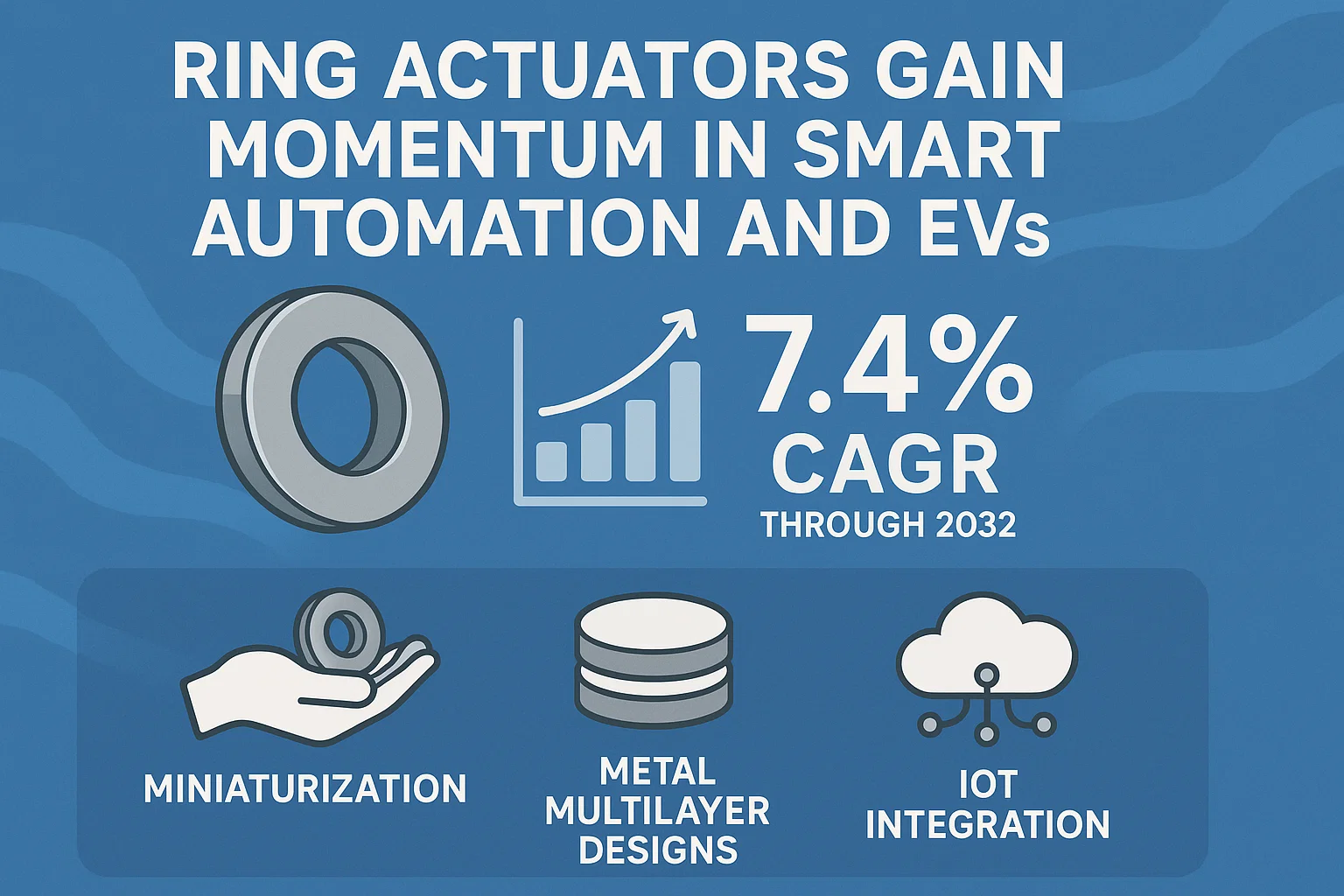
Ring Actuators Gain Momentum in Smart Automation and EVs: Miniaturization, Metal Multilayer Designs, and IoT Integration Drive 7.4% CAGR Through 2032
In the world of electromechanical control systems, actuators play a silent yet critical role. From steering systems in electric vehicles to robotic surgical arms and factory automation, these devices convert electrical energy into precise mechanical motion. Among the most innovative and fast-evolving segments within this ecosystem are ring actuators — compact, circular actuators designed for high-precision torque control and motion.
The Ring Actuator Market, valued at US$ 234.7 million in 2024, is projected to reach US$ 389.2 million by 2032, growing at a CAGR of 7.4% between 2025 and 2032. This rapid ascent is being driven by surging demand for smart automation, electric vehicles (EVs), robotics, and miniaturized precision devices in medical and aerospace sectors.
Access Your Free Sample Report- Ring Actuator Market
What is a Ring Actuator?
A ring actuator is a specific form of actuator characterized by its circular geometry and ability to generate uniform motion or force around its center. It typically uses piezoelectric, electromechanical, or magnetostrictive principles to produce controlled motion, often with very small displacement and high responsiveness.
Key attributes of ring actuators:
- Compact and symmetric form factor
- Precise torque control
- Miniaturization-friendly design
- Low power consumption
- High-frequency responsiveness
These features make them ideal for integration into systems requiring compact, high-accuracy rotational or axial control.
Recent Developments Shaping the Ring Actuator Landscape
1. Expansion of Smart Actuator Capabilities in EVs
One of the most impactful trends in the actuator industry is the widespread integration of smart actuators in electric vehicles (EVs). Automakers are increasingly embedding ring actuators in components such as:
- Electronic steering systems
- Battery management subsystems
- Brake-by-wire systems
- Climate and seat control modules
Modern ring actuators in EVs now feature:
- Embedded microcontrollers and diagnostics
- Sensor feedback loops for real-time motion control
- IoT-enabled connectivity
OEMs like Tesla, Hyundai, and Rivian are all incorporating these features to support autonomous driving, reduce mechanical complexity, and improve energy efficiency.
2. Miniaturization and Precision for Medical & Aerospace Devices
Ring actuators have emerged as a preferred solution in robotic-assisted surgery, catheter manipulation, and aerospace control systems due to their:
- Miniaturized footprint
- Precision torque generation
- Lightweight and durable design
A recent collaboration between medical device companies and actuator manufacturers led to the development of ring actuators with biocompatible casings, enabling long-term implantation in cardiac and orthopedic applications. In aerospace, they are being used in gimbal controls, antenna positioning, and reaction wheel systems.
3. Metal Multilayer Ring Actuators Dominate Industrial Demand
One of the most notable shifts is the rise of metal multilayer ring actuators, which accounted for over 55% of total market demand in 2024.
Benefits include:
- Higher torque output
- Enhanced durability
- Better resistance to thermal and mechanical stress
These actuators are now the default for:
- Factory automation robots
- CNC machines
- Semiconductor wafer handling tools
Manufacturers like PI (Physik Instrumente), Cedrat Technologies, and Noliac are leading the charge in this segment.
4. Soft Ring Actuators with Embedded Sensing Enter the Spotlight
Academic institutions and startups are experimenting with soft ring actuators that integrate sensing directly into their structure. These actuators, often made from elastomers and soft polymers, use embedded strain gauges and conductive pathways to:
- Measure deformation
- Provide real-time feedback
- Enable adaptive response to external forces
A study published in 2024 by researchers from ETH Zurich demonstrated a multi-material ring actuator capable of dynamic grip control, ideal for robotic end-effectors and prosthetic hands.
5. Laser-Cut Piezoelectric Rings for Precision Robotics
Recent breakthroughs in laser micro-machining have enabled the production of ring actuators with:
- Sub-micron tolerances
- Complex electrode patterns
- Custom curvature
These actuators are now used in:
- Optical lens focusing
- Precision vibration control
- Micro-robotics for laboratory automation
Such laser-cut piezoelectric rings offer ultra-fast response times and minimal hysteresis, elevating the performance of robotic and medical applications.
Download Sample Report PDF- Ring Actuator Market
Regional Dynamics
Asia-Pacific: Fastest-Growing Market
The Asia-Pacific region is seeing a massive boom in actuator adoption:
- China and South Korea: Investing in high-end robotics and EV manufacturing.
- Japan: Expanding actuator usage in medical robotics and high-tech automation.
- India and Southeast Asia: Emerging manufacturing hubs with rising demand for compact automation solutions.
By 2032, Asia-Pacific is expected to account for nearly 35% of global market share, up from 28% in 2024.
North America: Innovation Powerhouse
North America, led by the United States and Canada, remains the largest market, contributing over 40% of global revenue in 2024. Key drivers include:
- High adoption in aerospace and defense
- Government support for electric and autonomous vehicles
- Leadership in advanced medical device manufacturing
Several startups and research labs are pioneering new ring actuator designs for use in next-gen AI-integrated systems.
Europe: Automotive and Industrial Automation Growth
Germany, France, and the UK are leveraging ring actuators in:
- ADAS (Advanced Driver Assistance Systems)
- Electric vehicle assembly lines
- Industrial precision machinery
EU’s green initiatives and industrial automation funding are accelerating adoption of energy-efficient ring actuators with real-time monitoring and diagnostics.
Top Industry Applications Driving Growth
1. Automotive and EV Systems
- Integration into steering, brakes, and thermal systems.
- Emphasis on smart actuation for autonomous driving.
- Opportunity for high-volume production and scale.
2. Industrial Machinery and Robotics
- Use in automated inspection, pick-and-place systems, and precision tool heads.
- Demand for multilayer metal actuators with extended lifespan.
3. Medical and Healthcare Devices
- Compact actuators for surgical robots, wearable devices, and implants.
- Biocompatibility and low power draw as critical design requirements.
4. Aerospace and Defense
- Used in missile guidance, aerospace gimbals, and UAV controls.
- Preference for high-performance, temperature-resistant materials.
5. Consumer Electronics and Optics
- Actuators in camera stabilization, lens focusing, and haptic feedback systems.
- Need for miniaturized and cost-effective ring actuators.
Challenges Facing the Ring Actuator Industry
1. Manufacturing Precision and Cost
Producing multilayer or soft composite actuators requires:
- High tooling precision
- Strict quality control
- Specialized materials
This raises manufacturing costs and limits entry for new players.
2. Integration and Compatibility
Ensuring ring actuators work seamlessly with control units and other components demands:
- Customized electronics
- Advanced control algorithms
- Tailored firmware development
3. Supply Chain Constraints
Material shortages and geopolitical disruptions are affecting access to:
- Piezoelectric ceramics
- Rare earth magnets
- High-grade steel and copper
Competitive Landscape: Who’s Leading the Way?
| Company | Focus Area |
| Physik Instrumente (PI) | High-precision piezoelectric ring actuators for industrial and optics |
| Cedrat Technologies | Advanced smart actuators for aerospace and medical systems |
| Noliac (CTS Corporation) | Multilayer and stacked actuators |
| Smarter Alloys | Shape memory alloy-based actuators for medical and wearables |
| Tokin Corporation | Compact actuators for consumer electronics and automotive |
Startups in Europe and North America are entering the market with custom miniaturized ring actuators for niche applications like microrobots and IoT wearables.
Click Here To Download Full Sample Report- Ring Actuator Market
The Future of Ring Actuation: What Lies Ahead?
Looking forward, ring actuators are expected to evolve in several critical directions:
1. Smart and Adaptive Actuators
- AI-based control algorithms for real-time optimization
- Self-learning feedback systems
- Integration into smart grid-connected devices
2. Ultra-Thin and Flexible Designs
- Use in wearables, e-skin, and flexible robotics
- Thin-film actuators for biometric and environmental sensing
3. Sustainability and Eco-Design
- Development of recyclable actuator materials
- Lower power consumption and longer lifecycle
The Ring Actuator Market is entering a golden age of innovation, fueled by the demands of electric mobility, intelligent automation, and precision medical solutions. With strong momentum across Asia, North America, and Europe, the market is projected to rise from US$ 234.7 million in 2024 to US$ 389.2 million by 2032, representing a significant CAGR of 7.4%.
From smart embedded diagnostics to biocompatible surgical systems and AI-integrated robotics, ring actuators are playing a critical role in shaping the future of motion and control.

Comments (0)