
RF Coaxial Cable Assemblies Market Analysis: Performance Demands across Semiconductor Applications
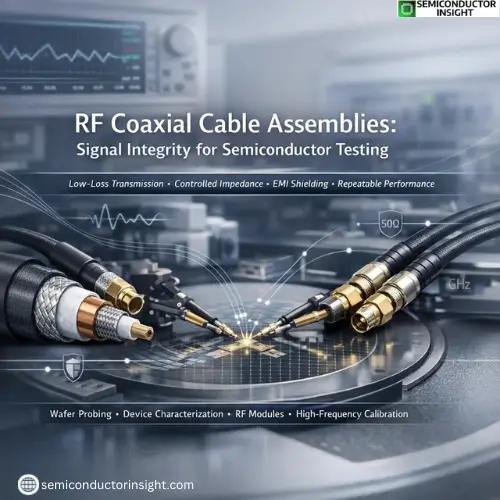
RF Coaxial Cable Assemblies Market serves a critical yet often understated role in semiconductor and electronics ecosystems. These assemblies are engineered interconnect solutions designed to transmit radio frequency signals with minimal loss, controlled impedance, and strong resistance to external interference. In contrast to conventional cables, RF coaxial assemblies incorporate specialized dielectric materials, shielding layers, and precise connections to preserve signal integrity over challenging frequency ranges.
In semiconductor environments, these assemblies are essential across wafer probing, device characterization, RF module testing, and production equipment calibration. As operating frequencies continue to rise and tolerances tighten, the reliability of RF signal paths becomes a decisive factor in overall system performance.
Why Precision Matters More than Volume?
This market is defined less by mass production and more by engineering accuracy and performance consistency. Semiconductor applications require RF coaxial cable assemblies that deliver stable electrical behavior across temperature variations, mechanical movement, and repeated connection cycles. Even minor impedance mismatches or shielding flaws can introduce signal distortion, leading to inaccurate measurements or system instability.
As a result, buyers prioritize suppliers capable of delivering application-specific assemblies rather than generic off-the-shelf solutions. This preference shapes long-term supplier relationships and creates high entry barriers for new manufacturers without deep RF expertise.
Material Engineering and Structural Design
At the core of RF coaxial cable assemblies lies careful material selection. Conductors are typically high-purity copper or silver-plated variants to minimize resistance and skin-effect losses at high frequencies. Dielectric materials such as PTFE and expanded fluoropolymers are widely used due to their low dielectric constant and thermal stability.
Shielding architecture is equally critical. Multi-layer braids, foil shields, and optimized grounding paths are employed to suppress electromagnetic interference (EMI) and signal leakage. In semiconductor testing environments where multiple RF signals operate in close proximity, effective shielding directly impacts measurement accuracy.
Connector interfaces including SMA, SMP, MMCX, and custom RF connectors are designed for repeatable performance under frequent mating cycles, ensuring consistency in lab and production settings.
Expanding Semiconductor Use Cases Driving Demand
The relevance of RF coaxial cable assemblies continues to grow as semiconductor applications diversify. Advanced nodes, RF front-end modules, and compound semiconductors require increasingly complex test and validation processes. These processes rely heavily on high-frequency signal transmission between devices under test and analytical equipment.
Beyond fabrication and testing, RF assemblies support:
- High-frequency probe stations
- Signal generators and spectrum analysers
- Millimetre-wave development platforms
- RF characterization of power devices and sensors
As semiconductor designs shift toward higher frequencies and tighter integration, demand for assemblies capable of maintaining performance consistency under extreme conditions remains strong.
Manufacturing Standards and Quality Expectations
Quality assurance defines competitiveness in the RF Coaxial Cable Assemblies Market. Assemblies must comply with strict electrical, mechanical, and environmental specifications. Semiconductor customers often require detailed traceability, including material origin, manufacturing process documentation, and performance test data.
Production environments emphasize clean assembly practices, precise connector termination, and controlled impedance validation. Many suppliers invest in advanced testing protocols, including time-domain reflectometry (TDR), insertion loss measurement, and phase stability testing to meet customer expectations.
This emphasis on quality not only supports performance but also reduces downstream risk in high-value semiconductor workflows.
Trade, Supply Chain, and Regional Considerations
Global supply chains influence market dynamics, particularly for raw materials and precision connectors. North America and Europe remain key innovation centres due to their concentration of semiconductor equipment manufacturers and test laboratories. Meanwhile, Asia Pacific represents a significant growth region, driven by expanding semiconductor fabrication capacity and electronics manufacturing hubs.
Trade regulations, material sourcing constraints, and logistics reliability all play a role in supplier selection. Customers increasingly favor partners with diversified production footprints and resilient sourcing strategies to minimize disruption risks.
To Know More about the Report, You Can Freely Browse Our Latest Updated Report:
https://semiconductorinsight.com/report/rf-coaxial-cable-assemblies-market/
Challenges That Shape Market Evolution
Despite steady demand, the market faces ongoing challenges. Rising material costs, increasing frequency performance expectations, and the need for faster customization cycles put pressure on manufacturers. Additionally, as frequencies extend into millimetre-wave ranges, traditional coaxial designs must be re-engineered to maintain signal stability.
Suppliers respond by investing in advanced simulation tools, precision manufacturing equipment, and modular design approaches that allow faster configuration changes without compromising performance.
Future Outlook: Performance-Driven Growth
The development of high-frequency electronics will have a significant impact on RF Coaxial Cable Assemblies Market in the future. As semiconductor devices push into higher bandwidths and tighter tolerances, the demand for assemblies that deliver repeatable, low-loss performance will intensify.
Emerging areas such as advanced RF packaging, heterogeneous integration, and next-generation wireless research will continue to expand the role of RF assemblies beyond traditional testing environments.
In this landscape, success belongs to manufacturers that balance material science, precision engineering, and application-specific collaboration, ensuring RF connectivity keeps pace with semiconductor innovation.

Comments (0)