
Revolutionizing Connectivity with the Surge in Low-Power AI Voice Processor Chip Market
In an era where voice commands seamlessly integrate into our daily lives from summoning virtual assistants to controlling smart homes the demand for efficient, energy-saving technology has never been higher. Low-power AI voice processor chips are at the forefront of this transformation, enabling devices to process speech intelligently while conserving battery life. These specialized semiconductors are not just components; they’re the silent enablers of smarter, more responsive ecosystems. As we delve into this dynamic market, we’ll explore its growth, key players, technological underpinnings, and the chemical foundations that make it all possible.
Unveiling the Market Dynamics
Low-power AI voice processor chip market is experiencing explosive expansion, driven by the proliferation of IoT devices and edge computing.
Pinnacle Players Ranking the Market Dominators
Competition in this arena is fierce, with established giants and agile innovators vying for supremacy. Based on 2025 market share analyses, here’s a ranked overview of top contenders in low-power AI voice processor chips:
- Qualcomm – Leading with over 20% market share, renowned for Snapdragon series chips that excel in mobile and automotive voice AI, emphasizing low-latency edge processing.
- Intel – Securing second place with Gaudi accelerators, focusing on energy-efficient inference for industrial applications, holding about 15% share.
- NXP Semiconductors – Third-ranked, specializing in automotive and IoT chips with ultra-low power designs, capturing 12% of the market.
- Renesas – Strong in embedded systems, offering voice detection solutions for smart homes, with an 8% share.
- POLYN Technology – An emerging force in neuromorphic analog chips, noted for microwatt-level consumption in voice activity detection.
Other notables include AONDevices, NVIDIA, Apple, MediaTek, and Texas Instruments, each innovating in niche areas like wearable and robotics. These rankings underscore a blend of scale and specialization, with Qualcomm’s edge in power efficiency setting the benchmark.
Engineering Excellence through Performance-Driven Technologies
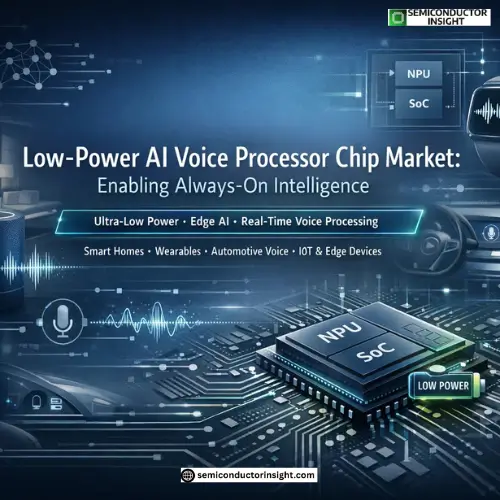
At the heart of these chips lie advanced architectures like neural processing units (NPUs) and system-on-chips (SoCs) optimized for voice tasks. Innovations such as analog neuromorphic processing enable microsecond latencies while sipping power in the nanowatt range. Edge AI integration allows real-time speech recognition without cloud dependency, crucial for battery-constrained devices.
Key tech enablers include:
- Multi-modal sensing for combined voice and sensor data.
- Always-on detection with sub-microwatt efficiency.
- Integration of DSPs for noise cancellation and keyword spotting.
These advancements ensure chips handle complex tasks like natural language processing while minimizing energy use.
Chemical Materials Driving Technological Miniaturization
Delving into the atomic level, semiconductor chemistry plays a pivotal role in achieving low-power feats. Silicon remains the cornerstone, doped with elements like phosphorus and boron to create n-type and p-type semiconductors, enhancing conductivity and efficiency.
Compound materials elevate performance:
- Gallium arsenide (GaAs) and gallium nitride (GaN) excel in high-frequency, low-power applications, outperforming silicon in voice signal processing.
- Germanium aids in high-speed transistors, vital for real-time AI inference.
- Rare earth elements like neodymium and specialty chemicals such as photoresists ensure precise fabrication.
These chemicals not only reduce power draw but also support sustainable manufacturing, addressing supply chain vulnerabilities from concentrated sources like China.
Additionally, the aimed market is buzzing with trends like ultra-low-power neuromorphic designs and on-device AI, transforming voice tech from reactive to proactive. Privacy-first processing keeps data local, while multi-modal AI fuses voice with visuals for richer interactions.
Notable shifts include:
- Rise of nW-grade consumption for always-listening devices.
- Integration in 6G networks for seamless connectivity.
- Focus on sustainable, recyclable materials amid environmental concerns.
These trends signal a future where voice AI is ubiquitous yet unobtrusive.
Lastly before we wrap up, don’t forget to look at our most recent exclusive report for in-depth insights:
https://semiconductorinsight.com/report/low-power-ai-voice-processor-chip-market/
Broad Horizons: Applications Transforming Sectors
From consumer gadgets to industrial automation, these chips are versatile. In smart homes, they power voice assistants like Alexa, enabling hands-free control. Automotive sectors leverage them for in-car commands, enhancing safety in vehicles from Tesla to Hyundai.
Other applications:
- Wearable: Real-time health monitoring via voice cues.
- Robotics: Intuitive human-robot interactions.
- Healthcare: Assistive devices for the elderly.
- Industrial IoT: Voice-activated machinery in factories.
This diversity amplifies market potential, with smart devices leading adoption.
Key Obstacles and Future Directions
Despite progress, challenges persist: supply chain disruptions for critical minerals, escalating fabrication costs, and balancing power with performance. Future pathways involve hybrid architectures and AI-driven optimization to overcome these.
By 2030, expect quantum-inspired designs and greener chemistries to redefine efficiency, fostering a resilient ecosystem.
Low-power AI voice processor chip market isn’t just growing it’s evolving our interaction with technology. With robust stats, innovative leaders, and chemical ingenuity at its core, this sector promises a future of efficient, intelligent connectivity. As adoption accelerates, staying attuned to these developments will be key for stakeholders aiming to lead in an AI-driven world.

Comments (0)