
Resistive Tactile Sensors Market Insights in Robotics Healthcare and Electronics
The semiconductor industry is quickly developing technologies that replicate touch, which has emerged as one of the most potent human-machine interfaces. Resistive tactile sensors market is emerging as a crucial segment within the broader sensor ecosystem, enabling devices to detect pressure, force, and physical interaction with remarkable precision. From robotic hands and wearable devices to automotive systems and smart electronics, these sensors are redefining how machines perceive and respond to their environment.
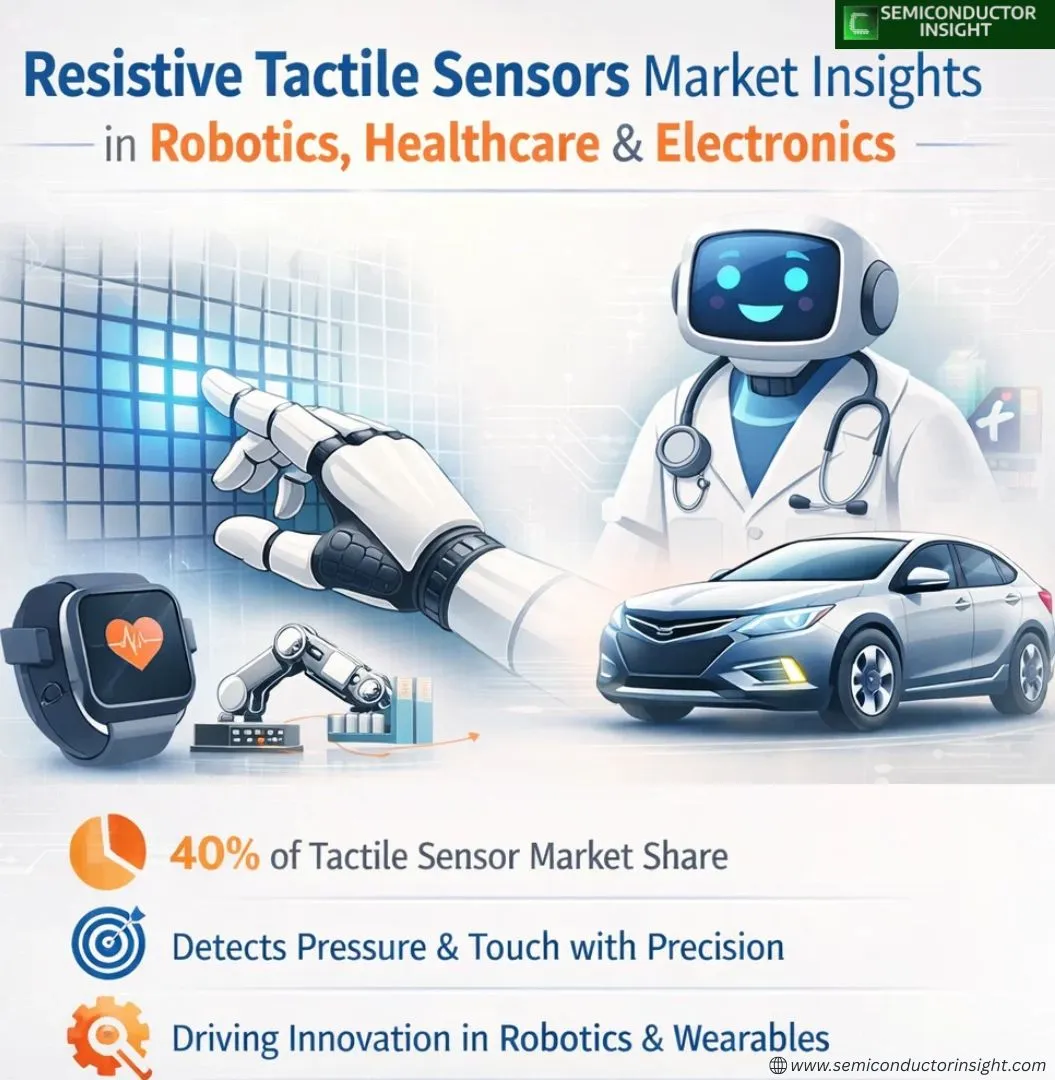
Resistive tactile sensors work on a straightforward but incredibly powerful concept, in contrast to intricate detecting devices. They measure variations in electrical resistance when mechanical pressure is applied, converting physical contact into measurable signals. This straightforward design provides advantages such as cost efficiency, high sensitivity, and easy integration, making these sensors widely adopted across industrial and consumer applications. The technology currently holds over 40% share of the tactile sensor industry, reflecting strong commercial demand and broad application potential.
The growing need for intelligent automation, precision robotics, and interactive electronic devices continues to push market expansion, positioning resistive tactile sensors as a fundamental component of next-generation semiconductor systems.
Core Technology and Working Mechanism
Resistive tactile sensors rely on layered structures consisting of conductive films, pressure-sensitive materials, and electrode interfaces. When external force is applied, the contact between layers changes, altering resistance values and generating measurable output signals.
This sensing mechanism allows accurate detection of parameters such as force intensity, pressure distribution, and touch location. The technology is widely valued for its simple structure and reliable performance in demanding environments. Semiconductor manufacturers are continuously improving material composition, sensitivity ranges, and response time to enhance performance across advanced applications.
Recent innovations focus on ultra-thin sensor architectures, flexible substrates, and enhanced durability, enabling integration into compact electronic systems and wearable technologies.
Integration across Robotics and Automation Systems
One of the most significant application areas for resistive tactile sensors is robotics and industrial automation. These sensors enable robotic systems to detect contact pressure, handle delicate objects, and perform precision assembly tasks.
Industrial automation currently accounts for nearly 32% of total sensor deployments, reflecting strong adoption in manufacturing environments. Sensors integrated into robotic grippers and automated production lines improve accuracy, reduce operational errors, and enhance productivity.
The rise of collaborative robots and smart manufacturing environments is further increasing demand for tactile sensing technologies that provide real-time feedback and adaptive control capabilities.
For More Detailed Insights You Can Surf Our Latest Report Here: https://semiconductorinsight.com/report/resistive-tactile-sensors-market/
Healthcare and Medical Device Applications
The healthcare sector is becoming a key contributor to market expansion, with resistive tactile sensors playing a vital role in medical robotics, prosthetic systems, and rehabilitation devices. These sensors provide accurate pressure feedback that enhances surgical precision and improves patient outcomes.
Tactile-enabled prosthetics equipped with advanced pressure mapping capabilities allow users to experience realistic touch sensations. Similarly, minimally invasive surgical tools use tactile sensing to detect tissue resistance and ensure safer procedures.
The increasing adoption of smart medical technologies and assistive devices is expected to drive continued innovation in sensor performance and reliability.
Material Innovations and Semiconductor Manufacturing Advances
Material science plays a central role in the development of resistive tactile sensors. Manufacturers are exploring advanced conductive polymers, nanomaterials, and flexible substrates to improve sensitivity and durability.
Emerging manufacturing techniques such as printed electronics and thin-film deposition are enabling scalable production and cost optimization. Supply chain integration for conductive materials and polyester films is also strengthening production efficiency and market stability.
These advancements are supporting the development of lightweight, energy-efficient, and high-performance sensors suitable for large-scale industrial deployment.
Emerging Applications in Intelligent Systems
Beyond traditional industries, resistive tactile sensors are finding new applications in smart homes, automotive electronics, and human machine interfaces. These sensors enable interactive surfaces, safety monitoring systems, and adaptive control mechanisms across modern electronic environments.
The rise of intelligent infrastructure and connected ecosystems is expanding the role of tactile sensing technologies, positioning them as essential components of next-generation semiconductor innovation.
The resistive tactile sensors market represents a powerful convergence of semiconductor engineering, material science, and intelligent sensing technology. With expanding applications across robotics, healthcare, automation, and consumer electronics, these sensors are reshaping how machines interact with the physical world.
Continuous advancements in materials, flexible designs, and digital integration are strengthening the industry’s growth trajectory. As demand for intelligent touch-enabled systems continues to rise, resistive tactile sensors will remain central to the evolution of smart technologies and precision electronics.

Comments (0)