
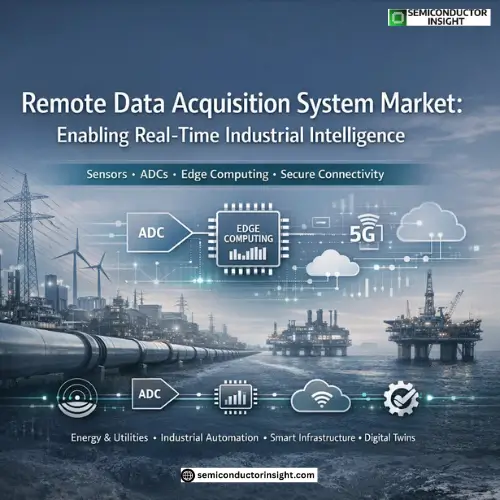
Remote Data Acquisition System Market Dynamics Shape Industrial and Infrastructure Digitization
Remote Data Acquisition (RDA) systems have emerged as essential pillars of modern industrial and infrastructure digitization. They serve as the sensor gateways that convert physical world signals temperature, pressure, vibration, flow, chemical concentration, and electrical parameters into digital data streams that can be monitored, analysed, and acted upon remotely.
In an era where downtime costs reach thousands to millions per hour in sectors like energy, manufacturing, and utilities, real-time data acquisition is no longer optional but it is strategic.
These systems span ruggedized field units, analog-to-digital converters (ADCs), semiconductor sensor front ends, edge compute nodes, and networking modules. Together, they deliver visibility across distributed assets, enabling predictive maintenance, early anomaly detection, and operational optimization.
How Semiconductor Technology Powers RDA Precision?
At the heart of every RDA system lies a semiconductor-enabled sensing, conversion, and processing stack. Key semiconductor elements include:
- Analog Front End (AFE) chips that accurately capture weak signals from sensors
- High-resolution ADCs converting physical analog inputs to digital values
- Low-power microcontrollers and DSPs handling real-time sampling, pre-processing, and communication stacking
- Communication SoCs for cellular, Wi-Fi, LoRa, and 5G connectivity
- Memory and storage silicon supporting edge buffering and local analytics
These semiconductor components must perform under wide temperature ranges, electromagnetic interference, and power constraints, particularly in remote installations like oil rigs, pipelines, substations, and smart grids.
As an example of growing performance demands: RDA designs with 24-bit ADCs are now common, offering precise capture of small signal changes that earlier systems could not resolve reliably.
Emerging Market Drivers: Connectivity, Automation, and Digital Twins
RDA system market is propelled by multiple drivers, chief among them:
- Industrial Automation: Smart factories require continuous, synchronized data flows from distributed sensors to central systems. RDA systems deliver the foundation for real-time process control and adaptive automation.
- IoT Expansion: With projected IoT connections exceeding 30 billion by 2030, RDA adoption is increasing across verticals as the bridge between physical devices and cloud analytics.
- Smart Infrastructure: Smart grids, water distribution networks, and environmental monitoring all depend on reliable data acquisition to optimize resources and manage risks.
- Digital Twins: RDA systems feed digital twin models with real-world data, enabling engineers to simulate operations, optimize performance, and forecast failures.
Feel Free to Reach Our Most Recent Updates of the Report:
https://semiconductorinsight.com/report/remote-data-acquisition-rda-system-market/
Sector Applications: Where RDA Is Making an Impact
Energy & Utilities: Power generation, distribution grids, and renewable plants utilize RDA systems for real-time monitoring of turbines, transformers, and grid segments. These systems help reduce outages and improve load balancing.
Oil & Gas: In upstream and midstream contexts, RDA modules capture pressure, flow, and vibration data across infrastructure that spans thousands of kilometres. Latency-sensitive decisions are made possible through edge processing enabled by semiconductor compute units.
Manufacturing & Industrial: Production lines equipped with RDA systems report equipment health, process variations, and quality metrics to central systems.
Environmental & Agricultural: Remote sensors monitor soil moisture, air quality, and water levels, feeding data into sustainability dashboards.
Across these sectors, digitally connected RDA systems are increasingly tied to enterprise analytics platforms, allowing cross-site comparisons and predictive performance modelling.
Recent Innovations Elevating RDA Capabilities
- Edge AI and Local Analytics: New RDA platforms integrate machine learning inference engines at the edge, enabling anomaly detection before data ever traverses the network. This reduces latency and uncovers insights closer to the source.
- Ultra-Low-Power Design: For battery-powered and solar-powered remote nodes, cutting-edge semiconductors now deliver nanowatt-class standby performance while waking rapidly for sampling bursts, extending field life beyond traditional expectations.
- Secure Communication Protocol Stacks: Hardware-level cryptography accelerators support encrypted MQTT, TLS, and 5G NR data streams, ensuring that sensitive operational data remains protected from edge to cloud.
- Multi-Modal Sensing Platforms: Integrated sensor ASICs able to measure temperature, humidity, vibration, and chemical concentration on a single chip reduce system complexity and improve reliability. These innovations illustrate a shift from mere data collection toward intelligent, secure, and efficient data acquisition ecosystems.
Chemical Process Considerations in RDA Deployments
Although Remote Data Acquisition is primarily an electronics and software domain, it intersects with chemical process industries in meaningful ways. In chemical plants, sensors connected to RDA networks capture:
- pH and ORP for corrosion control
- Conductivity and concentration during reaction monitoring
- Gas detection and safety thresholds
- Viscosity and turbidity for product quality insights
In such environments, chemical compatibility of sensor interfaces, housing materials, and signal conditioning circuits is essential. Chemical fouling, corrosive atmospheres, and high humidity can degrade sensor contacts and enclosures. Semiconductor designers and mechanical engineers work closely to ensure material selections (e.g., PTFE, PEEK, and corrosion-resistant alloys) protect the integrity of transducer outputs feeding into RDA systems.
Remote Data Acquisition System Market is more than a hardware segment, it is a gateway to real-time operational insight powered by semiconductors, digital connectivity, and intelligent edge computing. As global industries pursue efficiency, reliability, and predictive capabilities, RDA systems will remain a central enabler of digital transformation in the years to come.

Comments (0)