

Refurbished PC Market Insights across Enterprise and Education Sectors
Refurbished PC market has become a crucial part of the semiconductor and computing ecosystem as industries search for sustainable and cost-efficient hardware solutions. Instead of discarding older devices after corporate upgrade cycles, companies are refurbishing and redeploying computers into secondary markets such as education, startups, and developing economies.
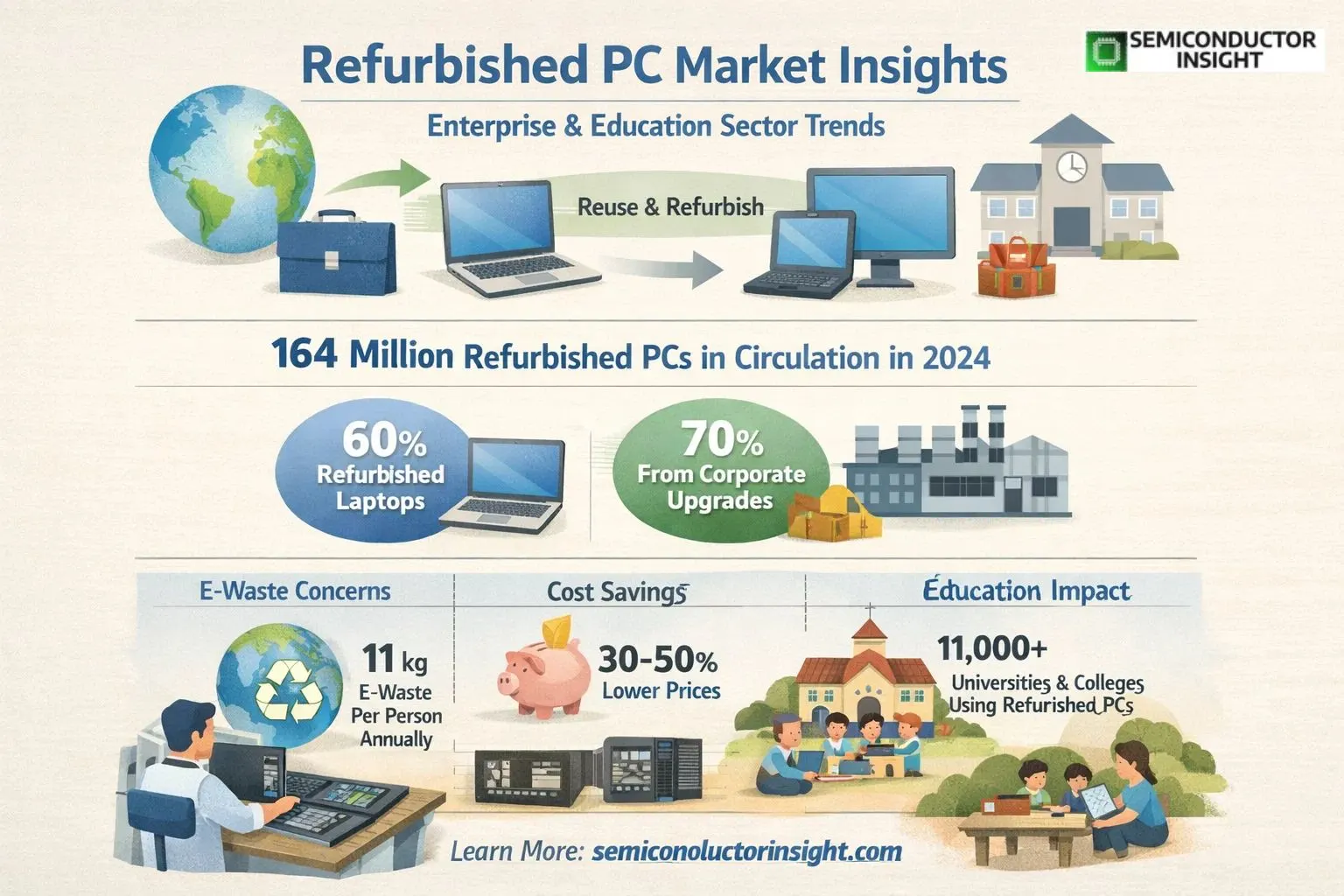
Globally, more than 164 million refurbished PCs were introduced into circulation in 2024, reflecting the growing demand for affordable computing infrastructure. Refurbished laptops alone represent over 60% of total refurbished PC demand, largely due to their portability and use in hybrid work environments.
Corporate IT refresh cycles are a major contributor to supply. Nearly 70% of refurbished computers originate from enterprise device replacement programs, where organizations upgrade hardware every three to four years and redirect older systems for refurbishment.
At the same time, the environmental impact of electronics waste is pushing governments and technology companies to promote device reuse. The United Nations reports that global e-waste generation exceeds 11 kg per person annually, highlighting the importance of extending hardware lifecycles through refurbishment.
Semiconductor Supply Pressures Driving Secondary PC Demand
- Refurbished PCs have gained attention partly due to fluctuations in semiconductor supply chains. Memory components, processors, and graphics chips have experienced periodic shortages as manufacturers prioritize high-performance computing and AI infrastructure.
- When component prices rise, businesses and individuals increasingly turn to refurbished systems as a cost-effective alternative. In many markets, refurbished PCs are sold 30-50% lower than newly manufactured systems, making them attractive for budget-conscious organizations such as schools and small businesses.
- Educational institutions have become one of the largest adopters of refurbished computing equipment. Worldwide, more than 11,000 universities and colleges deploy refurbished systems to support digital learning programs and campus infrastructure.
- Government digital inclusion programs also rely heavily on refurbished devices. In several developing economies, public initiatives have deployed millions of refurbished laptops and desktops to expand digital access in rural areas and public schools.
Enterprise IT Asset Recovery and Device Reuse
Large corporations generate enormous volumes of used computing hardware every year. As companies upgrade operating systems, storage systems, and processors, older devices are collected through IT asset disposition programs.
Industry data indicates that over 150 refurbishment facilities have been established globally to process retired enterprise hardware. These facilities test, repair, and upgrade systems before redistributing them through certified resale channels.
Hardware upgrades play a major role in refurbishment. More than 60% of refurbished laptops are upgraded with solid-state drives (SSD) or additional RAM, significantly improving system performance and extending device lifespan.
Online marketplaces have also transformed the refurbished ecosystem. Digital platforms now account for over half of global refurbished PC transactions, allowing certified refurbishers to reach customers across multiple regions.
For More Detailed Insights You Can Surf Our Latest Report Here: https://semiconductorinsight.com/report/global-refurbished-pc-market/
Major Companies Strengthening the Refurbished PC Ecosystem
- Several global technology companies are actively expanding refurbishment programs to support sustainability initiatives and secondary hardware markets.
- Among the leading players are Dell Technologies, HP Inc., Lenovo, Apple, and Acer, all of which operate certified refurbishment programs for enterprise and consumer devices.
- For example, Lenovo distributed more than 32 million refurbished devices globally in 2023, supported by enterprise leasing programs and device recovery initiatives.
- Dell Technologies reported shipments exceeding 27 million refurbished PCs in the same year, focusing heavily on corporate customers and government procurement programs.
- Meanwhile, HP Inc. launched eco-certified refurbished desktops designed for enterprise sustainability programs, contributing to rising institutional orders across schools and government organizations.
- Apple has also expanded its certified refurbished MacBook program across multiple regions, where many devices receive new batteries, upgraded storage, and updated operating systems before resale.
Technology Upgrades Enhancing Refurbished PC Performance
Modern refurbishment processes go far beyond simple repairs. Certified refurbishers now conduct comprehensive hardware diagnostics, component replacements, and software updates before systems are released back into the market.
For example, SSD upgrades can increase computer boot speeds by five to six times compared with older hard drives, significantly improving usability for everyday tasks such as cloud applications and data processing.
Battery replacements and memory upgrades also extend device lifespan. Many refurbished laptops now operate reliably for three to five additional years after refurbishment, making them practical solutions for schools, call centers, and startups.
In addition, operating system optimization and firmware updates ensure compatibility with modern software environments, including remote collaboration platforms and enterprise productivity tools.
Strategic Importance of Refurbished PCs in Digital Access
The refurbished PC ecosystem continues to play a vital role in expanding global digital access. By reintroducing functional computing devices into the market, refurbishers help bridge the technology gap between high-income and developing regions.
Startups, educational institutions, and non-profit organizations rely heavily on refurbished hardware to build affordable IT infrastructure. In many cases, a single enterprise upgrade cycle can generate thousands of reusable computers, enabling new opportunities for digital education and entrepreneurship.
As sustainability initiatives, semiconductor supply constraints, and circular economy programs gain momentum, the refurbished PC market will remain an important contributor to both environmental responsibility and global technology accessibility.

Comments (0)