
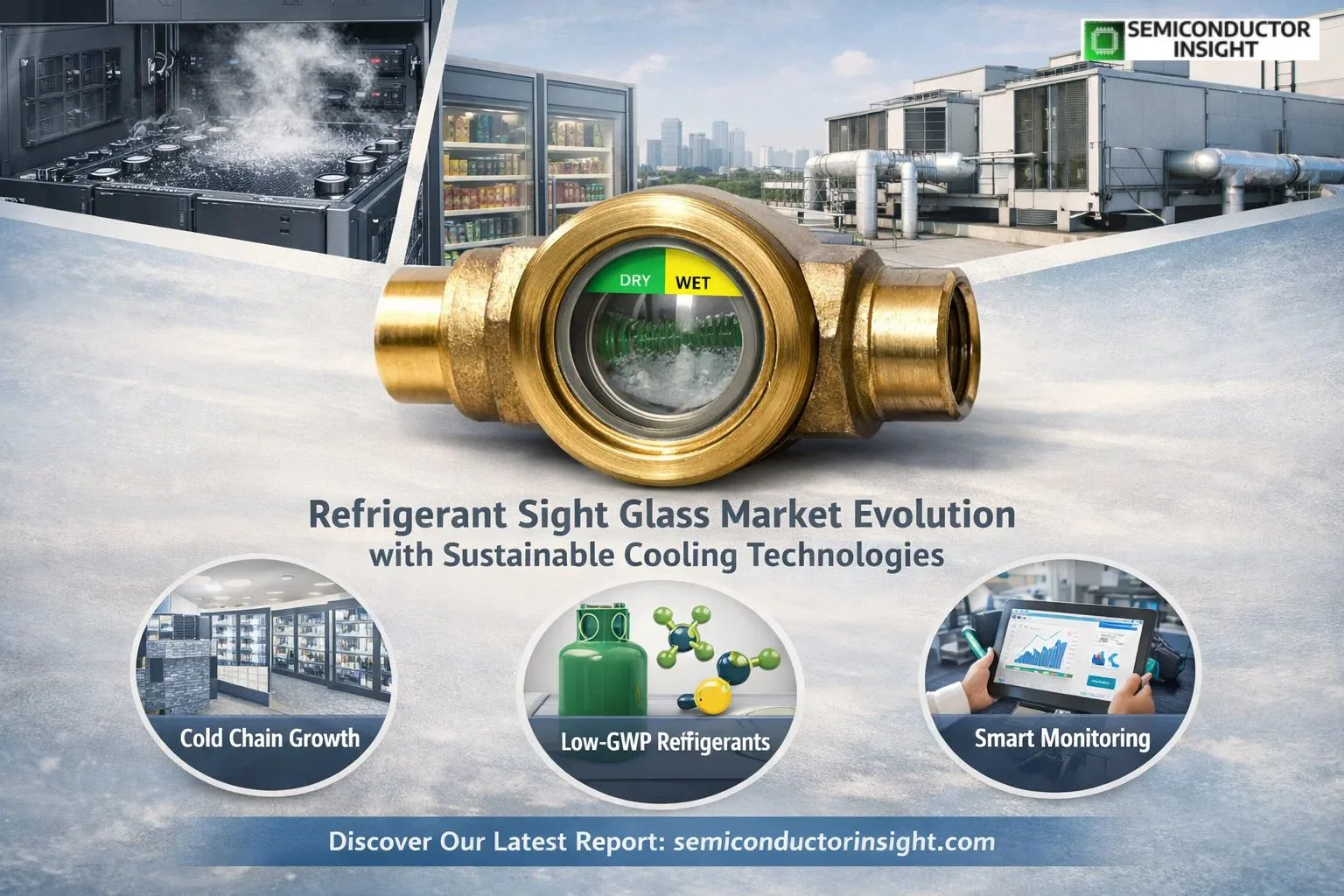
Refrigerant Sight Glass Market Evolution with Sustainable Cooling Technologies
Refrigerant sight glass market plays a silent yet critical role in modern HVAC and refrigeration systems. These compact components enable technicians to visually monitor refrigerant flow, detect moisture presence, and ensure optimal system performance. As global cooling demand rises, the importance of real-time monitoring and system transparency has significantly increased.
From supermarkets to pharmaceutical cold storage, sight glasses are widely used to maintain system integrity and avoid operational failures. Their ability to instantly indicate refrigerant conditions makes them indispensable in maintaining system reliability.
Why the semiconductor nexus matters for sight glasses specifically?
Two-phase immersion cooling, the method increasingly used in AI chip racks boils a fluorinated refrigerant directly off the chip surface, compresses vapor, and recirculates it. This is a closed refrigerant loop, not a water loop, meaning it requires in-line sight glasses for moisture detection and flow verification just like any industrial HVAC circuit.
In two-phase immersion, a refrigerant (normally a fluorinated compound) is brought to boil by the heat electronics generate, then compressed and flowed back into the pool of fluid. That circuit demands diagnostic components at specification levels far above residential HVAC.
In September 2025: Sanhua has declared the introduction of its new SYJ sight glass line, which is designed to satisfy high-pressure refrigerant requirements. With improved features targeted at dependability and compatibility, the SYJ versions, which are intended for use in liquid lines of refrigeration systems, offer visible indication of refrigerant condition and moisture level. For better readability, the redesigned SYJ series has a wide-angle, high-clarity sight glass. A color indicator allows for precise monitoring of the refrigerant’s moisture content. The sight glasses are constructed with corrosion-resistant brass and equipped with low-creep PTFE seals to ensure long-term, leak-free operation.
Top Factors Propelling Market Demand
- The expansion of global cold chain infrastructure is one of the most significant growth drivers. The food and beverage industry alone contributes nearly 40% of refrigeration demand, directly influencing the adoption of sight glass components.
- Additionally, rapid urbanization and increasing temperature variations are boosting HVAC installations worldwide. With stricter environmental regulations, industries are focusing on leak detection and system efficiency, where sight glasses act as the first line of inspection.
- Another emerging factor is the transition toward low-global-warming-potential refrigerants, which requires compatible monitoring components, further strengthening the demand for advanced sight glass solutions.
Technological Advancements and Smart Integration
The market is witnessing innovation through the integration of smart monitoring capabilities. Modern sight glasses are now being designed with moisture indicators and compatibility with IoT-enabled refrigeration systems.
This evolution aligns with the increasing adoption of intelligent HVAC systems, where predictive maintenance and automated diagnostics are becoming standard. These advancements not only enhance system lifespan but also reduce operational downtime in critical sectors like pharmaceuticals and food logistics.
Regional Insights and Market Distribution
Regionally, North America holds around 35% share, followed by Asia Pacific at nearly 32% and Europe contributing about 25%, indicating a balanced global distribution.
However, Asia Pacific is emerging as the fastest-growing region due to rapid industrialization, infrastructure expansion, and rising demand for refrigeration in developing economies.
Top 3 Major Companies and Their Offerings:
- Danfoss – Offers advanced refrigerant sight glasses with moisture indicators, HVAC controls, and energy-efficient cooling solutions.
- Emerson Electric Co. – Provides integrated refrigeration systems, monitoring components, and smart HVAC technologies with sight glass compatibility.
- Parker Hannifin Corporation – Specializes in fluid control systems, refrigeration components, and industrial-grade sight glass solutions.
These companies focus on product innovation, durability, and compatibility with next-generation refrigerants to maintain their competitive edge.
Go Through the refrigerant transition pressure point:
Starting in 2025, updates to the IMC, IBC, and IFC allow wider use of A2L refrigerants low-toxicity, mildly flammable compounds with lower GWP aligned with ASHRAE 15-2024 and 34-2024.
This is a direct growing factor for sight glass re-specification: A2L refrigerants like R-32 operate at different pressures and moisture thresholds than legacy R-410A, requiring updated indicator chemistry inside the sight glass housing.
At Last before Ending, Don’t Forget to Browse Our Recent Exclusive Report for Detailed Insights: https://semiconductorinsight.com/report/global-refrigerant-sight-glass-market/
Refrigerant sight glass market is expected to remain highly relevant as industries prioritize system efficiency, sustainability, and operational safety. Despite the emergence of digital sensors, the simplicity and reliability of visual inspection ensure continued demand.
As refrigeration systems become more complex, sight glasses will continue to serve as a fundamental diagnostic tool, bridging traditional monitoring with modern technological advancements.
In a world increasingly dependent on controlled environments from food preservation to medical storage the importance of this small yet powerful component continues to grow steadily.

Comments (0)