

Reed Switch vs. Hall Sensor in the Magnetic Reed Switch Market 2026: Where Each Technology Fits
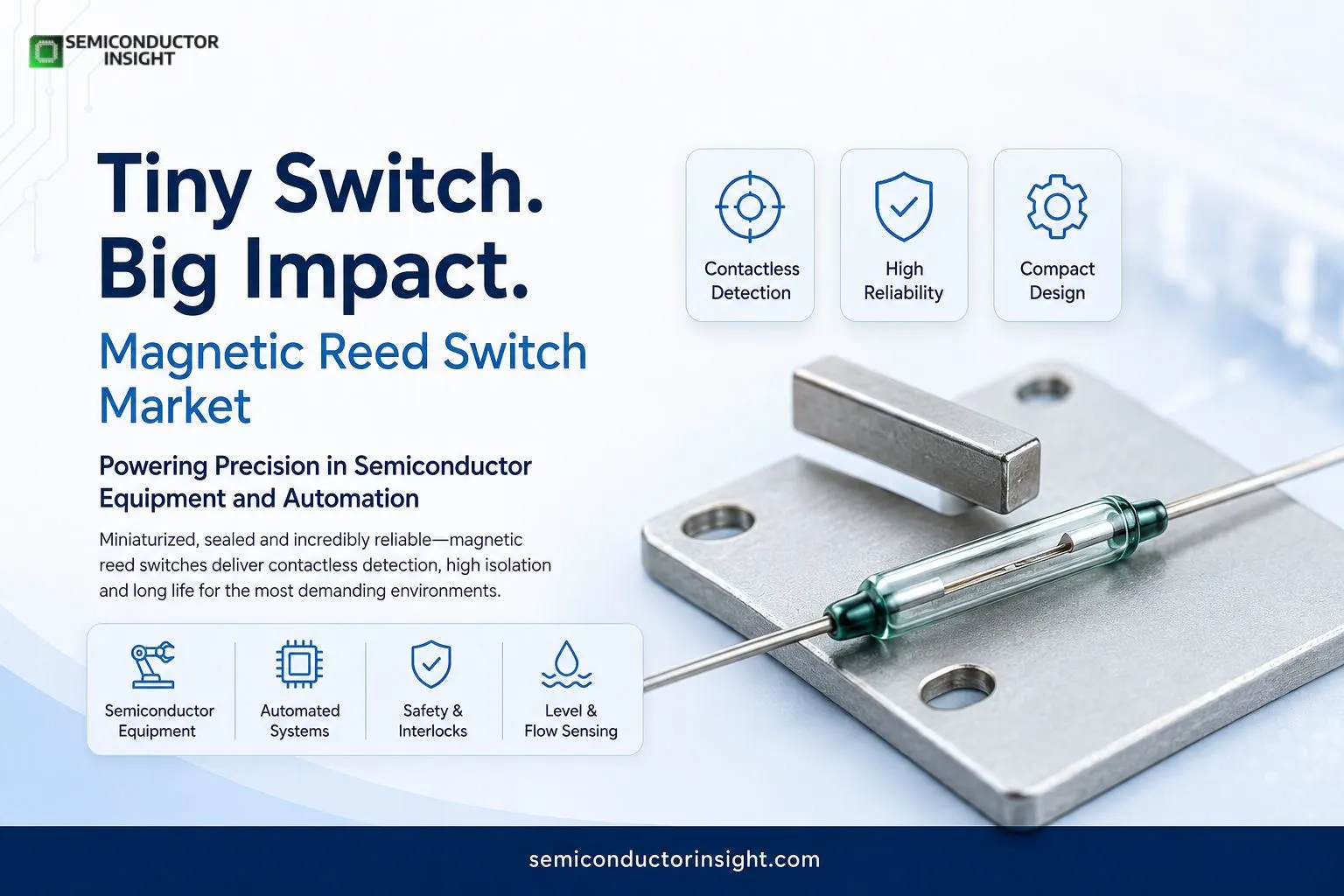
Magnetic reed switches are among the simplest components used for electronic position and proximity detection, yet their role becomes considerably more important when equipment must operate reliably inside compact and automated systems. A typical reed switch contains magnetically responsive contacts enclosed within a sealed glass tube. When an appropriate magnetic field reaches the contacts, they move together or apart to complete or interrupt an electrical circuit.
That basic operating principle gives the technology an unusual advantage. Detection can take place without mechanical contact between the moving object and the electrical switch itself. This makes reed switches useful for position detection, access monitoring, fluid-level sensing, safety interlocks and other applications where reliability and isolation matter.
For semiconductor equipment in particular, miniaturization is becoming a central design consideration. Standex Electronics identifies semiconductor equipment testing and medical devices among the critical areas where reed-sensor miniaturization is particularly important.
Why Semiconductor Equipment Needs Tiny Magnetic Detection?
- Modern semiconductor manufacturing equipment contains numerous moving assemblies, access panels, actuators, stages, valves and automated mechanisms. Knowing whether a component has reached a particular position can be essential before another operation begins.
- A reed sensor can provide this confirmation through a magnet mounted on the moving element. The sensor does not necessarily need physical contact with the mechanism, reducing wear associated with conventional mechanical switches.
- The connection with semiconductor testing is even more specific. Automated test equipment can require extremely controlled switching behaviour when evaluating semiconductor devices.
- Standex documentation describes reed relays being used for pulsed-current testing of discrete devices such as power MOSFETs, power transistors and related components, with applications requiring high-voltage isolation and fast, repeatable switching.
Compact Design Advances Reshaping the Future of High-Precision Technology
Commercial reed switches demonstrate just how far component miniaturization has progressed.
Littelfuse’s current selection guide includes reed switches with body lengths beginning at approximately 7.0 mm, with some products supporting switching powers of 10 W, switching voltages up to 200 VDC, and operating temperatures extending to +125°C. Certain high-voltage designs in the same portfolio reach substantially higher voltage ratings.
These specifications matter because designers increasingly need a component that occupies very little board or mechanical space while still maintaining predictable switching characteristics.
The engineering trade-off is therefore no longer simply small versus large. It is increasingly:
Smaller package → controlled magnetic sensitivity → reliable switching → environmental stability → integration into automated equipment
Glass Sealing Remains a Major Part of the Technology
One of the distinctive characteristics of conventional reed switches is their hermetically sealed construction. The contacts are enclosed inside a protective environment, helping isolate the switching mechanism from external contaminants.
This becomes valuable in applications where dust, moisture or other environmental exposure could affect exposed mechanical contacts.
Littelfuse’s product portfolio, for example, includes both glass-packaged and overmolded reed-switch constructions, with operating-temperature specifications reaching -40°C to +125°C across numerous designs.
For semiconductor manufacturing environments, where equipment cleanliness and process stability are critical, and the sealed architecture can be particularly attractive.
Our most recent updated related study is available for free at this link: https://semiconductorinsight.com/report/magnetic-reed-switch-market/
The Switch Is Becoming a Sensor Platform
- The magnetic reed switch is no longer confined to simple on/off detection.
- Current sensing portfolios show reed switches being applied to robotic-arm position and speed detection, semiconductor-performance monitoring environments, data-center rack access, EV charging infrastructure, smart meters, appliances and fluid-level systems.
- This expansion is important because the same fundamental magnetic principle can be adapted to very different equipment architectures.
- In an automated production line, it may confirm actuator position. In a battery-related system, it may detect a panel or access point. In a smart meter, it can contribute to tamper detection. In fluid-level equipment, a magnet attached to a float can activate the switch as the liquid level changes.
Reed Switches Are Finding a Place alongside Solid-State Sensors
The market is not simply a contest between old and new sensor technologies.
Hall-effect sensors and TMR devices offer advantages in applications requiring electronic sensing, while reed switches remain attractive where designers value galvanic isolation, simple switching behaviour, low power consumption and sealed contacts.
Littelfuse’s application matrix places reed switches, Hall-effect sensors and TMR switches across overlapping applications including EV infrastructure, appliances, fluid measurement and building automation.
This creates a technology-selection environment in which the question is increasingly which sensing architecture best matches the application, rather than whether one technology will replace all others.
Semiconductor Manufacturing Is Pulling the Component into a Higher-Precision Role
- The semiconductor industry’s continuing movement toward automation, advanced testing and compact equipment is increasing the importance of small sensing components that can provide reliable machine-state information.
- Standex currently describes its reed-based technologies as supporting automation, energy, transportation, test and measurement, while its product portfolio spans reed switches, reed relays and magnetic sensors.
- For the magnetic reed switch market, this creates an interesting trajectory. The component itself may be tiny, but its role is increasingly connected to sophisticated machines where position accuracy, switching reliability, isolation and compact integration directly affect equipment performance.
A Component Designed for the Invisible Layer of Electronics
The most interesting aspect of magnetic reed switches is that users rarely notice them. They sit inside equipment, behind panels, beside moving assemblies or within sensing mechanisms, quietly confirming whether something has moved, opened, closed, reached a position or crossed a predetermined point.
As semiconductor equipment, robotics, EV infrastructure, medical devices and automated systems become more compact and interconnected, that invisible layer becomes increasingly important.
The market’s evolution is therefore less about turning reed switches into complicated electronic devices and more about making a proven magnetic switching principle smaller, more precise, more application-specific and easier to integrate into increasingly sophisticated machines.

Comments (0)