
Magnetic Reed Switch Market Insights
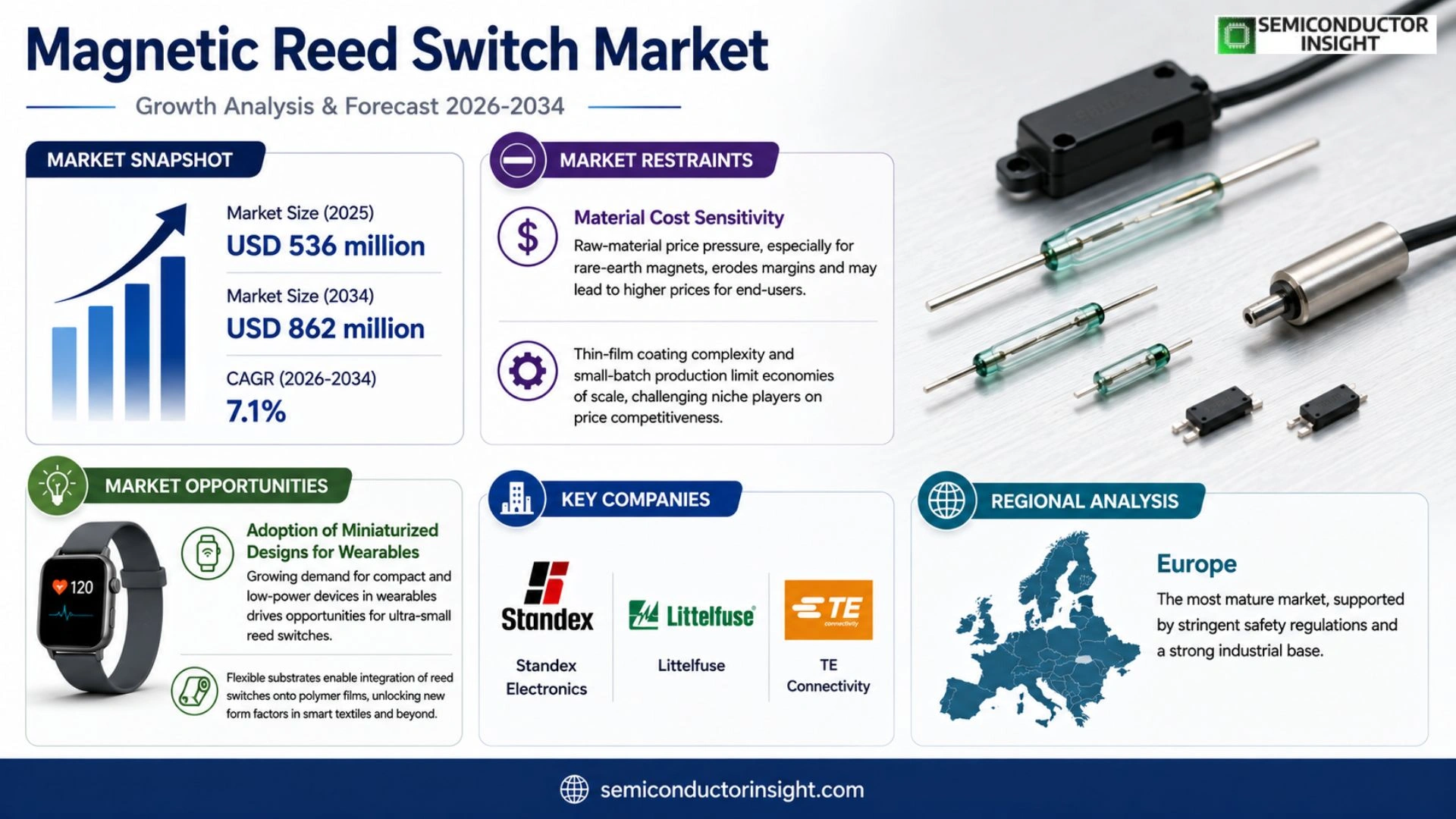
Magnetic Reed Switch market size was valued at USD 536 million in 2025 and is expected to reach USD 862 million by 2034, reflecting a CAGR of 7.1% over the forecast period.
A magnetic reed switch is a magnetically actuated electromechanical component consisting of two ferromagnetic reeds sealed within a glass capsule filled with inert gas or vacuum. When an external magnetic field is applied, the reeds attract each other and close the circuit; removal of the field separates them, opening the circuit. Key attributes include sealed reliability, very low leakage current, low contact resistance and near‑zero standby power. Common configurations are Form A (normally open), Form B (normally closed) and Form C (changeover), offered in molded or surface‑mount packages as well as latching variants.
The market benefits from several factors such as expanding production volumes,approximately 3,300 million units were manufactured worldwide in 2025,with an average price of about USD 170 per thousand units. Growing demand for compact sensors in security systems, automotive safety features and industrial automation fuels adoption, while recent introductions of high‑sensitivity and higher‑current capable designs broaden application scope into medical devices and harsh‑environment equipment. Leading suppliers including Standex Electronics, Littelfuse and HSI Sensing continue to invest in product innovation and capacity expansion.
MARKET DRIVERS
Rising Demand in Automotive Safety Systems
The acceleration of advanced driver‑assistance features has pressed OEMs to embed reliable position‑sensing components. Magnetic Reed Switch Market participants are benefitting from this shift because reed switches deliver contact‑less operation that aligns with stringent safety standards, while keeping bill of material costs low.
Expansion of IoT‑Enabled Sensor Networks
Edge‑computing deployments increasingly rely on small, low‑power switches that can survive harsh environments. Reed technology satisfies those requirements, prompting system integrators to specify it for smart‑metering, building‑automation and asset‑tracking solutions. The resulting design‑win momentum is reshaping supplier roadmaps.
➤ Manufacturers that integrate hermetically sealed reed switches into modular platforms are reporting faster time‑to‑market and reduced warranty claims.
Beyond hardware considerations, the reliability record of reed switches is influencing procurement policies. Procurement officers are now prioritizing components with proven long‑term endurance, which translates into recurring revenue streams for vendors that can certify consistent performance.
MARKET CHALLENGES
Stringent Certification Requirements
Automotive and medical applications demand compliance with a growing set of functional‑safety standards. Achieving certification often entails extensive testing cycles, which can extend product‑development timelines and inflate engineering budgets for reed‑switch manufacturers.
Other Challenges
Supply Chain Volatility
Fluctuations in the availability of high‑purity glass and specialty alloys have introduced lead times that exceed traditional expectations, compelling firms to reassess inventory strategies and negotiate longer‑term contracts.
MARKET RESTRAINTS
Material Cost Sensitivity
Raw‑material price pressure, especially for rare‑earth magnets, erodes margin expansion opportunities. Companies that cannot absorb cost spikes may be forced to raise prices, risking price‑sensitive end‑users in consumer electronics.
In addition, the thin‑film coating processes required for high‑frequency applications add a layer of complexity. Small‑batch production runs often lack economies of scale, making it difficult for niche players to compete on price.
MARKET OPPORTUNITIES
Adoption of Miniaturized Designs for Wearables
Wearable health monitors and fitness trackers are pushing designers toward sub‑millimeter switching solutions. Reed switches, with their inherent low power draw and immunity to electromagnetic interference, are well‑positioned to capture this segment. Vendors that can deliver ultra‑compact, lead‑free packages stand to gain early‑adopter contracts.
Furthermore, the rise of flexible substrates opens a pathway for integrating reed switches directly onto polymer films. This convergence of flexibility and magnetic actuation could unlock new form factors in smart‑textile applications, extending the addressable market beyond traditional niches.
Magnetic Reed Switch Market Trends
Automotive Safety Integration
The Automotive safety segment is reshaping demand for Magnetic Reed Switch market. Stricter crash‑avoidance standards and the migration toward electric drivetrains have forced OEMs to embed reed‑based position sensors in door modules, battery management units, and steering‑assist systems. In 2025 the sector accounted for roughly 38 % of total unit shipments, translating into an estimated 1,250 million devices. Because the switches operate with near‑zero standby power, they align with the low‑energy profiles of modern vehicles. Manufacturers that can guarantee hermetic sealing against vibration and temperature swings are gaining preferred‑supplier status, prompting a shift toward premium‑grade Ni‑Fe reeds and glass‑to‑metal seals. This emphasis on reliability is raising the average transaction price to about $185 per thousand, a modest uplift from the $170 level observed three years earlier.
Other Trends
Supply Chain Adjustments
Supply chain adjustments are emerging as a parallel driver for Magnetic Reed Switch market. Raw‑material scarcity for high‑purity nickel‑iron alloys has led key producers to diversify sourcing across Southeast Asian and Eastern European mills. Concurrently, advances in glass‑forming techniques have shortened capsule‑furnace cycles, enabling a 7 % boost in daily output without compromising hermetic integrity. End‑users reporting tighter inventory turns are prompting distributors to adopt just‑in‑time logistics, which, in turn, reduces buffer stock and squeezes margins on low‑volume custom packages. Companies that integrate real‑time demand analytics into their order‑fulfillment platforms are reporting inventory turns improving from 3.8 to 5.2 times per year, a shift that enhances cash flow while preserving service levels for automotive and industrial clients.
Industrial IoT Sensitivity Enhancements
Industrial IoT applications are catalyzing a second wave of innovation within Magnetic Reed Switch market. Sensors that monitor valve position, pneumatic pressure, and conveyor speed now demand response times below 200 µs and contact resistance under 10 mΩ. To meet these specifications, several manufacturers have introduced latching reeds with enhanced magnetic permeability, allowing operation at lower field strengths and reducing power draw by up to 30 %. This technical progress opens opportunities in process‑control equipment where energy efficiency and rapid actuation are decisive. Providers that bundle these high‑performance reeds with integrated signal‑conditioning ASICs are seeing order values rise 12 % year‑over‑year, signaling a shift from commodity sales toward value‑added solutions across the automation sector. As manufacturers broaden their product portfolios, the competitive landscape is expected to consolidate around firms that can combine high‑frequency performance with cost‑effective packaging, setting the tone for the next decade of market activity.
COMPETITIVE LANDSCAPE
Key Industry Players
Magnetic Reed Switch Market – Competitive Overview
Standex Electronics commands the highest share of the global market, leveraging its vertically integrated supply chain that spans reed alloy casting to glass‑to‑metal sealing. This control over upstream inputs translates into consistent pricing and rapid response to automotive OEM demand cycles. Littelfuse follows closely, differentiating through a broad portfolio of latching and SMD‑compatible devices that serve both consumer‑grade security sensors and industrial automation nodes. TE Connectivity’s recent acquisition of a niche reed‑sensor developer expanded its footprint in the medical‑device segment, where low‑leakage specifications are mandatory. Collectively, these three firms shape the pricing floor and set technical benchmarks that smaller players must meet to stay competitive.
Beyond the tier‑one group, a constellation of specialty manufacturers sustains market depth. Sensata Technologies and Coto Technology excel in high‑sensitivity variants for railway signalling, while PIT‑RADWAR and PIC GmbH focus on ruggedized forms for harsh‑environment industrial controls. HSI Sensing and Comus International provide cost‑effective molded packages that target the residential security market. Regional champions such as Xurui Electronic in China, STG GmbH in Germany, and Nippon Aleph in Japan deliver localized support and compliance expertise that larger multinationals cannot replicate. These niche players, though smaller in revenue, inject innovation,particularly in bistable and high‑current designs,that continually reshapes application opportunities.
List of Key Magnetic Reed Switch Companies Profiled
- Standex Electronics
- Littelfuse
- TE Connectivity
- Sensata Technologies
- Coto Technology
- PIT‑RADWAR
- PIC GmbH
- HSI Sensing
- Comus International
- RMCIP
- Xurui Electronic
- STG GmbH
- Nippon Aleph
- Alco Controls
- Hamlin Electronics
Segment Analysis:
| Segment Category | Sub-Segments | Key Insights |
| By Type |
|
Form A (Normally Open) dominates due to its inherent simplicity and reliable actuation. – Provides consistent contact closure with minimal leakage. – Suits low‑power and battery‑operated devices where standby consumption must be near zero. – Preferred in safety‑critical sensing where a definitive “off” state is essential. |
| By Application |
|
Magnetic Sensors are the leading application because they capitalize on the switch’s sealed reliability. – Enable precise proximity detection without physical contact. – Operate effectively in harsh environments where dust or moisture are concerns. – Integrated into security, automotive, and industrial automation systems for fault‑tolerant monitoring. |
| By End User |
|
Automotive Systems represent a primary end‑user due to stringent reliability standards. – Reed switches provide tamper‑resistant door‑open detection and seat‑belt status monitoring. – Their low power draw aligns with vehicle electrification trends. – Ability to function across wide temperature ranges supports under‑hood and cabin applications. |
| By Function |
|
Bistable (Latching) is favored for applications requiring state retention without continuous power. – Eliminates need for power to maintain the switched condition, enhancing energy efficiency. – Provides clear “on” and “off” states that persist through power interruptions. – Supports designs where minimal circuitry is desirable, such as remote alarms and safety interlocks. |
| By Industry |
|
Industrial Control emerges as a key industry owing to the switch’s robustness. – Enables reliable status feedback in machinery and process equipment. – Withstands vibrations, contaminants, and temperature swings typical of factory floors. – Supports modular designs where compact, hermetically sealed components simplify integration and maintenance. |
Regional Analysis: Magnetic Reed Switch Market
Europe
EU directives on electromagnetic compatibility and product safety compel manufacturers to adopt components that guarantee long‑term reliability. Reed switches, with their hermetically sealed contacts, align with these expectations, encouraging OEMs to specify them over mechanical alternatives in new designs.
A cluster of precision metal‑working firms in Central Europe shortens the feedback loop between design tweaks and production, allowing quick response to demand spikes in automotive safety programs without compromising component integrity.
Tier‑one automotive suppliers are standardising on reed‑based safety interlocks, while railway operators increasingly specify them for door‑locking systems, reflecting confidence in the technology’s fail‑safe characteristics.
European R&D centres are experimenting with micro‑actuated reed assemblies that integrate magnetic shielding, a move that could open new applications in medical devices where contamination risk must be minimised.
North America
In the United States and Canada, Magnetic Reed Switch market is shaped by a strong defence procurement pipeline and a burgeoning smart‑home segment. Defence contracts often stipulate components that survive harsh electromagnetic environments, positioning reed switches as the preferred choice for proximity sensing in unmanned systems. Meanwhile, consumer‑grade smart locks and garage‑door openers are integrating reed technology to meet user expectations for durability and low power consumption. The region’s emphasis on rapid product cycles encourages suppliers to invest in flexible manufacturing lines that can accommodate both high‑volume automotive orders and low‑volume specialty orders, fostering a balanced portfolio of offerings.
Asia‑Pacific
Asia‑Pacific’s growth narrative stems from manufacturing scale and rising automation in electronics assembly. Countries such as China, Japan, and South Korea leverage reed switches for equipment monitoring in factories where non‑contact actuation reduces wear and maintenance downtime. Additionally, the expansion of electric‑vehicle production in the region creates a fresh demand for reliable safety interlocks. Suppliers are responding by establishing joint ventures with local OEMs, which accelerates technology transfer and aligns product specifications with regional cost structures. The resulting ecosystem enables Magnetic Reed Switch market to capture incremental demand across both high‑volume consumer devices and industrial control systems.
South America
South American adoption is anchored in the region’s renewable‑energy initiatives, particularly wind‑farm turbine control and solar‑panel tracking systems. Reed switches provide the necessary isolation from harsh outdoor conditions while delivering precise positional feedback. Brazil’s increasing focus on domestic production of energy‑infrastructure components has sparked interest in locally sourced magnetic reed devices, prompting a modest expansion of regional assembly capabilities. Although overall market size remains smaller than in other continents, the strategic importance of reliable switching in critical energy projects gives this region a distinct niche within the global landscape.
Middle East & Africa
In the Middle East and Africa, Magnetic Reed Switch market is influenced by infrastructure development and oil‑field automation. Petroleum extraction equipment frequently incorporates reed‑based sensors to monitor valve positions under extreme temperature fluctuations, a requirement that drives demand for ruggedised variants. Emerging smart‑city projects across the Gulf Cooperation Council are also integrating reed switches into building‑management systems for door‑control and fire‑safety applications. While distribution networks are still consolidating, partnerships between multinational component manufacturers and regional distributors are facilitating market entry and creating a foothold for future growth.
Report Scope
This market research report provides a comprehensive analysis of the Magnetic Reed Switch Market , covering the forecast period 2026–2034. It offers detailed insights into market dynamics, technological advancements, competitive landscape, and key trends shaping the industry.
Key focus areas of the report include:
- Market Overview: The report begins with an overview outlining its current market scenario, key growth indicators, and industry transformation drivers. It discusses macroeconomic factors, demand–supply balance, regulatory landscape, and the strategic role of semiconductors in powering advancements across industries such as automotive, telecommunications, consumer electronics, and industrial automation.
- Market Size & Forecast: Historical data and future projections for revenue, unit shipments, and market value across major regions and segments.
- Segmentation Analysis: Detailed breakdown by product type, technology, application, and end-user industry to identify high-growth segments and investment opportunities.
- Regional Insights: Insights into market performance across North America, Europe, Asia-Pacific, Latin America, and the Middle East & Africa, including country-level analysis where relevant.
- Competitive Landscape: Profiles of leading market participants, including their product offerings, R&D focus, manufacturing capacity, pricing strategies, and recent developments such as mergers, acquisitions, and partnerships.
- Technology Trends & Innovation: Assessment of emerging technologies, integration of AI/IoT, semiconductor design trends, fabrication techniques, and evolving industry standards.
- Market Drivers & Restraints: Evaluation of factors driving market growth along with challenges, supply chain constraints, regulatory issues, and market-entry barriers.
- Stakeholder Insights: Insights for component suppliers, OEMs, system integrators, investors, and policymakers regarding the evolving ecosystem and strategic opportunities.
Primary and secondary research methods are employed, including interviews with industry experts, data from verified sources, and real-time market intelligence to ensure the accuracy and reliability of the insights presented.
FREQUENTLY ASKED QUESTIONS:
What is the current market size of Magnetic Reed Switch Market?
-> Magnetic Reed Switch market is expected to reach USD 862 million by 2034, reflecting a CAGR of 7.1% over the forecast period.
Which key companies operate in Magnetic Reed Switch Market?
-> Key players include Standex Electronics, Nippon Aleph, Comus International, RMCIP, Littelfuse, HSI Sensing, PIC GmbH, PIT‑RADWAR, Xurui Electronic, STG GmbH, Coto Technology.
What are the key growth drivers?
-> Key growth drivers include sealed reliability, low leakage, near‑zero standby power, expanding use in automotive, industrial control, security sensors, and demand for low‑power battery‑operated devices.
Which region dominates the market?
-> Asia accounts for the largest share of production and demand, while Europe remains a significant market.
What are the emerging trends?
-> Emerging trends include development of high‑sensitivity and high‑current reed switches, integration into IoT‑enabled sensors, and adoption in medical device applications.
Get Sample Report PDF for Exclusive Insights
Report Sample Includes
- Table of Contents
- List of Tables & Figures
- Charts, Research Methodology, and more...
 Download Sample Report PDF





