
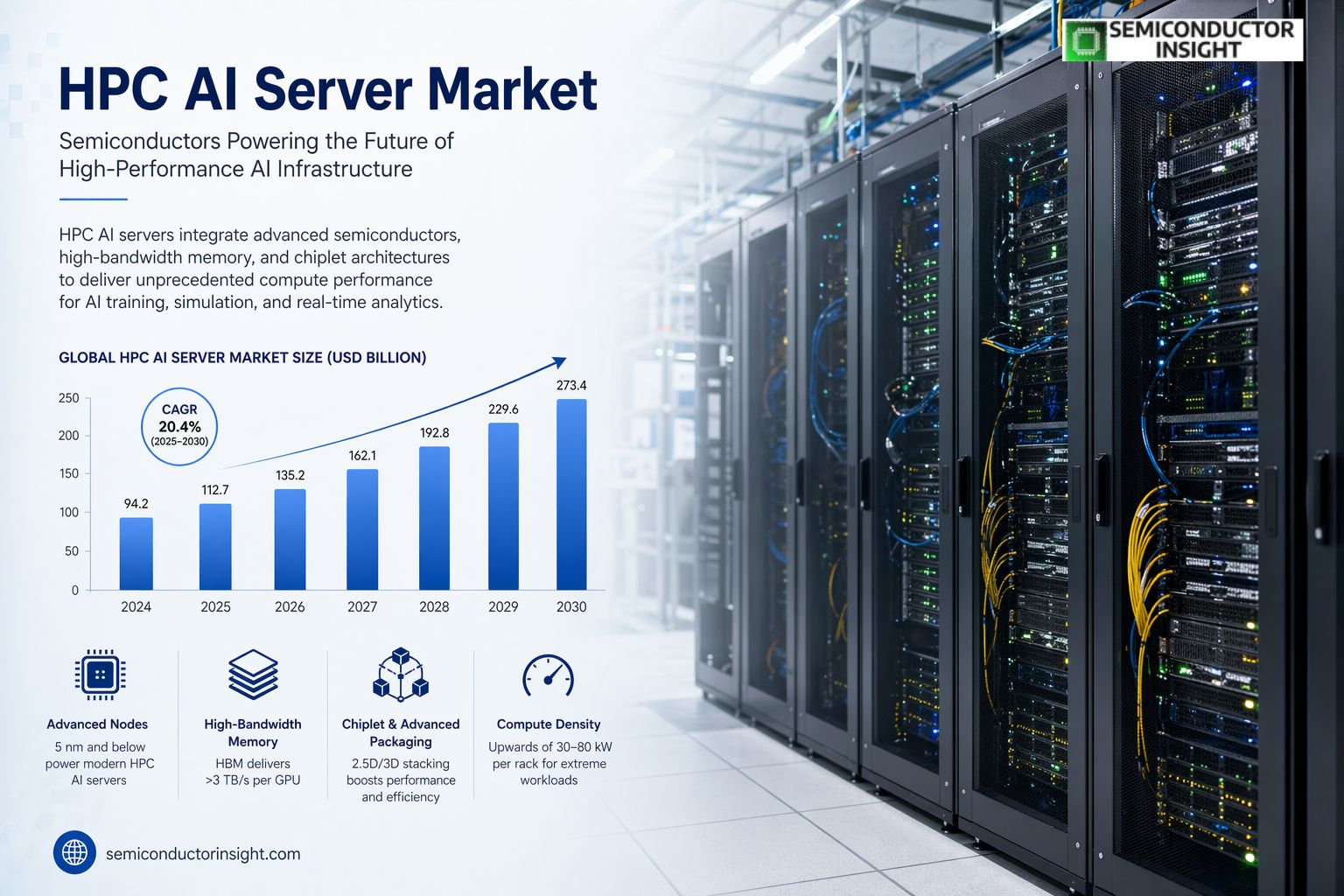
Redefining Compute Boundaries via the HPC AI Server Market and Advanced Silicon
High-Performance Computing (HPC) AI server landscape has evolved into a critical pillar of semiconductor innovation, driven by the need to process massive datasets for artificial intelligence, scientific simulations, and real-time analytics. HPC AI servers are designed around dense compute nodes that combine CPUs, GPUs, and specialised accelerators made on advanced process nodes like 5 nm and lower, in contrast to traditional data center servers.
Modern AI training clusters can scale to thousands of interconnected GPUs, with individual racks consuming upwards of 30-80 kW of power, reflecting the sheer intensity of semiconductor utilization.
Semiconductor design plays a defining role here. Chiplet architectures, high-bandwidth memory (HBM), and advanced packaging technologies such as 2.5D and 3D stacking are now standard in HPC AI servers. For instance, HBM stacks can deliver memory bandwidth exceeding 3 TB/s per GPU, enabling faster tensor operations critical for deep learning workloads.
HPC AI Server Types and Their Functional Importance
- HPC AI servers are not uniform; they are purpose-built depending on computational intensity and workload specialization. GPU-accelerated servers dominate AI model training, often housing 4 to 8 GPUs per node interconnected via high-speed links such as NVLink or PCIe Gen5. These systems are essential for training large language models that can exceed hundreds of billions of parameters.
- CPU-centric HPC servers, while less prominent in AI training, remain indispensable for simulation-heavy workloads such as computational fluid dynamics and genomic sequencing. They rely on high-core-count processors, sometimes exceeding 128 cores per socket, optimized for parallel processing.
- AI inference servers form another category, designed for low-latency execution. These systems use ASICs or domain-specific accelerators that prioritize energy efficiency, often delivering performance-per-watt improvements of 3-5x compared to general-purpose GPUs. Edge HPC AI servers are emerging as well, integrating compact semiconductor designs to bring AI processing closer to data sources, reducing latency in applications like autonomous systems.
Access the full study using the link provided here: https://semiconductorinsight.com/report/hpc-ai-server-market/
Semiconductor-Centric Advantages and Limitations
The primary advantage of HPC AI servers lies in their unparalleled compute density. Advanced semiconductors enable petaflop-scale performance within a single rack, dramatically reducing the time required for complex model training from weeks to days. Energy efficiency improvements in modern chips, combined with liquid cooling solutions, have also enabled sustained high performance under extreme workloads.
However, these benefits come with trade-offs. Fabrication complexity and reliance on cutting-edge nodes significantly increase costs, with a single high-end GPU costing several thousand dollars. Thermal management is another constraint; advanced chips can exceed 700 watts per unit, necessitating sophisticated cooling infrastructure. Additionally, semiconductor supply chain dependencies—particularly for advanced nodes and HBM—can create bottlenecks in large-scale deployments.
Leading Semiconductor-Driven HPC AI Server Providers
- The HPC AI server ecosystem is dominated by companies that tightly integrate semiconductor innovation with system-level engineering.
- NVIDIA leads with GPU-centric platforms leveraging its CUDA ecosystem and HBM-enabled architectures.
- AMD has gained traction with its EPYC CPUs and Instinct accelerators, offering competitive performance in both HPC and AI workloads.
- System manufacturers such as Supermicro, Dell Technologies, and Hewlett Packard Enterprise (HPE) play a crucial role in assembling these semiconductor components into scalable server architectures.
- Their designs often incorporate modular chassis, high-speed interconnects, and optimized airflow or liquid cooling tailored to semiconductor heat profiles.
Emerging Semiconductor Innovations Shaping the Market
One of the most transformative trends is the shift toward heterogeneous integration. Instead of relying on monolithic dies, HPC AI servers increasingly use chiplets connected through advanced interposers, improving yield and scalability. Silicon photonics is another emerging area, enabling faster data transfer between nodes with lower latency compared to traditional electrical interconnects.
Additionally, the adoption of advanced packaging technologies such as CoWoS (Chip-on-Wafer-on-Substrate) has enabled tighter integration of logic and memory, significantly boosting performance. The global production of advanced packaging substrates has become a strategic priority, with fabrication volumes reaching millions of units annually to meet HPC demand.
Strategic Role in National and Scientific Infrastructure
HPC AI servers are no longer confined to commercial enterprises; they are integral to national research labs, weather forecasting systems, and defense applications. Semiconductor advancements directly impact the capabilities of these systems, enabling simulations with higher resolution and accuracy. For example, climate models now run at resolutions below 10 km, requiring immense computational throughput supported by advanced chips.
In essence, the HPC AI server market is a direct reflection of semiconductor progress. Each leap in chip design, packaging, and memory technology translates into exponential gains in computational capability, reinforcing the central role of semiconductors in shaping the future of high-performance AI infrastructure.

Comments (0)