
RAID Controller Card Market Evolution from SAS to Advanced NVMe Tri Mode Support
RAID controller cards, which are nearly invisible inside the hardware stack, provide the silent, steady beat of thousands of discs operating in perfect sync when you walk into any modern server room. Striping, mirroring, and parity computations are handled by these specialised cards, freeing up the main CPU for real operations.
Hardware RAID controller cards provide reliable low-latency access even during periods of high system load, in contrast to software RAID, which borrows memory and processor cycles. Models such as the PERC H730P have a specialised 2 GB 1866 MT/s DDR3 cache to protect write operations during power events, guaranteeing data integrity without slowing down the host processor, according to official Dell technical guides for PowerEdge servers.
The Technical Leap to NVMe and Tri-Mode RAID Controller Cards
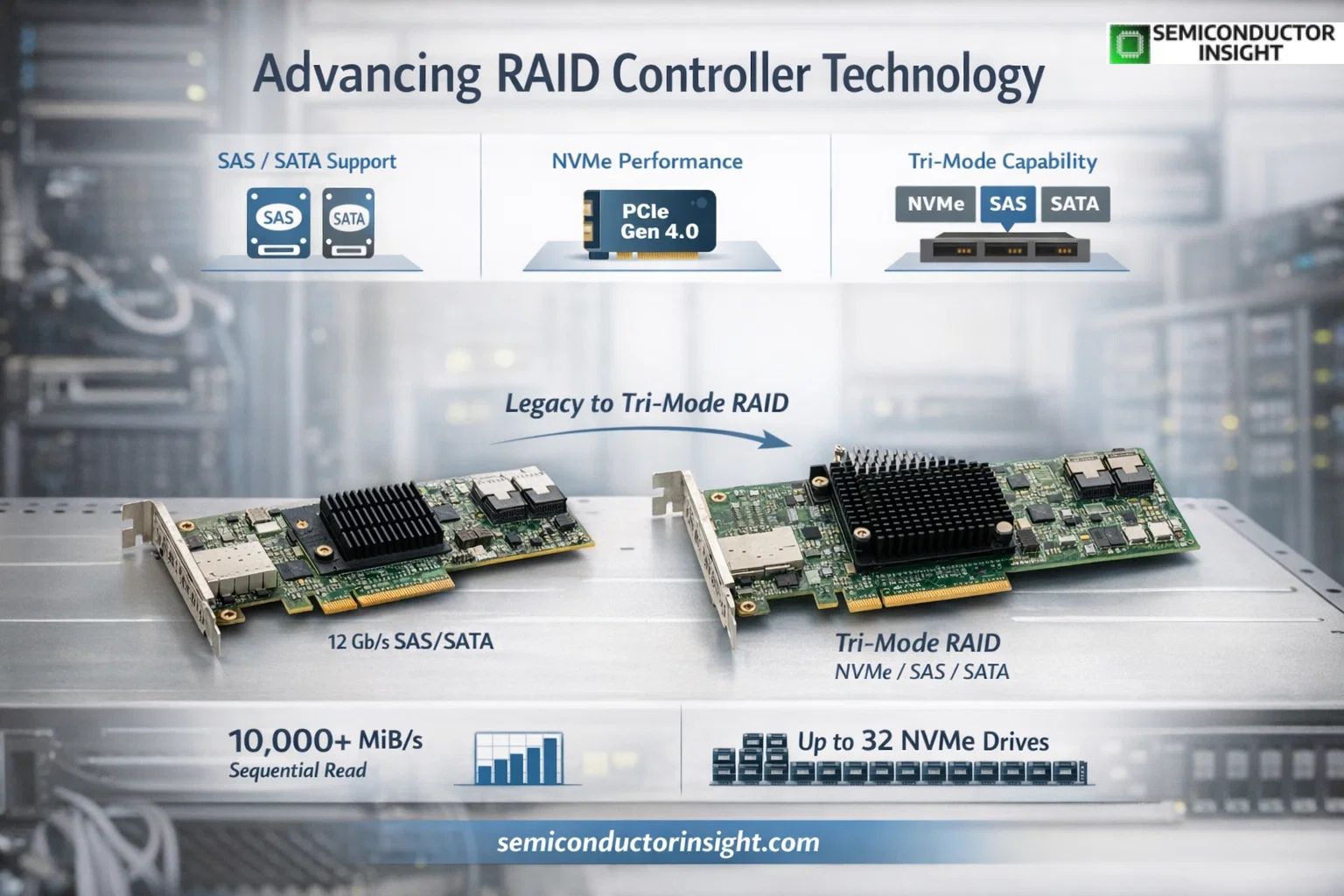
- The shift from traditional SAS-only designs to full Tri-Mode support marks one of the biggest advances in recent years.
- Broadcom’s MegaRAID 9560-8i PCIe Gen 4.0 adapter, for example, negotiates seamlessly between NVMe, SAS, and SATA devices in the same backplane using the SFF-TA-10001 U.3 specification.
- This single card doubles the performance of previous-generation controllers while supporting up to 32 native NVMe drives in high-density configurations.
- Engineers no longer need separate HBAs or multiple controller types; one card handles everything from legacy 12 Gb/s SAS drives to the latest PCIe Gen 4 NVMe SSDs, simplifying cabling and reducing power draw inside dense 1U and 2U racks.
Official Performance Benchmarks That Showcase Real Gains
Official testing from Fujitsu on PRIMERGY servers provides concrete numbers that matter to IT teams. In RAID five configurations using 16 NVMe drives connected through a hardware controller, sequential read performance reached 10,000 to 12,000 MiB/s while maintaining stable latency even under mixed 4K random workloads.
RAID 0 setups saturated the PCIe bandwidth limit once four drives were active, showing that the controller itself is no longer the bottleneck modern NVMe drives and Gen 4 lanes are. These results come directly from Fujitsu’s 2021-2026 performance report and match what administrators see in real production environments when moving from older SAS-based cards to current Tri-Mode models.
Want more details? Check out our latest updated report anytime: https://semiconductorinsight.com/report/raid-controller-card-market/
Step-by-Step RAID Controller Card Configuration for Peak Results
Getting maximum value from a new RAID controller card follows a repeatable sequence used across enterprise deployments. First, confirm the server’s PCIe slot version and lane count match the card’s requirements. Install the card and attach the correct mini-SAS HD or SlimSAS cables to the backplane or direct drives. On first power-up, enter the RAID BIOS utility to create virtual disks, select the RAID level that balances capacity and protection, and set stripe size according to the workload typically 64 KB for databases or 128 KB for large sequential files. Run an initial consistency check, then hand the logical volumes over to the operating system.
Finally, enable patrol read and SMART monitoring through the management console so the card can proactively flag issues before they become outages. This workflow, documented in Dell PERC user guides, consistently delivers the highest sustained throughput with the lowest risk of configuration errors.
Comparing Popular RAID Controller Card Models Side by Side
- Dell PERC H730P
- Comes with 2 GB DDR3 cache (1866 MT/s) for improved data handling
- Supports up to 255 physical drives, making it suitable for large storage environments
- Operates on 12 Gb/s SAS/SATA interface
- Key strength lies in its battery-backed write cache, which protects data during unexpected power loss
- Commonly used in enterprise servers where data integrity and reliability are critical
- Broadcom MegaRAID 9560-8i
- Features on-chip cache with optional upgrades for flexible performance scaling
- Supports up to 32 native NVMe drives, enabling high-speed storage configurations
- Built on PCIe Gen 4.0 Tri-Mode interface, allowing compatibility with NVMe, SAS, and SATA
- Its standout capability is the ability to seamlessly mix NVMe, SAS, and SATA drives within a single system
- Ideal for modern data centers requiring high performance and storage versatility
- Dell PERC H330
- Does not include onboard cache, offering a pass-through mode for direct storage access
- Supports up to 32 drives per volume
- Uses 12 Gb/s SAS/SATA interface
- Positioned as a cost-effective entry-level RAID solution
- Best suited for high-density 1U servers or budget-conscious deployments
Overall, the choice between these models depends on specific needs:
- High reliability and data protection → Dell PERC H730P
- Advanced performance with mixed storage support → Broadcom MegaRAID 9560-8i
- Affordable and basic RAID functionality → Dell PERC H330
These cards continue to evolve quietly in the background, quietly enabling the massive scale and rock-solid reliability that modern data centers demand. From AI training racks that mix drive types to rugged field systems that cannot afford downtime, RAID controller cards remain the dependable foundation that lets storage keep pace with ever-growing workloads.

Comments (0)