

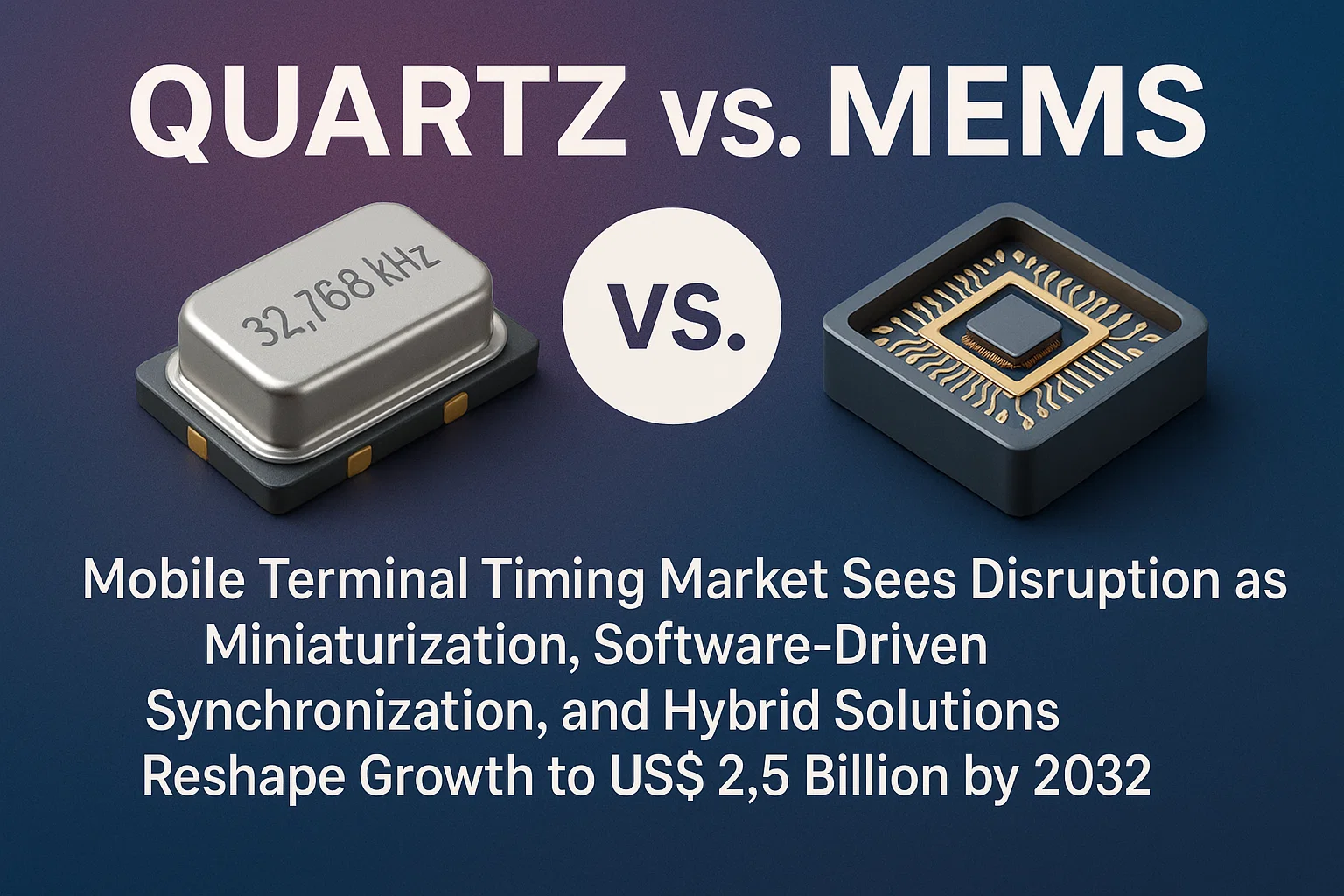
Quartz vs. MEMS: Mobile Terminal Timing Market Sees Disruption as Miniaturization, Software-Driven Synchronization, and Hybrid Solutions Reshape Growth to US$ 2.5 Billion by 2032
Timing is deceptively simple. A smartphone, wearable, or IoT endpoint may appear to function as a single, smart device, but beneath its sleek chassis sits a complex orchestra of subsystems processors, radios, sensors and power management each coordinated by tiny timing elements. For decades, quartz crystal units (QCUs) have been the backbone of that orchestration: relatively inexpensive, reliable, and well understood. Yet the demands of modern mobile terminals smaller form factors, tighter power budgets, complex multi-radio stacks and new use cases such as AR/VR have triggered a technological and market shift..
Access Your Free Sample Report- Mobile Terminal Quartz Crystal Unit Market
1. Why Timing Matters In Mobile Terminals
Timing components do more than keep clocks running. In mobile terminals they:
- Provide reference frequencies for radios (cellular, Wi‑Fi, Bluetooth, GNSS). Without them, radio chains cannot lock onto carriers or execute reliable handovers.
- Coordinate sensor fusion pipelines (IMUs, cameras, microphones) so data can be timestamped and fused for AR, navigation, and context awareness.
- Drive power management subsystems by enabling optimal duty cycles for radios and processors.
- Support secure communications by providing stable clocks for cryptographic timestamping and time-based protocols.
Because of these roles, timing inaccuracies ripple across key device attributes: connectivity robustness, battery life, location accuracy, and user experience. Even small improvements in size, drift, or power can unlock new designs and use cases for mobile terminals.
2. Market Overview and Growth Drivers
The Mobile Terminal Quartz Crystal Unit market stood at US$ 1,625 million in 2024. Analysts project it to grow to US$ 2,495 million by 2032 a compound annual growth rate of 6.5%. Several forces are driving this expansion:
- Proliferation of mobile endpoints: Smartphones remain the largest single category, but the explosive growth in wearables, AR/VR headsets, hearables, and industrial IoT endpoints keeps demand high.
- More radios per device: Modern devices bundle multiple radios and support multi‑band, multi‑mode connectivity. Each radio often needs multiple timing references at different performance levels.
- Higher performance requirements: 5G and advanced Wi‑Fi standards impose tighter phase noise, jitter and stability demands especially for uplink synchronisation and TDD systems.
- Miniaturization and form‑factor diversity: Smaller devices and new mechanical packages require smaller, lighter timing elements.
- Supply-chain resilience: After the disruptions experienced in recent years, OEMs increasingly value reliable suppliers and diversified sourcing for passive components like QCUs.
However, growth is not uniform. Premium handsets demand higher‑spec QCUs with better phase noise and drift, while the low‑end segment is increasingly price-sensitive and open to alternative timing technologies.
3. Recent Developments Reshaping The Landscape
The timing component ecosystem is more dynamic than it appears. The last two years brought a convergence of commercial product launches, strategic product positioning, and academic research that together suggest a multi‑pronged transition rather than a single, sudden replacement of quartz.
3.1 MEMS / silicon resonators step into the limelight
A notable trend is the commercialization of MEMS-based resonators and oscillators that aim to replace or complement quartz units in many mobile terminal applications. MEMS vendors market a few compelling advantages:
- Size reduction: MEMS resonators can be substantially smaller than traditional quartz packages, fitting into ultra‑compact wearables and space-constrained modules.
- Mechanical robustness: Silicon-based resonators are less fragile than crystal substrates, improving tolerance to shock and vibration important for wearables and ruggedized devices.
- Integration potential: MEMS devices are more readily integrated with semiconductor processes and can be offered as combined resonator + oscillator + programmable timing solutions.
These advantages are particularly attractive in mobile terminals where every fraction of a millimeter and milliwatt counts.
3.2 Timing as a system feature: hardware + software
Newer entrants and even established oscillators vendors are pairing hardware products with timing software and firmware. Time-stack offerings combining resonator hardware, oscillator ICs, and synchronization software allow OEMs to treat timing as a managed subsystem. For example, software-driven holdover features, network time synchronization (PTP implementations), and clock‑conditioning firmware can notably improve device-level synchronization without changing radio hardware.
3.3 Academic advances nudging future architectures
On the research front, advances in phononic crystal resonators, surface acoustic wave (SAW) oscillator stabilization, and thin-film quartz structures suggest future hybrid architectures. Long‑term drift reduction via injection locking and phononic engineering could theoretically bring quartz-class stability to much smaller resonator forms, or enable hybrids that combine the best of quartz and MEMS.
4. What This Means For Quartz Crystal Unit Manufacturers
Quartz manufacturers face a complex set of opportunities and risks. The core value propositions of quartz cost efficiency, established supply chains, and high performance in certain metrics (e.g., ultra‑low phase noise) remain relevant. But they can’t be complacent.
4.1 Innovate on size and package
To defend share in mobile terminals, quartz vendors must pursue aggressive miniaturization and advanced packaging (including low-profile packages, system-in-package (SiP) approaches and wafer-level packaging). For many OEMs, a smaller QCU that preserves quartz’s stability is the most attractive proposition.
4.2 Offer hybrid solutions
There is increasing appetite for hybrid approaches quartz resonators combined with smart clock ICs, or quartz crystals integrated into multi‑die modules alongside MEMS components. Vendors that can provide such hybrid subsystems offer a pragmatic migration path for OEMs sensitive to cost and risk.
4.3 Emphasize proven reliability and qualification support
A strength of quartz vendors is their decades-long qualification pedigree. For critical applications GNSS receivers, safety-supporting comms, and some RF subsystems OEMs still prefer quartz unless a new technology is demonstrably superior and validated. Providing thorough qualification kits, lifecycle support, and technical consultancy will be essential.
5. OEM and System Designer Perspective: Choosing Between Quartz and MEMS
Device architects weigh multiple factors when selecting timing components. These include size, power, phase noise/jitter, environmental resilience, cost, supply‑chain risk, and ease of integration.
- When quartz wins: Applications where phase noise and frequency stability under specific thermal conditions are critical, or where the cost per unit is extremely sensitive and existing supply agreements or qualification cycles favor quartz.
- When MEMS wins: Ultra‑compact wearables, devices facing severe mechanical stress, and designs where integration with silicon/process ecosystems or software-driven timing features yield system-level benefits.
In many mobile terminals the answer is mixed. A premium smartphone might use a mix of quartz and MEMS depending on the radio path and subsystem. The trend is toward best‑of‑breed selections for each timing role rather than an all‑in/all‑out swap.
6. Technical Tradeoffs
A decision to switch timing technologies hinges on several technical attributes. Here’s a practical comparison framed for mobile terminals:
- Phase noise and jitter: High‑end quartz crystals still typically outperform many MEMS resonators in raw phase noise at some offsets, making them preferred in certain RF front ends. However, high-performance MEMS oscillators are narrowing the gap, and for many consumer radios their noise floor is acceptable.
- Temperature stability and drift: Quartz can be engineered (e.g., TCXOs, OCXOs) for excellent tempco performance. MEMS manufacturers compensate with calibration, temperature compensation algorithms, and system‑level filtering.
- Power consumption: The intrinsic power usage of the resonator is small; the oscillator IC and required conditioning circuits matter more. MEMS-based silicon resonators sometimes enable leaner oscillator designs or tighter integration with power-management logic.
- Form factor: MEMS typically wins on raw size and thickness, enabling new form factors in wearables and true earbud-design integration.
- Cost and yield: For high-volume, low-cost endpoints, the per-unit cost and manufacturing yield are deciding economics. Quartz production economies remain strong, but MEMS scales quickly due to semiconductor processes and fabs.
Download Sample Report PDF- Mobile Terminal Quartz Crystal Unit Market
7. Regional Dynamics and Supply Chain Considerations
The QCU ecosystem is global. Manufacturing footprints, raw-material sourcing (e.g., quartz blanks), and precision machining or crystal-growth capacity affect supply dynamics.
- Asia-Pacific remains dominant for both quartz component manufacturing and final device assembly. Many quartz vendors have long-standing manufacturing enablers in Japan, Taiwan, South Korea, China, and Southeast Asia.
- Diversification post‑pandemic: OEMs now demand multi-regional sourcing to mitigate disruptions. Suppliers that can offer geographically diversified production lines have an edge.
- Specialized fabs for MEMS: Silicon resonator vendors lean on semiconductor fabs and packaging houses. Strategic partnerships with foundries and OSATs (outsourced semiconductor assembly and test) are critical for scaling MEMS timing.
8. Competitive Landscape: Established Players Vs Challengers
The timing space is populated by traditional crystal manufacturers longtime suppliers of QCUs and TCXOs and a new class of silicon/MEMS timing specialists who sell oscillators and resonators as part of a broader timing portfolio.
- Legacy quartz vendors bring domain expertise and qualification processes, deep relationships with handset OEMs, and mass manufacturing capability. Their challenge is to modernize packaging and move faster on hybridization.
- MEMS/silicon challengers offer compactness, system integration, and software-enabled features. They typically position timing as a managed subsystem rather than a commodity component.
Competition is increasingly collaborative, not strictly adversarial. Expect more licensing deals, co‑packaged modules, and joint design wins that pair quartz stability with silicon integration.
9. Where The Market Will Shift First
- Hearables (true wireless earbuds): These devices are a prime target for MEMS replacement of quartz because size and ruggedness matter more than the ultra‑lowest phase noise. Battery life improvements and compactness deliver direct user value.
- Wearables and health devices: Smart watches and health‑monitoring bands favor small, low‑power, and robust resonators again a favorable environment for MEMS.
- Premium smartphones: Here the radio front-end demands and cost tolerances are mixed. High‑end phones may still use quartz for certain RF paths but could adopt MEMS for auxiliary functions.
- AR/VR headsets: Extremely sensitive to size, weight, and sensor fusion accuracy, AR/VR devices are likely to adopt advanced timing stacks combining MEMS resonators with timing software.
10. Business Models And Go-To-Market Strategies
For vendors, success will depend on how well they can add system value and make life easier for OEMs:
- Component supply + design support: Offer reference designs, evaluation kits, and integration assistance so OEMs can accelerate time-to-market.
- Timing-as-a-platform: Bundle hardware with timing firmware, synchronization services, and long-term support charging for premium features that tangibly improve device performance.
- Co‑engineering with ODMs/OEMs: Early collaboration to tailor resonator specifications to module-level constraints (height, shock, thermal cycling) will win design slots.
- After‑sales lifecycle and qualification services: Provide long-term product lifecycle roadmaps and steps to ease requalification across device generations.
11. Risks and Headwinds
- Technological risk: MEMS and hybrid technologies are improving, but adoption timelines depend on maturity and qualification cycles. Over-investing in a single technology bet can be risky.
- Price pressure: Commodity market segments remain highly price sensitive erosion of margins is a real possibility.
- Supply-chain vagaries: Specialized materials, geopolitical events, or capacity bottlenecks in fabs/OSATs could create short-term shortages or cost pressures.
- Standards and certification hurdles: For some critical radio subsystems and safety-related features, regulators and standards bodies may impose lengthy certification processes that favor incumbents.
12. Opportunities and Strategic Recommendations
For quartz suppliers:
- Invest in miniaturization and wafer-scale packaging to remain competitive in small-form-factor mobile terminals.
- Explore hybrid modules that combine quartz and MEMS or quartz with smart oscillator ICs to bridge the adoption gap.
- Build software competence for timing management and synchronization features that add system-level value.
For MEMS/silicon challengers:
- Focus on co‑engineering with OEMs to meet specific RF and environmental performance needs don’t assume one-size-fits-all.
- Strengthen supply chain partnerships with OSATs and foundries to ensure predictable capacity scaling.
For OEMs and system designers:
- Adopt a multi-source strategy for timing components to reduce supply risk and exploit the strengths of both quartz and MEMS.
- Design with modularity so timing elements can be swapped mid-cycle without extensive requalification.
13. Forecast and What To Watch
If the market follows current trends, the mobile terminal timing landscape will evolve in stages:
- 2025–2027 (early adoption): MEMS resonators and hybrid modules capture share in wearables, hearables, and some AR/VR modules. Quartz remains dominant in high‑performance RF paths and low‑cost mass devices.
- 2028–2030 (widening adoption): Silicon timing solutions mature further; integration and supply scale bring down costs. OEMs adopt mixed architectures where MEMS handle size/power-sensitive roles and quartz covers the highest‑performance needs.
- Beyond 2030 (consolidation): The market will likely settle into a bimodal equilibrium: MEMS for size/robustness-sensitive roles and quartz (or advanced thin-film/quartz hybrids) for the most demanding RF/phase-noise roles. Cross-licensing, consolidation, and co‑packaging become commonplace.
These qualitative forecasts align with the market projection (US$ 1,625M in 2024 to US$ 2,495M in 2032, CAGR 6.5%), which reflects steady growth driven by device proliferation and incremental increases in per-device timing complexity.
Click Here To Download Full Sample Report- Mobile Terminal Quartz Crystal Unit Market
14. Actionable Next Steps For Stakeholders
For quartz vendors: prioritize R&D into packaging, seek foundry partnerships for hybrid modules, and create a clear product roadmap that maps to wearable and AR/VR adoption timelines.
For MEMS vendors: demonstrate qualification across a handful of blue‑chip OEMs and produce robust long-term supply agreements to build trust with handset makers.
For OEMs: run parallel validation tracks for quartz and MEMS solutions in new product programs and quantify the trade-offs (size, cost, integration time) early in the design cycle.
The mobile terminal quartz crystal unit market is neither dying nor frozen in place. Instead, it’s being remixed. Quartz retains core strengths cost, performance in certain metrics, and a deep qualification heritage while MEMS and silicon-based resonators offer compelling new capabilities around size, robustness, and system integration. The market projection to US$ 2,495 million by 2032 at 6.5% CAGR captures this picture of steady growth punctuated by technological evolution.

Comments (0)