MARKET INSIGHTS
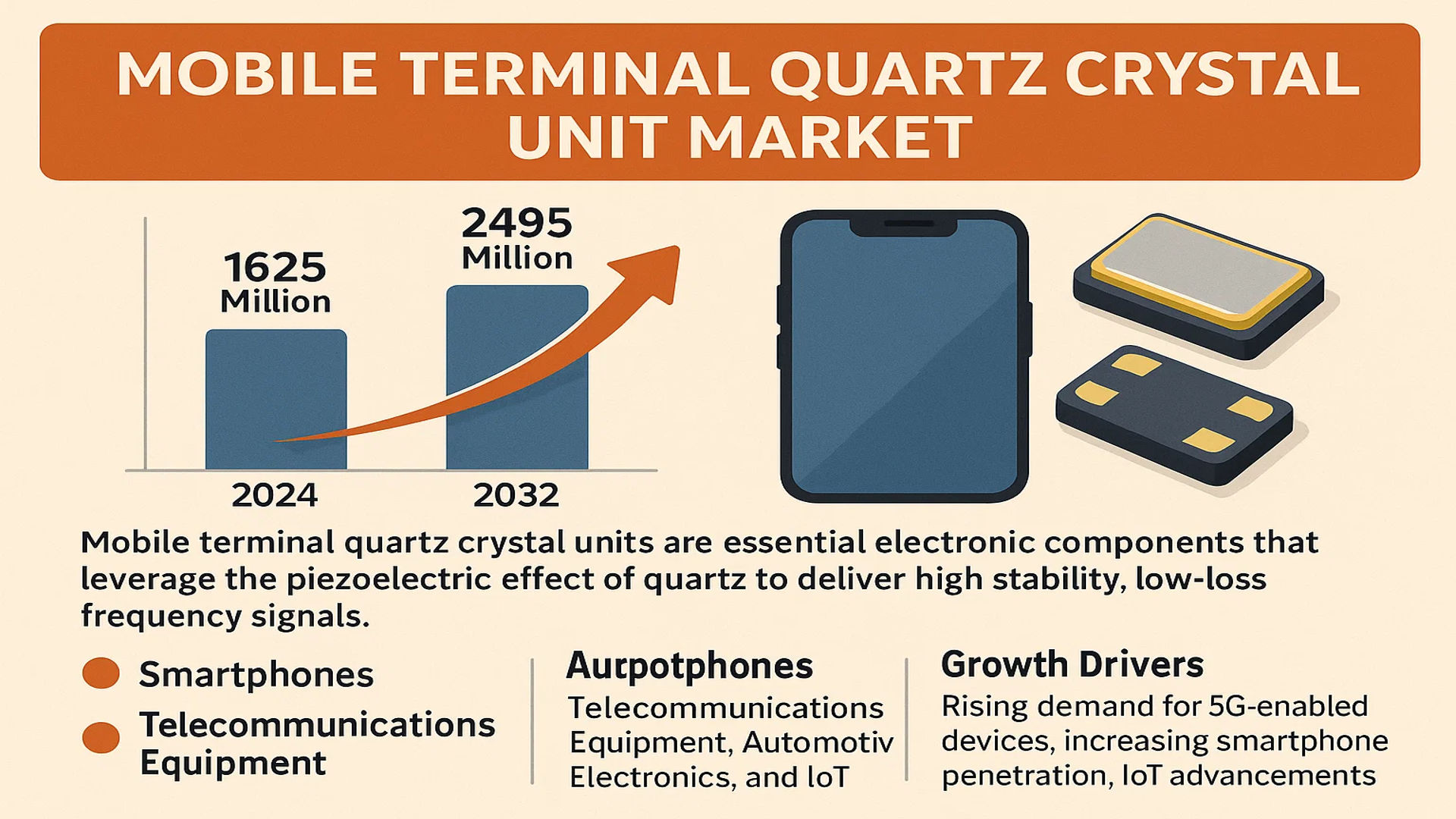
The global Mobile Terminal Quartz Crystal Unit Market was valued at 1625 million in 2024 and is projected to reach US$ 2495 million by 2032, at a CAGR of 6.5% during the forecast period.
Mobile terminal quartz crystal units are essential electronic components that leverage the piezoelectric effect of quartz to deliver high stability, low-loss frequency signals. These components serve as critical timing devices in smartphones, telecommunications equipment, automotive electronics, and IoT-enabled devices. The market includes crystal units and crystal oscillators, which ensure precise synchronization and clock signal generation.
Growth is driven by rising demand for 5G-enabled devices, increasing smartphone penetration, and advancements in IoT applications. Key players such as Seiko Epson Corp, Murata Manufacturing, and TXC Corporation dominate the market, collectively holding a significant revenue share. The Asia-Pacific region, led by China and Japan, remains the largest market due to high electronics manufacturing activity. However, supply chain disruptions and raw material shortages pose challenges to sustained expansion.
MARKET DYNAMICS
MARKET DRIVERS
Proliferation of 5G Networks and Smart Devices to Accelerate Market Expansion
The global rollout of 5G infrastructure is significantly driving demand for high-frequency, high-stability quartz crystal units in mobile terminals. 5G technology requires components that can operate at higher frequencies with minimal signal loss and exceptional precision. Quartz crystal units provide the necessary frequency stability and low phase noise required for 5G modems, RF transceivers, and connectivity modules in smartphones and other mobile devices. With over 1.8 billion 5G subscriptions active worldwide and smartphone manufacturers increasingly integrating 5G capabilities even in mid-range devices, the need for reliable timing solutions has never been greater. This technological transition is compelling component manufacturers to develop advanced quartz crystals that meet the stringent requirements of next-generation mobile communication standards.
Growing Adoption of IoT and Wearable Technology to Fuel Market Growth
The expanding Internet of Things ecosystem and wearable technology market are creating substantial opportunities for mobile terminal quartz crystal units. These components are essential for providing accurate timing and frequency control in smartwatches, fitness trackers, and various IoT-enabled mobile devices. The wearable technology market has demonstrated remarkable growth, with shipments exceeding 500 million units annually, each requiring precise timing components for functionality. Furthermore, the proliferation of IoT devices, projected to reach 30 billion connected devices globally, necessitates reliable frequency control solutions for seamless connectivity and data synchronization. This expanding application landscape is driving manufacturers to develop miniaturized, low-power quartz crystal units that can operate efficiently in space-constrained mobile and wearable devices.
Additionally, the increasing integration of advanced features in mobile terminals, such as augmented reality, high-resolution displays, and sophisticated sensors, requires more precise timing solutions. These features demand stable clock signals for proper synchronization and operation, further bolstering the need for high-quality quartz crystal units. The trend toward multi-functional devices with enhanced processing capabilities continues to drive innovation in frequency control components, ensuring they meet the evolving requirements of modern mobile technology.
MARKET RESTRAINTS
Intense Price Competition and Margin Pressures to Constrain Market Growth
The mobile terminal quartz crystal unit market faces significant pressure from intense price competition, particularly from manufacturers in cost-competitive regions. The industry has experienced consistent price erosion of approximately 3-5% annually over recent years, squeezing profit margins across the supply chain. This price pressure is especially pronounced in consumer mobile devices, where manufacturers aggressively seek to reduce bill-of-materials costs. The situation is further exacerbated by the availability of alternative timing technologies and the emergence of new market entrants offering products at lower price points. While quality remains a critical factor, the relentless focus on cost reduction in mobile device manufacturing creates substantial challenges for quartz crystal unit suppliers maintaining profitability while investing in research and development.
Additionally, the cyclical nature of the consumer electronics industry presents inventory management challenges and demand volatility. Periods of oversupply can lead to aggressive pricing strategies as manufacturers attempt to clear inventory, creating unpredictable market conditions. These pricing dynamics require quartz crystal unit manufacturers to continuously optimize their production processes and supply chain operations to remain competitive while maintaining the high quality standards demanded by mobile terminal manufacturers.
MARKET CHALLENGES
Technical Limitations in Miniaturization and Frequency Stability to Hinder Market Progress
The ongoing trend toward device miniaturization presents significant technical challenges for quartz crystal unit manufacturers. Mobile terminal manufacturers continuously demand smaller form factors, with the industry moving toward components measuring 1.0×0.8 mm and smaller, while maintaining or improving frequency stability and performance characteristics. Achieving these size reductions without compromising performance requires advanced manufacturing techniques and material science innovations. The precision required in etching quartz blanks and packaging these miniature components demands substantial capital investment in manufacturing equipment and rigorous quality control processes. Furthermore, as devices become smaller, issues related to thermal stability, shock resistance, and power consumption become increasingly critical, requiring sophisticated engineering solutions.
Other Challenges
Supply Chain Vulnerabilities
The quartz crystal unit market faces ongoing challenges related to supply chain resilience and material availability. The industry relies on high-purity quartz materials, and disruptions in the supply of raw materials can significantly impact production capacity. Recent global events have highlighted the vulnerability of extended supply chains, with logistics challenges and geopolitical factors creating uncertainty in material availability and cost stability.
Technological Obsolescence Risks
The rapid pace of technological innovation in mobile communications creates constant pressure on component manufacturers to keep pace with evolving requirements. The emergence of new timing technologies, including silicon-based oscillators and microelectromechanical systems, presents competitive challenges to traditional quartz crystal units. Manufacturers must continuously invest in research and development to ensure their products remain relevant and competitive in the face of evolving technological landscapes.
MARKET OPPORTUNITIES
Expansion into Emerging Applications and Automotive Electronics to Create New Growth Avenues
The integration of mobile connectivity features in automotive applications presents significant growth opportunities for quartz crystal unit manufacturers. Modern vehicles incorporate numerous electronic systems requiring precise timing, including infotainment systems, advanced driver assistance systems, and vehicle-to-everything communication modules. The automotive electronics market is projected to grow substantially, with the average vehicle containing over 100 timing components requiring high reliability and stability under varying environmental conditions. This expansion into automotive applications allows quartz crystal unit suppliers to diversify their customer base and reduce dependence on the consumer mobile device market, while commanding better margins for automotive-grade components that meet stringent quality and reliability standards.
Furthermore, the development of specialized quartz crystal units for emerging technologies such as augmented reality glasses, foldable devices, and advanced medical mobile equipment offers additional growth pathways. These applications often require custom solutions with specific performance characteristics, enabling manufacturers to develop specialized products with enhanced value propositions. The ongoing digital transformation across industries continues to create new applications for mobile connectivity, each requiring reliable frequency control solutions, thereby expanding the addressable market for quartz crystal units beyond traditional mobile terminals.
MOBILE TERMINAL QUARTZ CRYSTAL UNIT MARKET TRENDS
Miniaturization and High-Frequency Demand Driving Market Evolution
The relentless push towards smaller, more powerful mobile devices is fundamentally reshaping the Mobile Terminal Quartz Crystal Unit market. This trend is driven by the consumer demand for slimmer smartphones and the rapid expansion of wearable technology, which requires components that occupy minimal space while delivering superior performance. To meet these demands, manufacturers are pioneering the development of ultra-compact crystal units, such as those in the 2016 and 1612 package sizes, which offer a significant reduction in footprint without compromising on stability or accuracy. Concurrently, the global rollout of 5G infrastructure necessitates quartz crystals capable of operating at higher frequencies with exceptional precision to manage increased data throughput and lower latency. This dual pressure for miniaturization and enhanced performance is compelling innovation in materials science and manufacturing processes, leading to the adoption of advanced techniques like wafer-level packaging and the use of novel piezoelectric materials to achieve the required thermal stability and frequency characteristics in increasingly constrained form factors.
Other Trends
Automotive Electronics Integration
Beyond consumer mobile devices, the automotive sector is emerging as a significant growth driver for quartz crystal units. The proliferation of Advanced Driver-Assistance Systems (ADAS), in-vehicle infotainment (IVI), and vehicle-to-everything (V2X) communication systems requires highly reliable timing solutions that can withstand harsh automotive environments characterized by extreme temperature fluctuations and vibrations. This has led to a surge in demand for Automotive Grade quartz crystals that meet stringent AEC-Q200 reliability standards. The increasing electronic content per vehicle, a trend often referred to as the software-defined vehicle, directly correlates with a higher number of timing components needed for various ECUs and sensors, thereby expanding the addressable market for these critical components within the automotive supply chain.
Supply Chain Resilience and Regional Manufacturing Shifts
Recent global disruptions have underscored the critical importance of supply chain resilience, prompting a strategic reevaluation within the quartz crystal unit industry. While a significant portion of manufacturing and raw material sourcing remains concentrated in the Asia-Pacific region, there is a growing trend towards geographical diversification of production facilities. This is particularly evident as key markets in North America and Europe seek to mitigate risks associated with geopolitical tensions and logistical bottlenecks by fostering local or near-shore manufacturing capabilities for critical electronic components. Furthermore, leading manufacturers are investing heavily in automation and smart factory technologies to enhance production yields, reduce costs, and improve the consistency and quality of output. This focus on operational excellence is crucial for maintaining competitiveness in a market where pricing pressure is intense and product differentiation is increasingly driven by reliability, lead time, and the ability to provide customized solutions for specific high-volume applications.
COMPETITIVE LANDSCAPE
Key Industry Players
Leading Manufacturers Focus on Technological Innovation and Miniaturization to Secure Market Position
The global mobile terminal quartz crystal unit market exhibits a highly competitive and fragmented landscape, characterized by the presence of numerous established international players and a growing number of regional manufacturers, particularly from Asia-Pacific. This intense competition is driven by the critical nature of these components as timing devices in virtually all modern electronics. Murata Manufacturing Co., Ltd. and NDK (Nihon Dempa Kogyo Co., Ltd.) are recognized as dominant forces, leveraging their extensive R&D capabilities, vast product portfolios spanning various frequencies and form factors, and robust global supply chains to serve leading smartphone OEMs worldwide.
Japanese companies, including Seiko Epson Corporation and KDS Daishinku Corp., also command a significant portion of the market share. Their leadership is historically rooted in decades of precision engineering expertise and strong relationships with the consumer electronics industry. These players are continuously innovating to produce smaller, more stable, and lower-power consumption crystals to meet the evolving demands of 5G devices and IoT applications.
Meanwhile, Taiwanese manufacturers like TXC Corporation and Siward Crystal Technology have aggressively expanded their market presence by offering cost-competitive and reliable solutions, effectively capturing volume-driven business from mid-tier device makers. Their growth is further bolstered by strategic expansions of production capacity to mitigate supply chain risks and meet rising global demand.
Furthermore, companies such as Microchip Technology Inc. and Rakon Limited are strengthening their positions through vertical integration, offering not just crystal units but also complete timing solutions including oscillators and integrated circuits. This strategy provides a value-added proposition to customers looking to simplify their sourcing and design processes, ensuring these players remain integral to the market’s ecosystem.
List of Key Mobile Terminal Quartz Crystal Unit Companies Profiled
- Murata Manufacturing Co., Ltd. (Japan)
- NDK (Nihon Dempa Kogyo Co., Ltd.) (Japan)
- Seiko Epson Corporation (Japan)
- TXC Corporation (Taiwan)
- KDS Daishinku Corp. (Japan)
- Microchip Technology Inc. (U.S.)
- Hosonic Electronic Co., Ltd. (Taiwan)
- Micro Crystal AG (Switzerland)
- Rakon Limited (New Zealand)
- Siward Crystal Technology Co., Ltd. (Taiwan)
- Failong Crystal Technologies Co., Ltd. (China)
- River Eletec Corporation (Japan)
- Abracon, LLC (U.S.)
Segment Analysis:
By Type
Crystal Units Segment Dominates the Market Due to High Volume Integration in Mobile Devices
The market is segmented based on type into:
- Crystal Units
- Subtypes: SMD Crystal Units, Through-Hole Crystal Units, and others
- Crystal Oscillators
- Subtypes: SPXO, TCXO, VCXO, OCXO, and others
By Application
Smart Phone Segment Leads Due to Pervasive Global Adoption and Continuous Technological Upgrades
The market is segmented based on application into:
- Smart Phone
- Telecommunications Room
- Wearable Devices
- Automotive Electronics
- Others
By End User
Consumer Electronics Segment Leads Owing to Mass Production and High Replacement Cycles
The market is segmented based on end user into:
- Consumer Electronics
- Telecommunications
- Automotive
- Industrial
- Others
Regional Analysis: Mobile Terminal Quartz Crystal Unit Market
Asia-Pacific
The Asia-Pacific region dominates the global Mobile Terminal Quartz Crystal Unit market, accounting for over 60% of total consumption volume. This leadership position is driven by the massive concentration of smartphone manufacturing, particularly in China, which produces approximately 70% of the world’s mobile phones. Countries like China, Japan, South Korea, and Taiwan host the world’s leading quartz crystal component manufacturers, including Murata Manufacturing, NDK, and TXC Corporation. The region’s robust electronics supply chain, coupled with significant investments in 5G infrastructure deployment, fuels continuous demand for high-frequency, low-power consumption crystal units. Furthermore, the rapid adoption of IoT devices and wearables across densely populated nations like India and Southeast Asian countries provides additional growth vectors. However, intense price competition and the need for miniaturization present ongoing challenges for manufacturers operating in this region.
North America
North America represents a significant market characterized by high-value, advanced quartz crystal units. The United States, in particular, is a hub for innovation in telecommunications and high-performance mobile devices. Demand is primarily driven by the need for precision timing components in 5G infrastructure, premium smartphones, and specialized communication equipment. The presence of major technology companies and stringent quality requirements pushes manufacturers toward producing highly reliable, temperature-compensated crystal oscillators (TCXOs) and oven-controlled crystal oscillators (OCXOs). While the region’s manufacturing volume is lower than Asia-Pacific, its focus on research and development and premium applications results in higher average selling prices. The market is also influenced by defense and aerospace applications, which require components meeting rigorous standards.
Europe
Europe maintains a stable and technologically advanced market for mobile terminal quartz crystal units. The region is characterized by strong demand from the automotive sector (for connected car systems) and industrial IoT applications, alongside traditional mobile communications. Germany, the UK, and France are key markets, hosting several automotive OEMs and telecommunications equipment manufacturers. European regulations emphasizing product quality, energy efficiency, and environmental compliance influence component specifications, pushing for lead-free and RoHS-compliant products. While the region does not have the same volume of component manufacturing as Asia, it possesses strong design and R&D capabilities, with companies like Micro Crystal AG (a Swiss company) specializing in high-precision, miniature crystal units.
South America
The South American market for mobile terminal quartz crystal units is emerging and primarily import-dependent. Growth is largely tied to the expansion of mobile network coverage and smartphone penetration in countries like Brazil and Argentina. Economic volatility and currency fluctuations can impact the cost of imported electronic components, making the market somewhat unpredictable. Demand is mostly for cost-effective, standard-frequency crystal units used in consumer mobile devices, with limited local manufacturing or advanced R&D activities. The market potential is recognized, but growth is often tempered by broader economic conditions and infrastructure development pace.
Middle East & Africa
This region presents a developing market with growth potential driven by urbanization, digital transformation initiatives, and increasing mobile subscriber rates. The demand for quartz crystal units is primarily linked to the deployment of new telecommunications infrastructure and rising consumer electronics imports. Countries like Israel, Turkey, and the UAE show more advanced demand patterns due to local tech sectors. However, the market overall is price-sensitive and reliant on imports, with limited local manufacturing presence. Long-term growth is anticipated as digital infrastructure projects advance, but the market currently remains a smaller segment of the global landscape.
Report Scope
This market research report provides a comprehensive analysis of the global and regional Mobile Terminal Quartz Crystal Unit markets, covering the forecast period 2025–2032. It offers detailed insights into market dynamics, technological advancements, competitive landscape, and key trends shaping the industry.
Key focus areas of the report include:
- Market Size & Forecast: Historical data and future projections for revenue, unit shipments, and market value across major regions and segments.
- Segmentation Analysis: Detailed breakdown by product type, technology, application, and end-user industry to identify high-growth segments and investment opportunities.
- Regional Outlook: Insights into market performance across North America, Europe, Asia-Pacific, Latin America, and the Middle East & Africa, including country-level analysis where relevant.
- Competitive Landscape: Profiles of leading market participants, including their product offerings, R&D focus, manufacturing capacity, pricing strategies, and recent developments such as mergers, acquisitions, and partnerships.
- Technology Trends & Innovation: Assessment of emerging technologies, integration of AI/IoT, semiconductor design trends, fabrication techniques, and evolving industry standards.
- Market Drivers & Restraints: Evaluation of factors driving market growth along with challenges, supply chain constraints, regulatory issues, and market-entry barriers.
- Stakeholder Analysis: Insights for component suppliers, OEMs, system integrators, investors, and policymakers regarding the evolving ecosystem and strategic opportunities.
Primary and secondary research methods are employed, including interviews with industry experts, data from verified sources, and real-time market intelligence to ensure the accuracy and reliability of the insights presented.
FREQUENTLY ASKED QUESTIONS:
What is the current market size of Global Mobile Terminal Quartz Crystal Unit Market?
-> Mobile Terminal Quartz Crystal Unit Market was valued at 1625 million in 2024 and is projected to reach US$ 2495 million by 2032, at a CAGR of 6.5% during the forecast period.
Which key companies operate in Global Mobile Terminal Quartz Crystal Unit Market?
-> Key players include Seiko Epson Corp, TXC Corporation, NDK, Murata Manufacturing, and Microchip, among others.
What are the key growth drivers?
-> Key growth drivers include rising smartphone penetration, expansion of 5G infrastructure, and increasing demand for automotive electronics and IoT devices.
Which region dominates the market?
-> Asia-Pacific is the dominant market, driven by strong manufacturing presence in China, Japan, and South Korea.
What are the emerging trends?
-> Emerging trends include miniaturization of components, development of ultra-low power consumption crystals, and integration into advanced wearable technology.

Get Sample Report PDF for Exclusive Insights
Report Sample Includes
- Table of Contents
- List of Tables & Figures
- Charts, Research Methodology, and more...
 Download Sample Report PDF