
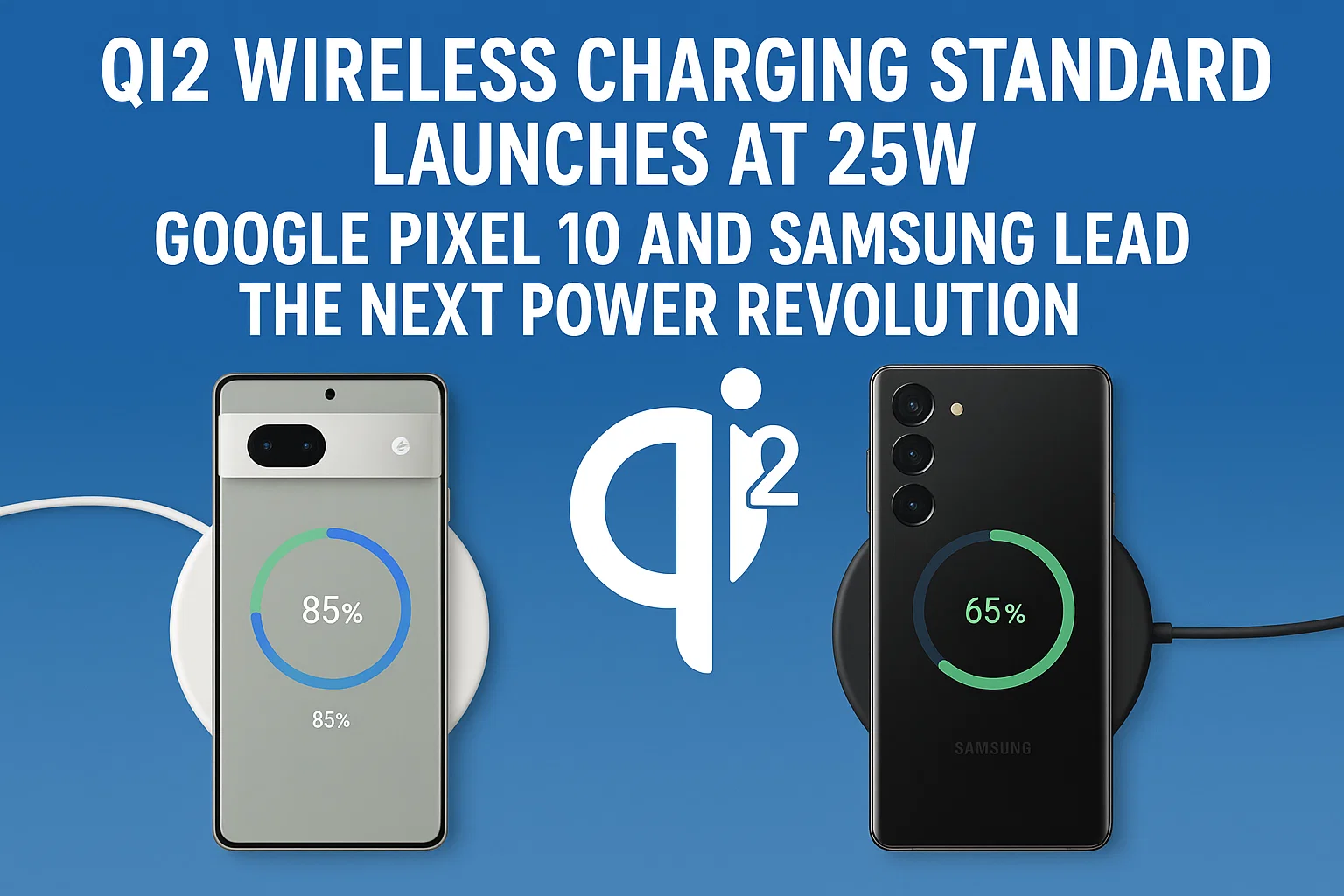
Qi2 Wireless Charging Standard Launches at 25W: Google Pixel 10 and Samsung Lead the Next Power Revolution
Wireless charging has transitioned from a luxury feature to an essential part of the modern smartphone ecosystem. Once considered slow and inefficient, today’s wireless charging technologies are evolving to compete head-to-head with wired solutions. With the Wireless Power Consortium (WPC) launching the Qi2 standard at 25W, Google’s Pixel 10 leaks showcasing built-in magnetic charging, Samsung’s exploration of MagSafe-style upgrades, and the introduction of multi-device wireless power banks, the industry is heading toward a future where wireless charging may even replace cables altogether.
At the same time, the global smartphone wireless chargers market is surging. Valued at US$ 4,820 million in 2024, it is expected to reach US$ 12,650 million by 2032, growing at a robust CAGR of 12.8% during 2025–2032. This growth is fueled by the adoption of the Qi2 standard, the push from flagship devices, and the demand for more convenient, universal charging solutions.
Access Your Free Sample Report- Smartphone Wireless Chargers Market
The Evolution of Wireless Charging: From Niche to Mainstream
When wireless charging first appeared in smartphones over a decade ago, it was more a gimmick than a necessity. Early implementations were notoriously slow—often less than 5W—and required precise alignment with charging pads. Users frequently complained about inefficiency, heat buildup, and lack of compatibility across devices.
Fast forward to 2024, and the picture has changed dramatically:
- Magnetic alignment pioneered by Apple’s MagSafe made charging consistent and reliable.
- Qi-certified devices are now nearly universal across the smartphone industry, from Apple to Samsung to Xiaomi.
- Fast wireless charging at speeds up to 50W or more (with proprietary tech) is available in some flagship devices.
- Portable wireless power banks and 3-in-1 charging stations have transformed how people power their phones, watches, and earbuds simultaneously.
This progress sets the stage for the next big leap: Qi2 and beyond.
Qi2 Standard: The Wireless Power Consortium’s 25W Breakthrough
In August 2024, the Wireless Power Consortium (WPC) officially launched Qi2 v2.2.1, unlocking charging speeds up to 25W. This represents a major upgrade over the previous Qi1.3 standard, which capped at 15W.
Why Qi2 Matters:
- Universal Fast Charging: Instead of relying on brand-specific proprietary standards (e.g., OnePlus Warp, Xiaomi Turbo), Qi2 promises faster speeds across all devices, provided they are Qi2-certified.
- Magnetic Power Profile (MPP): Borrowing Apple’s MagSafe innovation, Qi2 ensures magnetic alignment is standardized across all devices—making cross-brand compatibility seamless.
- Efficiency Gains: Qi2 improves energy transfer efficiency, reducing heat buildup and making wireless charging more eco-friendly.
- Broader Device Ecosystem: Beyond smartphones, Qi2 will expand into laptops, wearables, gaming devices, and smart home gadgets.
Industry Response:
According to reports, Android giants like Samsung and Google are already testing Qi2 in their next-generation devices. This sets the stage for 2025 smartphones to ship with native 25W wireless charging, narrowing the gap between wired and wireless experiences.
This development also boosts consumer confidence, as one universal standard simplifies accessory purchases—no more worrying about whether a charger will be “fast” on your device.
3. Google Pixel 10: The Qi2 Pioneer?
Leaks around the upcoming Pixel 10 series suggest Google is preparing to fully embrace Qi2. Unlike previous Pixels that required special cases or accessories, the Pixel 10 reportedly comes with built-in magnets, making magnetic alignment a native feature.
Key Leaked Features:
- Native Qi2 Charging: No more case dependency—Google may follow Apple’s MagSafe approach.
- “PixelSnap” Cases & Stands: Accessory leaks hint at a new charging stand and magnetic case lineup, potentially offering a seamless wireless ecosystem.
- Colorful New Designs: PixelSnap cases reportedly come in Indigo, Obsidian, Limoncello, and Frost, making charging accessories more fashionable.
- Foldable Support: The Pixel 10 Pro Fold is expected to feature 15W Qi2 charging, doubling the speed of the Pixel Fold’s previous 7.5W implementation.
Why It Matters:
If Pixel 10 becomes one of the first Android devices to natively support Qi2, it could:
- Pressure Samsung to follow suit with Galaxy devices.
- Inspire other OEMs (Oppo, Xiaomi, OnePlus) to adopt Qi2 faster.
- Position Google as a serious innovator in hardware, not just AI software.
Download Sample Report PDF- Smartphone Wireless Chargers Market
Samsung’s Wireless Charging Ambitions
Samsung has long been at the forefront of wireless charging adoption. It was among the first to ship Qi-enabled phones and has consistently integrated reverse wireless charging into Galaxy flagships.
Now, rumors suggest Samsung is exploring a MagSafe-style magnetic system for its Galaxy lineup. Reports indicate that by the Galaxy S26 series, Samsung might even ditch wired charging entirely, betting on Qi2 and ultra-fast wireless speeds to carry the load.
Strategic Benefits:
- Slimmer Phones: Removing charging ports could allow for thinner, more water-resistant designs.
- Accessory Ecosystem: Like Apple’s MagSafe, Samsung could build an entire ecosystem of chargers, power banks, wallets, and stands.
- Standardization with Qi2: Unlike Apple’s proprietary ecosystem, Samsung may leverage Qi2 to ensure broader compatibility.
If Samsung makes the leap, it could accelerate the industry toward a cable-free future, especially as USB-C standardization reaches its peak.
Accessory Innovation: The Rise of Multi-Device Wireless Power
Beyond smartphones, accessory makers are pushing the boundaries of wireless power. One standout product is the Kuxiu K1 MagSafe-compatible wireless power bank:
- 3-in-1 Charging: Supports iPhones (15W), Apple Watch (5W), and AirPods simultaneously.
- Rotating Design: Adjustable alignment makes it versatile and portable.
- Dual Battery Options: 5,000 mAh and 10,000 mAh versions.
- USB-C Port: 20W wired output for emergencies.
This trend shows that consumers increasingly want consolidated charging solutions—not just for smartphones, but for their entire ecosystem of devices.
Other brands are experimenting with charging pads built into desks, cars, and even furniture, pointing to a future where charging becomes invisible and ubiquitous.
Market Outlook: Explosive Growth Ahead
The global smartphone wireless chargers market is on a steep growth trajectory:
- 2024 Market Value: US$ 4,820 million
- 2032 Projection: US$ 12,650 million
- CAGR (2025–2032): 12.8%
Growth Drivers:
- Qi2 Adoption: Faster, universal wireless charging will accelerate consumer adoption.
- Device Ecosystem Expansion: More devices (phones, foldables, wearables, laptops) will adopt wireless charging.
- Consumer Demand for Convenience: People increasingly value the ability to charge multiple devices wirelessly at once.
- EV & IoT Integration: The growth of electric vehicles and IoT ecosystems is creating cross-industry wireless charging opportunities.
- Sustainability Goals: Wireless chargers are becoming more efficient, aligning with global energy-saving initiatives.
Regional Insights:
- North America: Strong adoption due to premium smartphone users and early Qi2 rollout.
- Asia-Pacific: Expected to dominate growth, led by Chinese OEMs and rising disposable incomes.
- Europe: Growth linked to the EU’s regulatory push for USB-C and interest in portless smartphones.
Challenges Ahead: What Could Slow Adoption?
Despite rapid growth, wireless charging faces a few hurdles:
- Energy Efficiency: Wireless charging is still less efficient than wired—though Qi2 aims to close the gap.
- Heat Management: Prolonged wireless charging can overheat devices if not optimized.
- Standard Wars: While Qi2 looks promising, some brands may stick to proprietary fast-charging standards.
- Consumer Education: Many users still don’t fully understand how to maximize wireless charging efficiency.
Addressing these concerns will be critical for industry players if they want to fully replace wired charging.
Click Here To Download Full Sample Report- Smartphone Wireless Chargers Market
The Road Ahead: Toward a Wireless-Only Future?
The smartphone industry is inching closer to a portless reality. Apple is already testing portless iPhones, Samsung is reportedly exploring the same, and Qi2 provides the technological backbone to make it viable.
By 2030, we may see:
- Wireless charging as the default, not an option.
- Universal magnetic alignment across brands.
- Smart charging ecosystems—AI-powered chargers that optimize energy transfer based on device health.
- Cross-industry wireless charging—imagine topping up your phone while driving, working at your desk, or even sitting in a café with charging-enabled furniture.
Wireless charging has officially entered a new era. With Qi2 at 25W, Google Pixel 10 leaks, Samsung’s MagSafe ambitions, and innovative accessories like the Kuxiu K1, the technology is evolving from “convenient but slow” to “fast, reliable, and universal.”
Coupled with a booming market set to triple in size by 2032, it’s clear that the next decade will be defined by a shift away from cables and toward seamless, wireless power ecosystems.
For consumers, this means more speed, more compatibility, and more convenience. For manufacturers, it represents a chance to reshape the smartphone experience entirely—potentially eliminating ports, simplifying accessories, and paving the way for a fully wireless future.
The age of wireless charging is no longer on the horizon—it’s here, and it’s accelerating faster than ever.

Comments (0)