
Precision Automation Trends in the Glass Handling Robot Market
The semiconductor industry operates in an environment where even microscopic contamination or a minor handling error can translate into significant yield losses. Within this precision-driven ecosystem, glass handling robots have emerged as a critical layer of automation, particularly in processes involving flat panel displays, photomasks, and advanced packaging substrates. These robots are engineered to move fragile glass materials with controlled force, ensuring zero surface damage while maintaining cleanroom standards.
Glass handling robots in semiconductor facilities are made to work in extremely clean conditions, frequently in vacuum or controlled atmospheres, in contrast to traditional robotic systems. Their ability to handle transparent and delicate substrates without human intervention is increasingly becoming a necessity rather than a choice as chip manufacturing complexity intensifies.
Automation Intensity Is Redefining Handling Standards
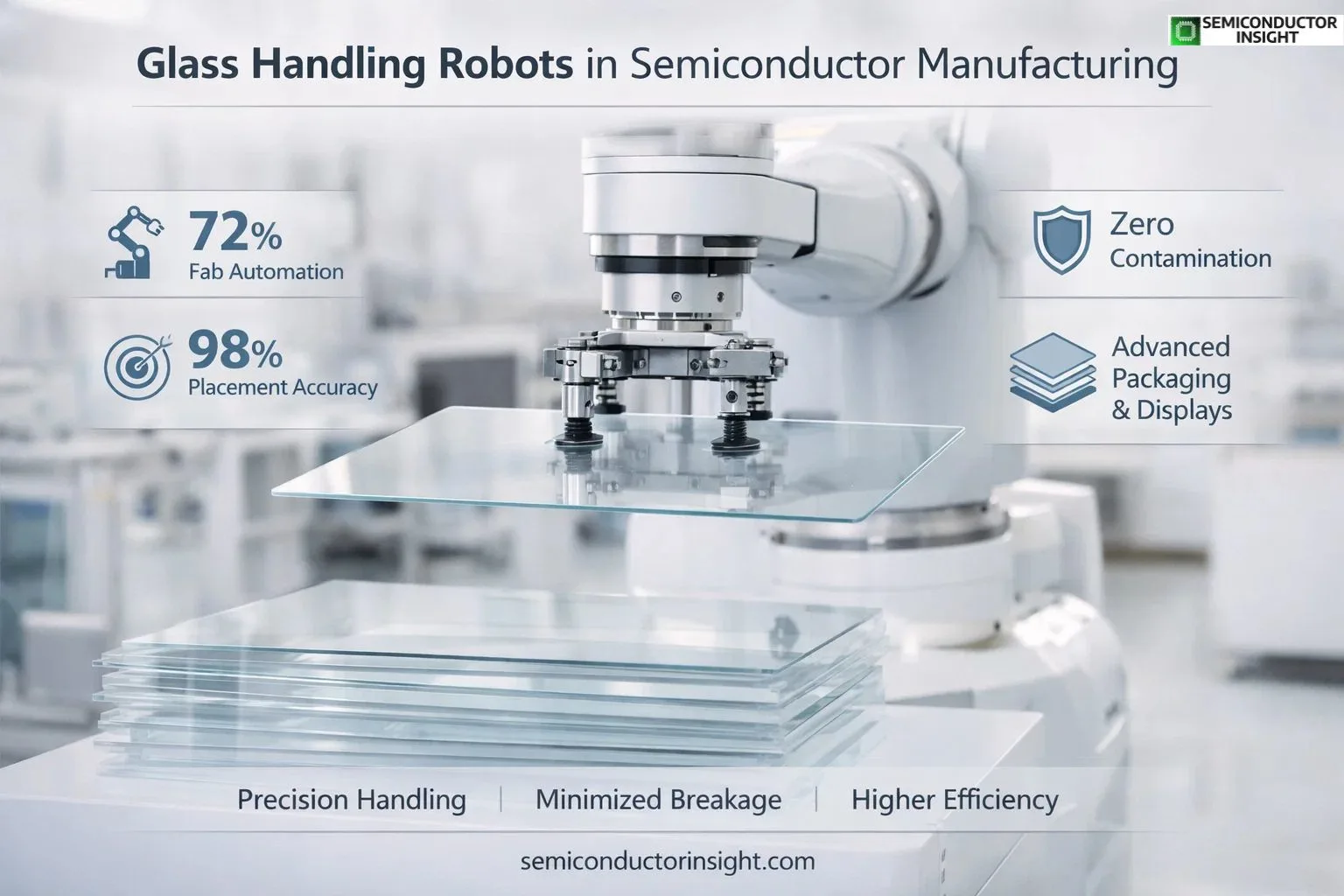
- Semiconductor fabs today are among the most automated manufacturing environments globally. More than 72% of advanced fabrication facilities rely on robotic systems for nearly 90% of wafer transfer operations, reflecting how deeply automation is embedded into production workflows.
- This level of automation directly influences the adoption of glass handling robots. As fabs move toward higher throughput and tighter tolerances, manual handling becomes impractical. Even a minimal breakage rate can result in thousands of lost units annually, pushing manufacturers toward robotic precision systems that significantly reduce handling errors.
- A practical example can be seen in next-generation fabs where multiple robotic systems operate in coordination handling wafers, glass substrates, and packaging materials simultaneously. This synchronized automation ensures not only efficiency but also uniformity in production quality.
Growing Industry Preference for Smart Handling Solutions
Current changes in how semiconductors are made show even further how automation is becoming more common. In 2026, a European semiconductor company started using more than 100 robots in its factories to do repetitive and physically demanding activities like moving wafers and materials.
These robots can do more than only handle glass, but this move is part of a larger trend in the business where fewer people are involved in handling materials. Because they are so fragile, glass substrates are some of the first things to gain from this change.
At the same time, research settings are also making progress in robotic handling. When working with translucent surfaces, experimental systems have shown placement accuracy of over 98%. This shows that precision robotics can do delicate tasks better than people.
Engineering Design That Supports Fragility
The design philosophy behind glass handling robots is centred on minimizing stress while maximizing control. Unlike traditional grippers, these robots often use vacuum-based or edge-grip systems that distribute force evenly across the surface. Advanced sensors detect micro-level variations in alignment, ensuring that even ultra-thin glass panels are handled without distortion.
Another important development is the integration of AI-driven vision systems. These systems allow robots to identify the exact position, thickness, and orientation of glass substrates in real time, reducing dependency on pre-programmed paths. This adaptability is especially valuable in semiconductor environments where product variations are frequent.
Expanding Role beyond Traditional Applications
- While initially associated with display manufacturing, glass handling robots are now extending their role into newer semiconductor domains such as advanced packaging and heterogeneous integration.
- These processes often involve combining multiple materials, including glass, to achieve higher performance and miniaturization.
- In solar and energy-related semiconductor applications, glass substrates are also gaining importance, further expanding the scope of these robotic systems.
- The ability to handle large-format, delicate materials efficiently is becoming a competitive advantage for manufacturers operating in these segments.
To get a detailed related report, reach out to us with our latest version: https://semiconductorinsight.com/report/robotics-market/
A Subtle yet Critical Layer of Semiconductor Automation
Glass handling robots may not always be the most visible component in semiconductor fabs, but their impact is deeply embedded in production efficiency and yield optimization. As fabrication processes continue to evolve toward higher precision and complexity, the reliance on such specialized robotic systems will only deepen.
Their role is no longer limited to handling materials it extends to enabling consistency, reducing waste, and supporting the next generation of semiconductor innovation through precision-driven automation.

Comments (0)