

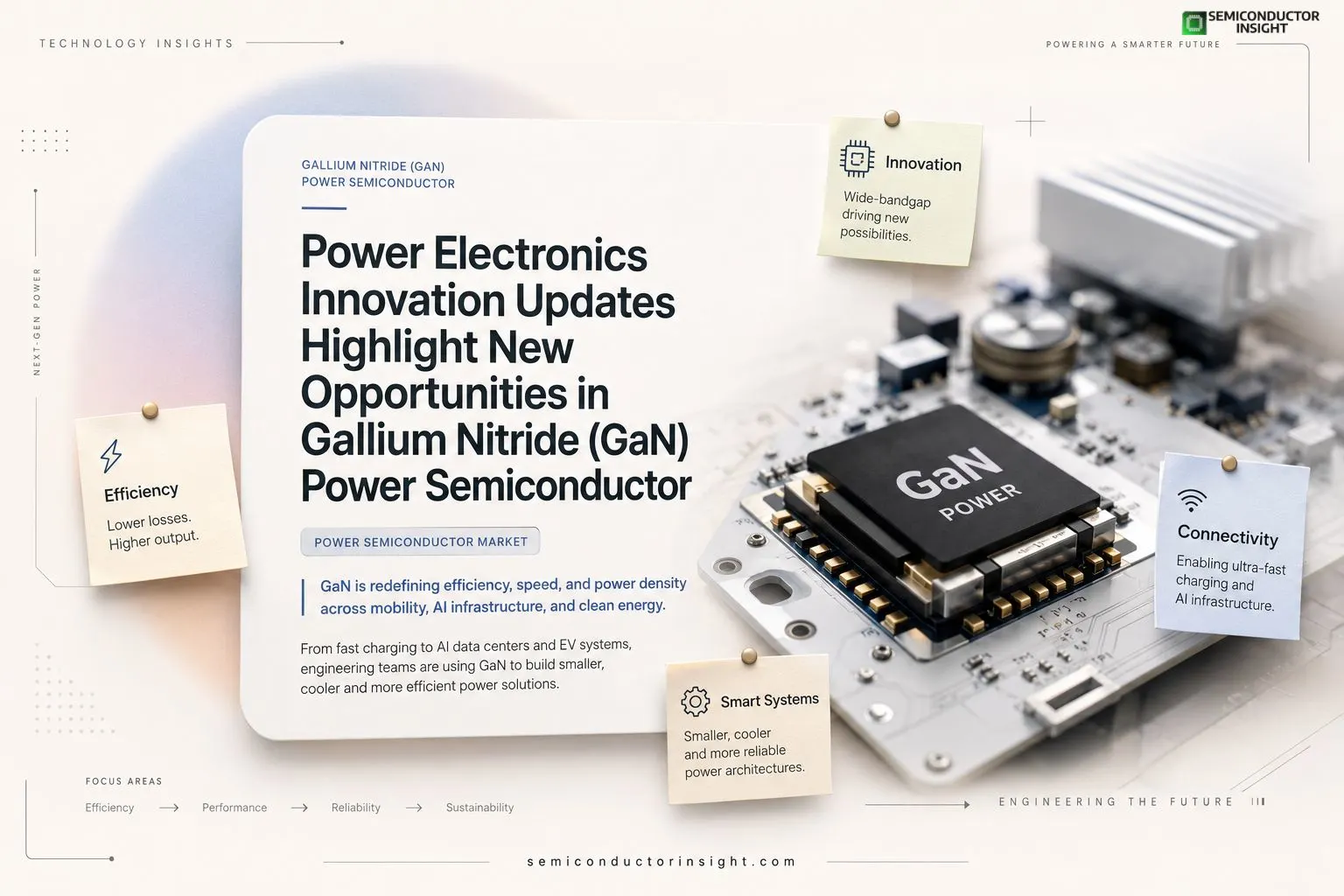
Power Electronics Innovation Updates Highlight New Opportunities in Gallium Nitride (GaN) Power Semiconductor
For decades, silicon remained the dominant material in power electronics. Today, Gallium Nitride (GaN) is redefining expectations for efficiency, switching speed, thermal performance, and power density. Gallium Nitride (GaN) Power Semiconductor Market is increasingly linked with electric mobility, AI infrastructure, renewable energy systems, industrial automation, and ultra-fast consumer charging technologies.
Unlike conventional silicon devices, GaN semiconductors operate at higher frequencies with lower energy losses, enabling engineers to build smaller, lighter, and more efficient power systems. This capability has placed GaN at the center of modern power conversion strategies.
The Data for Electronics with High Efficiency
Recent deployment trends highlight the growing relevance of GaN technology.
According to the International Energy Agency (IEA), global electric vehicle sales surpassed 17 million units in 2024, creating substantial demand for efficient onboard chargers and power conversion systems. Simultaneously, the rapid expansion of AI-focused data centers has intensified the need for energy-efficient power supplies capable of handling increasing computing loads.
The U.S. Department of Energy estimates that advanced wide-bandgap semiconductors such as GaN can significantly reduce power conversion losses in numerous applications, improving overall energy utilization across industrial and commercial systems.
Explore the full report details in our recently refreshed edition anytime: https://semiconductorinsight.com/report/gallium-nitride-gan-power-semiconductor-market/
Why Fast Charging Has Become a GaN Showcase?
One of the most visible examples of GaN adoption is the smartphone and laptop charging ecosystem.
Traditional silicon chargers often require larger components and generate more heat. GaN-based chargers can deliver 65W, 100W, and even 240W charging capabilities while maintaining compact form factors. Major consumer electronics manufacturers have expanded GaN charger portfolios to support USB-C Power Delivery standards across laptops, tablets, gaming devices, and smartphones.
The result is a shift from bulky power adapters toward pocket-sized charging solutions capable of powering multiple devices simultaneously.
AI Data Centers Are Creating New Design Priorities
- The rise of generative AI has increased power consumption requirements within hyperscale data centers.
- Modern AI clusters require high-performance power architectures capable of minimizing energy losses during conversion and distribution.
- GaN devices are increasingly being evaluated for server power supplies, voltage regulation modules, and high-frequency power conversion systems because they support higher switching frequencies and reduced cooling requirements.
- Industry reports from leading semiconductor engineering publications indicate that power efficiency improvements of even a few percentage points can translate into substantial electricity savings when applied across thousands of servers operating continuously.
The Quiet Revolution inside Electric Vehicles
Electric vehicles represent another important application area where GaN technology is gaining traction.
Automotive engineers are exploring GaN devices for onboard chargers, DC-DC converters, and auxiliary power systems. Higher switching frequencies enable reductions in passive component size, supporting lighter vehicle architectures.
Several automotive technology demonstrations have shown that GaN-based systems can achieve higher power density compared with conventional silicon solutions, allowing manufacturers to optimize available space while improving energy efficiency.
As EV charging networks continue expanding globally, efficient power conversion remains a key engineering objective.
Packaging Innovation Is Becoming a Competitive Engineering Focus
- Much of the current innovation within the sector extends beyond the semiconductor itself.
- Advanced packaging technologies such as chip-scale packaging, integrated power modules, and enhanced thermal management designs are helping unlock the full performance capabilities of GaN devices.
- Engineers are increasingly focused on reducing parasitic inductance, improving heat dissipation, and enhancing reliability under demanding operating conditions.
- These developments are particularly important in aerospace, industrial automation, telecommunications infrastructure, and renewable energy applications.
Manufacturing Capacity Expands Alongside National Semiconductor Strategies
Governments worldwide continue investing in semiconductor resilience and advanced manufacturing capabilities. Semiconductor initiatives in the United States, Europe, Japan, South Korea, India, and Taiwan have increased attention on next-generation materials that support energy efficiency and technology independence.
The broader semiconductor ecosystem is simultaneously investing in wafer production, fabrication capacity, and advanced power electronics research programs. These initiatives are creating new opportunities for GaN technologies across multiple industries.
Where the Engineering Conversation Is Heading Next
Gallium Nitride (GaN) Power Semiconductor Market is increasingly defined by practical performance outcomes rather than theoretical potential. From AI-ready data centers and electric vehicles to industrial automation systems and ultra-fast charging platforms, GaN technology is becoming a critical component of modern power electronics design.
As energy efficiency, miniaturization, and power density continue to shape technology roadmaps, GaN is transitioning from a specialized semiconductor material into a foundational building block of next-generation electronic infrastructure.

Comments (0)