
Power Electronics Evolution inside GaN Half Bridge ICs Market Transforming Next Gen Systems
GaN half bridge ICs market is steadily redefining how modern electronic systems handle power. Built on gallium nitride technology, these integrated circuits are enabling faster switching speeds, higher efficiency, and compact system designs that were difficult to achieve with traditional silicon-based solutions. As industries push for energy-efficient infrastructure and high-performance electronics, GaN-based half bridge ICs are becoming central to next-generation power conversion architectures.
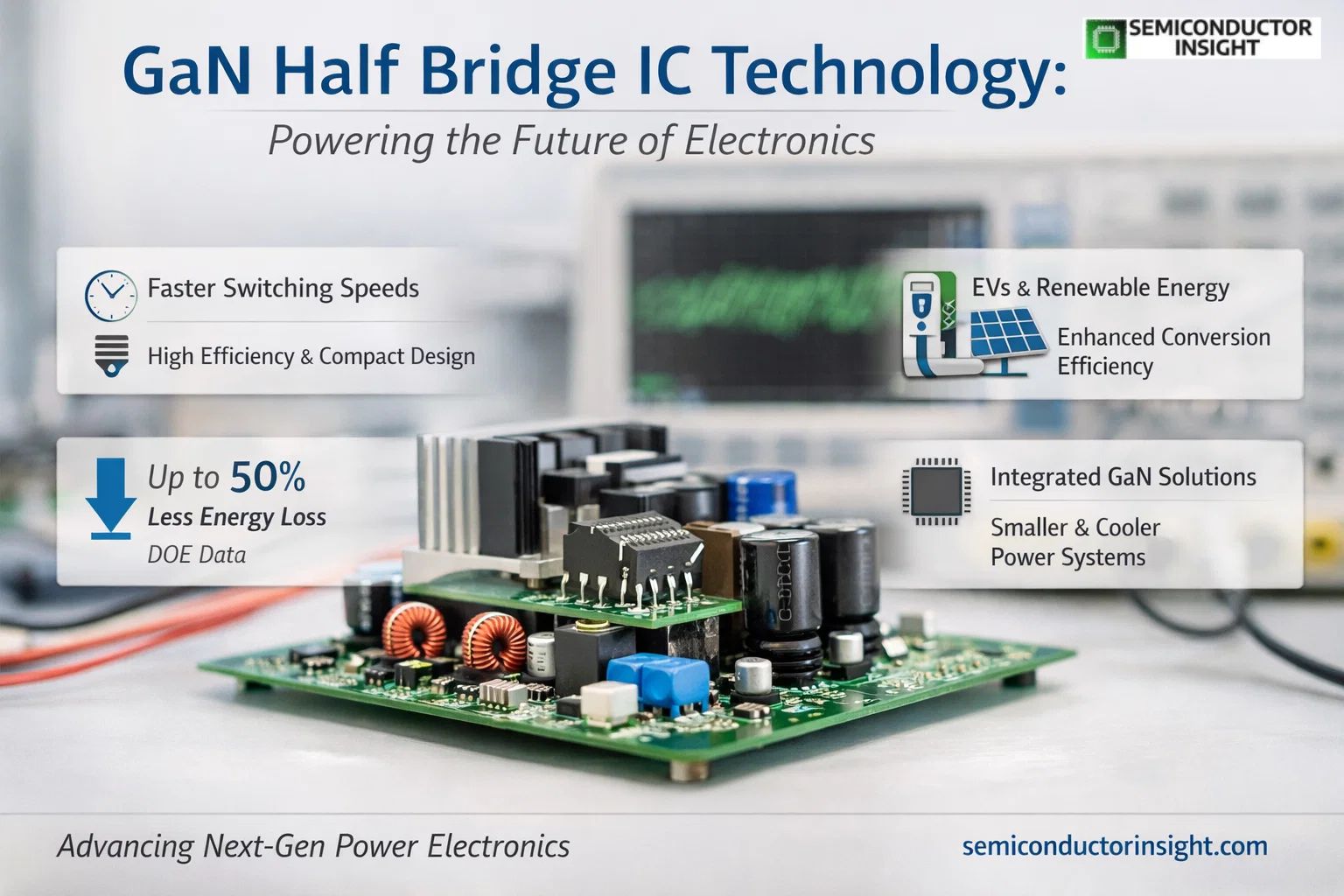
Gallium nitride, a wide bandgap semiconductor, allows devices to operate at higher voltages and temperatures. According to data from the United States Department of Energy, wide bandgap materials like GaN can reduce energy losses in power systems by up to 50% in certain applications, making them critical for improving overall energy efficiency in sectors such as data centers, electric vehicles, and renewable energy systems.
Why Engineers Are Replacing Silicon with GaN Architectures
- Design engineers are increasingly moving away from conventional silicon MOSFETs toward GaN-based half bridge ICs due to their superior electrical characteristics.
- GaN devices can switch at frequencies exceeding several megahertz, significantly reducing the size of passive components such as inductors and capacitors.
- In practical terms, this translates into smaller and lighter power systems.
- For example, leading laptop and smartphone charger manufacturers have already introduced GaN-based adapters that are nearly 40% smaller than their silicon counterparts while delivering the same power output.
- This shift is not just about miniaturization but also about thermal efficiency, as GaN devices generate less heat during operation.
Integration Trends Reshaping Circuit Design Approaches
The integration of half bridge configurations into single IC packages is simplifying circuit layouts and reducing external component requirements. Instead of using multiple discrete components, engineers can now rely on compact GaN ICs that combine high-side and low-side switches along with integrated drivers.
This level of integration is particularly valuable in high-density applications such as server power supplies and telecom infrastructure. Reports from data centre operators indicate that power supply units using GaN technology can achieve efficiency levels above 96%, helping reduce energy consumption and cooling requirements in large-scale facilities.
Real World Deployment across High Impact Industries
The influence of GaN half bridge ICs is clearly visible across several fast-evolving industries. In electric vehicles, these ICs are being used in on board chargers and DC to DC converters, improving energy conversion efficiency and extending driving range. Automotive engineering reports suggest that GaN-based power systems can reduce energy losses by several watts per vehicle, which becomes significant at scale.
In renewable energy systems, particularly solar inverters, GaN technology enables higher switching frequencies, allowing for more efficient energy conversion from solar panels to the grid. Government-backed renewable energy programs across countries like India and the United States are increasingly supporting the adoption of advanced semiconductor technologies to improve grid efficiency.
Visit the link below to view the comprehensive report: https://semiconductorinsight.com/report/gan-half-bridge-ics-market/
Manufacturing Advancements Supporting Wider Adoption
- One of the earlier concerns around GaN technology was manufacturing complexity and cost. However, advancements in fabrication processes are addressing these issues.
- GaN devices are now being produced on silicon substrates, which allows manufacturers to leverage existing semiconductor fabrication infrastructure.
- Industry publications and semiconductor company reports indicate that GaN-on-silicon technology is improving yield rates and reducing production costs, making these ICs more accessible for mass-market applications.
- As fabrication techniques mature, the gap between GaN and silicon in terms of cost continues to narrow.
Thermal Performance and Reliability under Real Conditions
Thermal management has always been a critical factor in power electronics, and GaN half bridge ICs offer a distinct advantage in this area. Their ability to operate at higher temperatures without significant performance degradation reduces the need for bulky cooling systems.
Testing data from engineering labs and product validation reports show that GaN devices can operate efficiently at junction temperatures exceeding 150 degrees Celsius. This makes them suitable for demanding environments such as industrial automation systems and high-performance computing infrastructure.
Government Policies and Energy Efficiency Goals Influencing Adoption
Governments and regulatory bodies are playing an important role in promoting energy-efficient technologies. Policies aimed at reducing carbon emissions and improving energy utilization are indirectly supporting the adoption of GaN-based power solutions.
Energy efficiency standards for external power supplies in regions such as North America and Europe are becoming more stringent, encouraging manufacturers to adopt technologies that can meet these requirements. GaN half bridge ICs, with their high efficiency and compact design, are well positioned to align with these regulatory goals.
Expanding Design Ecosystem and Industry Collaboration
- The ecosystem around GaN technology is rapidly expanding, with semiconductor companies, research institutions, and system integrators collaborating to accelerate innovation.
- Development kits, reference designs, and simulation tools are making it easier for engineers to integrate GaN ICs into their products.
- Academic research and industry collaborations are also contributing to the advancement of GaN technology.
- Universities and government-funded research programs are exploring new device structures and materials to further enhance performance and reliability.
This growing ecosystem is not only simplifying adoption but also opening new possibilities for innovation in power electronics, making GaN half bridge ICs a cornerstone of modern semiconductor design.

Comments (0)