
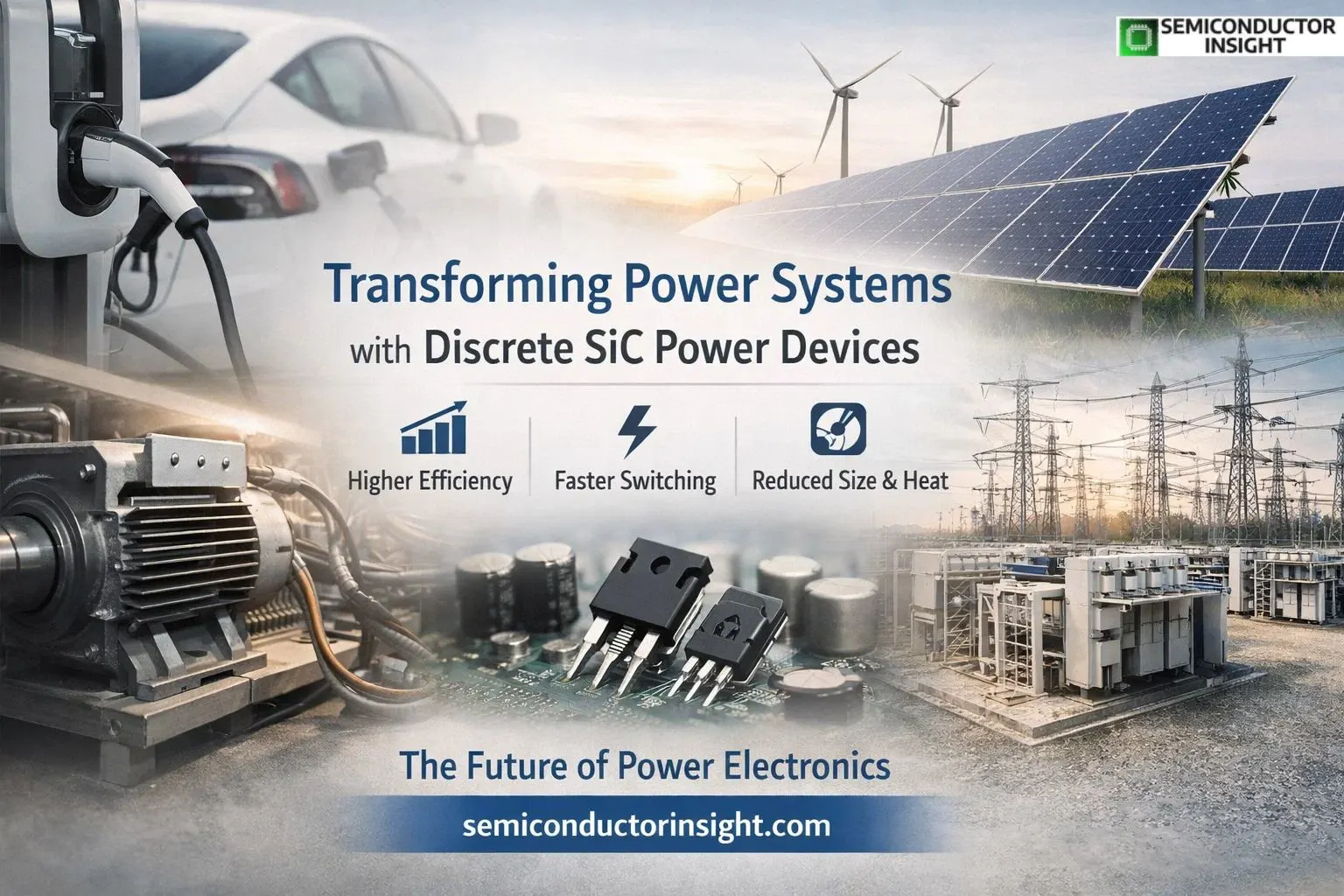
Why Discrete SiC Power Devices Market Is Transforming Power Systems?
Power electronics is entering a new phase where efficiency and size are no longer trade-offs. At the center of this shift lies Silicon Carbide (SiC), enabling devices that operate faster, cooler, and under higher voltages compared to traditional silicon.
Discrete SiC power devices primarily MOSFETs and diodes are increasingly becoming the backbone of modern power architectures. These components are not just replacing silicon; they are redefining system design by reducing energy losses and improving switching performance across industries.
What makes this transition significant is scale. Discrete devices alone contribute nearly 58% of the total SiC semiconductor device landscape, highlighting their dominance in real-world applications.
Where Performance Meets Practical Deployment?
Discrete SiC devices enjoy greater popularity than integrated modules due to their superior flexibility and ability to enhance performance in targeted applications. They dominate in lower to mid-power systems where precision and efficiency are paramount.
For example, nearly 49% of discrete MOSFET demand centers on power supplies under 50 kW, underscoring their vital role in compact, distributed setups like onboard EV chargers, industrial motor drives, solar inverter circuits, and telecom power units. This trend extends beyond theory into practical deployment, with industrial upgrades driving approximately 28% growth in motor control modernization powered by SiC-based solutions.
Electrification Is Rewriting Demand Patterns
The strongest push for discrete SiC devices is coming from electrification. Electric mobility, renewable energy, and high-efficiency grids are creating a demand environment where performance margins matter.
Today, about 60% of total SiC demand originates from the automotive sector, making it the single largest application area.
Even more striking:
- Around 90% of leading EV manufacturers have committed to SiC-based systems
- Over 60% of EV models in production already integrate SiC into drivetrains
- SiC-based inverters deliver ~5% higher efficiency than conventional solutions
This is not just about efficiency it directly translates into longer driving range, reduced cooling requirements, and lighter system designs.
Take a Quick Glance at Our In-Depth Analysis Report: https://semiconductorinsight.com/report/discrete-sic-power-devices-market/
Efficiency Gains That Redefine System Design
The transition to SiC is fundamentally driven by measurable performance advantages. These gains are not incremental they reshape how systems are engineered.
Discrete SiC devices enable:
- Up to 34% improvement in power density
- Around 23% better thermal performance
- Nearly 21% reduction in system size
In renewable energy, these improvements are equally impactful. Solar inverters using SiC technology can reduce lifecycle energy losses by nearly 20%, making them a preferred choice for large-scale installations.
In telecom, the benefits extend to thermal management, where SiC adoption reduces heat dissipation requirements by approximately 40%, enabling more compact base station designs.
Real-World Innovation Taking Shape
The momentum around discrete SiC power devices is also visible in ongoing technological advancements. Manufacturers are focusing on improving voltage classes, switching speeds, and packaging efficiency.
Recent developments show:
- Around 31% of newly launched power devices now use SiC as the base material
- About 27% increase in advanced MOSFET designs focused on higher voltage ranges
- Nearly 25% rise in custom device configurations tailored for specific applications
Additionally, the industry is moving toward larger wafer production, with a 33% shift toward 200mm wafers, improving scalability and reducing manufacturing complexity.
Strategic Growth into Critical Infrastructure beyond EV Ecosystems
While electric vehicles dominate headlines, discrete SiC devices are quietly expanding into other critical sectors.
In rail systems, SiC-based traction technology has improved energy efficiency by around 10%, supporting sustainable transportation initiatives.
In power grids, adoption in smart converters has grown steadily, with over 24% of grid systems integrating SiC modules for better load handling and reduced losses.
Even aerospace and defense applications are increasing their reliance on SiC due to its ability to operate at temperatures up to 200°C, far exceeding traditional semiconductor limits.
A Material Driving a System-Level Shift
What makes power efficiency and high-voltage performance central to this evolution is not just the device itself, but its cascading impact on entire systems. This combination is what positions electric vehicles and renewable infrastructure as the biggest beneficiaries of this transition.
Discrete SiC devices reduce:
- Cooling system complexity
- Component count
- Overall system footprint
At the same time, they enable:
- Faster switching speeds
- Higher frequency operations
- Improved reliability over longer lifecycles
The Momentum Behind Discrete SiC Adoption
The growth of discrete SiC power devices is not a short-term trend it reflects a deeper transformation in how energy is generated, converted, and consumed.
With increasing demand for compact, efficient, and high-performance electronics, these devices are becoming foundational to next-generation systems.
As industries push toward electrification and sustainability, discrete SiC technology is no longer optional it is rapidly becoming the standard for advanced power electronics.

Comments (0)