

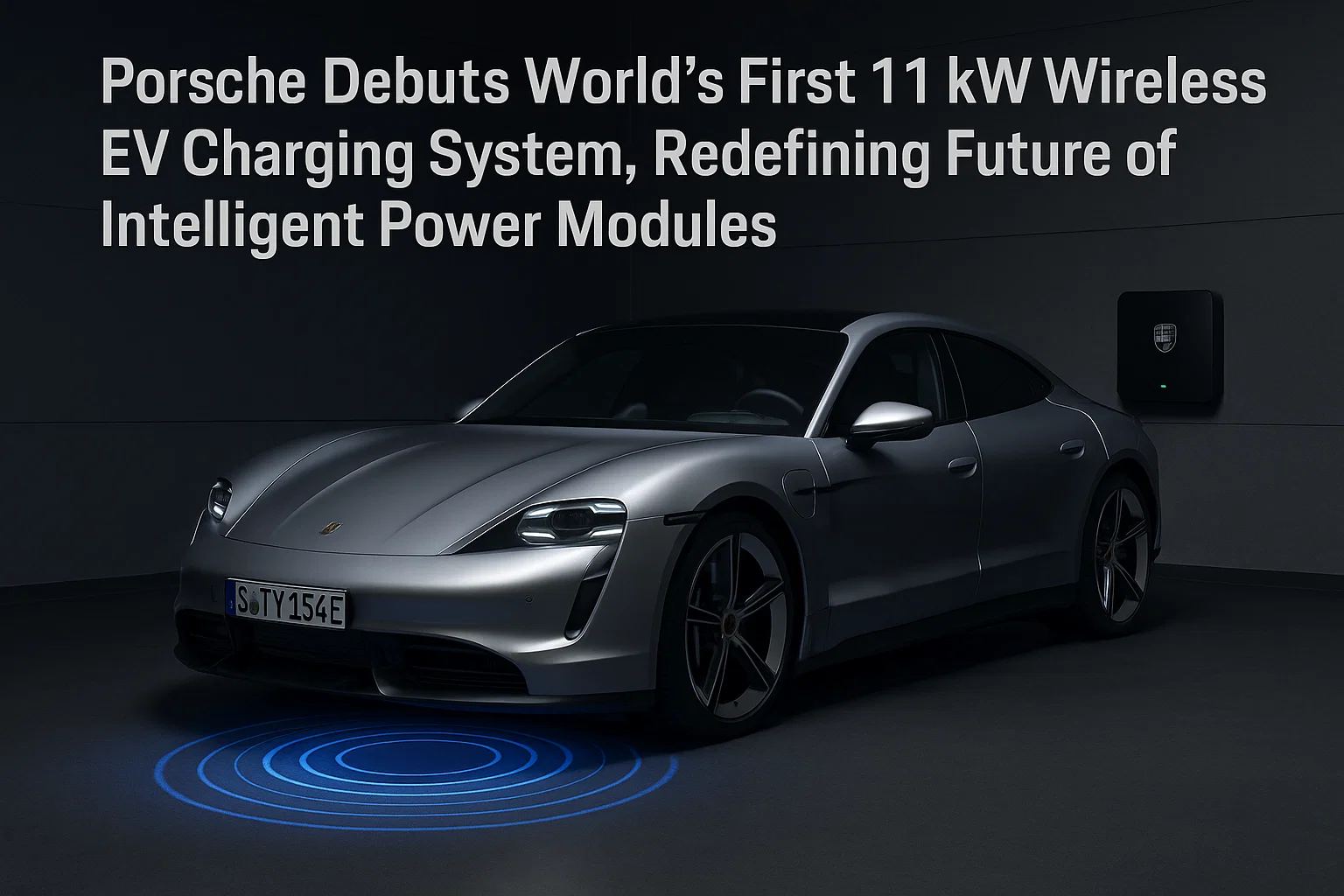
Porsche Debuts World’s First 11 kW Wireless EV Charging System, Redefining Future of Intelligent Power Modules
The Electric Vehicle (EV) Intelligent Power Module (IPM) market is undergoing a rapid transformation, driven by the global push toward clean transportation, advancements in semiconductor technologies, and a surge in EV adoption worldwide. Valued at USD 1,527 million in 2024, the market is projected to reach USD 3,096 million by 2032, growing at a CAGR of 10.7% during the forecast period.
Recent developments, such as wireless charging solutions, high-voltage architectures, and AI-integrated powertrains, are redefining how IPMs are designed and deployed in EVs. These innovations are not only improving energy efficiency but also reducing system complexity, enhancing performance, and paving the way for next-generation electric mobility.
Access Your Free Sample Report- EV Intelligent Power Module Market
Understanding EV Intelligent Power Modules
An Intelligent Power Module (IPM) is an advanced electronic component that integrates power devices like Insulated Gate Bipolar Transistors (IGBTs) or Silicon Carbide (SiC) MOSFETs, along with protection circuits and control systems, into a single compact package. In EVs, IPMs are essential for:
- Traction inverters – controlling the motor drive efficiently.
- Battery management systems (BMS) – optimizing battery performance and safety.
- On-board chargers – ensuring fast and safe charging.
- DC-DC converters – maintaining proper voltage levels between subsystems.
By integrating these functions, IPMs reduce energy losses, minimize heat generation, and simplify design architecture, making EV powertrains more compact, efficient, and cost-effective.
Recent Industry Developments Driving Growth
-
Porsche Introduces Wireless 11 kW Charging – A Game-Changer for EVs
Porsche recently announced a breakthrough in wireless inductive charging technology for its upcoming 2026 Cayenne Electric model. The 11 kW charging system eliminates the need for physical cables, offering seamless charging through a smart alignment system using ultra-wideband (UWB) technology.
- How It Works: The car automatically aligns itself over a charging pad using UWB sensors. Once parked correctly, power is transferred wirelessly to the vehicle’s battery.
- Connectivity Features: Equipped with LTE and WLAN connectivity for over-the-air (OTA) updates, ensuring continuous performance improvements.
- Advantages for IPM Systems:
- Reduces wear on physical charging ports.
- Simplifies the vehicle’s charging architecture.
- Integrates directly with high-efficiency IPMs to optimize power transfer.
This development positions Porsche ahead of competitors like Tesla, setting a new benchmark for future EV charging ecosystems.
-
BMW’s Neue Klasse Platform: 800V Architecture with “Superbrain” Computing
BMW unveiled its Neue Klasse iX3, featuring 800-volt electrical architecture designed to revolutionize EV performance:
- Ultra-fast Charging: Capable of delivering 400 kW charging power, enabling 230 miles of range in just 10 minutes.
- “Heart of Joy” Centralized Computing: A revolutionary control system that integrates multiple computing functions into a single unit, reducing hardware redundancy and improving real-time decision-making.
- Impact on IPMs:
- High-voltage systems require next-generation IPMs capable of handling higher currents with minimal losses.
- Integration with centralized computing improves predictive energy management, boosting efficiency and extending battery life.
BMW’s platform demonstrates the growing demand for SiC and GaN-based IPMs, which are ideal for high-power applications.
-
onsemi Launches EliteSiC SPM 31 – 1200V Silicon Carbide IPM
Semiconductor giant onsemi has introduced the EliteSiC SPM 31, a 1200V silicon carbide-based IPM designed specifically for electric vehicles.
- Key Features:
- Superior power density and compact design.
- Reduced switching losses compared to traditional IGBT modules.
- Enhanced thermal performance for demanding EV environments.
- Benefits for Automakers:
- Simplifies system design, leading to faster development cycles.
- Lowers total system costs while meeting stringent efficiency regulations.
- Ideal for traction inverters and on-board chargers.
With SiC adoption accelerating, onsemi’s product positions itself as a critical enabler for next-gen EVs.
-
Infineon Advances GaN-Based IPM Technology
Infineon Technologies, a leader in power electronics, has made significant strides in Gallium Nitride (GaN) IPM technology:
- EasyPACK CoolGaN 650 V modules introduced in May 2025 deliver up to 70 kW per phase, ideal for EV chargers and industrial applications.
- GaN offers faster switching speeds, higher efficiency, and smaller footprint compared to silicon or even SiC.
- Enables automakers to reduce vehicle weight and boost driving range, two critical factors in EV adoption.
Infineon’s innovations underscore the shift toward wide-bandgap materials as the foundation for next-generation IPMs.
Download Sample Report PDF- EV Intelligent Power Module Market
- Pulsetrain’s AI-Driven Integrated Powertrain
German startup Pulsetrain GmbH has secured €6.1 million in funding to commercialize its groundbreaking integrated powertrain system:
- Combines the inverter, on-board charger, and battery management system into a single compact module.
- Uses AI algorithms to optimize energy flow, improving battery life by up to 80%.
- Significantly reduces system complexity, weight, and cost.
This disruptive approach could reshape EV manufacturing, allowing smaller and mid-sized automakers to compete with industry giants by simplifying the supply chain and reducing integration challenges.
Market Dynamics: Key Growth Drivers
-
Rapid EV Adoption Worldwide
Global EV sales surpassed 14 million units in 2024, and projections suggest over 30 million annual sales by 2032.
- Governments are pushing zero-emission policies with strict timelines for ICE vehicle phase-outs.
- Subsidies and incentives in regions like Europe, China, and the U.S. are accelerating consumer adoption.
- Growing EV fleets create an exponential demand for high-performance IPMs.
-
Shift to High-Voltage 800V Architectures
Traditionally, EVs used 400V systems, but automakers are now transitioning to 800V platforms to support:
- Ultra-fast charging (under 15 minutes).
- Improved efficiency, with reduced current and heat losses.
- Smaller, lighter cabling for better vehicle dynamics.
This shift directly increases demand for advanced SiC and GaN IPMs.
-
Advances in Wide-Bandgap Semiconductors
- Silicon Carbide (SiC) and Gallium Nitride (GaN) are replacing silicon in many applications.
- Benefits include:
- Lower energy losses.
- Higher operating temperatures.
- Smaller form factor.
Companies like onsemi, Infineon, and Wolfspeed are heavily investing in these materials, driving innovation in IPM technology.
-
Demand for Cost Reduction & Simplification
Automakers are under pressure to reduce production costs while improving performance. Integrated solutions, such as Pulsetrain’s AI-driven module, address this challenge by:
- Simplifying supply chains.
- Reducing assembly time.
- Enabling scalable, modular designs.
Challenges Facing the EV IPM Market
Despite its rapid growth, the EV IPM industry faces several hurdles:
| Challenge | Impact |
| High cost of SiC/GaN materials | Slows mass adoption among budget EV models. |
| Supply chain disruptions | Dependence on rare materials creates vulnerability. |
| Thermal management complexities | Higher power densities demand advanced cooling solutions. |
| Standardization gaps | Lack of universal design standards complicates cross-manufacturer integration. |
Addressing these issues will be crucial to sustaining long-term growth.
Regional Insights
- Asia-Pacific: The Epicenter of Growth
- China leads the global EV market with over 50% of total sales.
- Local players like BYD, NIO, and Geely are adopting SiC-based IPMs to enhance competitiveness.
- Japan and South Korea, home to Toyota, Hyundai, and LG, are heavily investing in R&D for next-gen modules.
- Europe: Focus on Premium EV Performance
- German automakers like BMW, Porsche, and Mercedes-Benz are pioneering 800V platforms.
- EU’s strict emission regulations drive demand for high-efficiency IPMs.
- North America: Rising Investments in EV Infrastructure
- U.S. companies such as Tesla and Rivian are pushing for domestic IPM manufacturing.
- Federal incentives support semiconductor fabrication plants, like those by onsemi and Wolfspeed.
Technological Trends to Watch
- AI-Enhanced Predictive Power Management
- AI algorithms will enable real-time optimization of energy distribution, reducing waste and extending battery life.
- Integration of IPMs with Wireless Charging Systems
- As seen with Porsche, IPMs will play a vital role in ensuring efficient, loss-free power transfer.
- Ultra-Compact Modular Designs
- Future IPMs will integrate multiple functions (charger, inverter, BMS) into a single module for simplified vehicle architectures.
- Next-Gen Cooling Solutions
- Innovations like liquid immersion cooling will address the heat challenges of high-density IPMs.
Competitive Landscape
The EV IPM market is highly competitive, with leading players investing heavily in R&D:
| Company | Key Focus Areas |
| onsemi | SiC-based IPMs, advanced traction inverters. |
| Infineon Technologies | GaN IPMs, EasyPACK modular solutions. |
| Mitsubishi Electric | Integrated power solutions for global automakers. |
| Wolfspeed | Expansion of SiC wafer production for EV applications. |
| Alpha and Omega Semiconductor | Mid-range IPMs for household and commercial EVs. |
These companies are forming strategic partnerships with automakers, ensuring a steady pipeline of innovations and product launches.
Click Here To Download Full Sample Report- EV Intelligent Power Module Market
Future Outlook
By 2032, the EV IPM market will be transformed by:
- Mainstream adoption of SiC and GaN technologies, making EVs more efficient and affordable.
- Integration with AI-driven systems, enabling self-optimizing powertrains.
- Growth of wireless charging ecosystems, reducing dependence on physical connectors.
- Increased localization of semiconductor manufacturing to mitigate supply chain risks.
The EV Intelligent Power Module market is at the forefront of the global transition to sustainable transportation. With its value projected to nearly double from USD 1.53 billion in 2024 to USD 3.10 billion by 2032, the sector offers immense opportunities for innovation and growth.

Comments (0)