
Plug-in Touch Switch Market Trends Shaping Smart Homes and Industrial Controls
The transformation from traditional switches to plug-in touch switches marks a subtle yet powerful shift in how users interact with electrical systems. Built on semiconductor-based sensing technologies, these switches rely on capacitive touch ICs and microcontrollers rather than mechanical contacts.
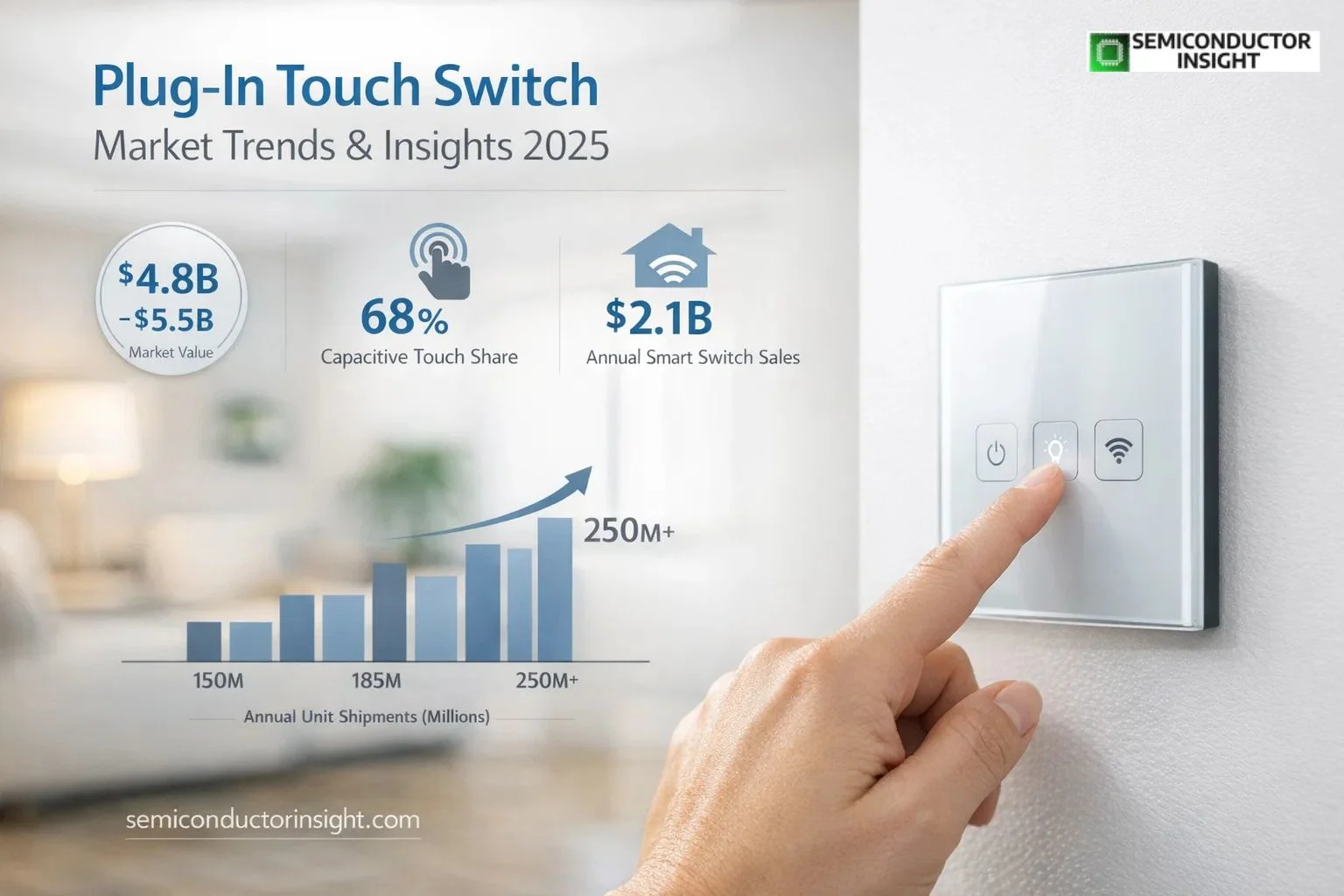
In 2025, global shipments of touch-enabled switch modules exceeded 185 million units, with adoption expanding across residential automation, hospitality infrastructure, and consumer electronics. The appeal lies in sleek design, durability (no moving parts), and seamless integration with smart systems.
Market Footprint with Real Industry Numbers
- The plug-in touch switch industry is currently worth between $4.8 billion and $5.5 billion. Demand is continuously rising as more smart homes and business automation projects are built.
- More than 68% of all installations are capacitive touch switches
- Smart-enabled plug-in versions bring in around $2.1 billion a year in sales.
- The average price per unit is between $8 for basic modules to $60 or more for multi-functional smart panels.
- The company makes more than 150 million units a year, mostly in East Asia.
- The semiconductor content of each switch, which is mostly touch sensor ICs, signal processors, and low-power controllers, makes up 20 -30% of the entire product cost. This shows how important chip-level innovation is.
You can review our most recent insights here: https://semiconductorinsight.com/report/plug-in-touch-switch-market/
Core Technologies Driving Smart Touch Solutions
At the core of plug-in touch switches lies a compact semiconductor architecture that enables high sensitivity and reliability.
- Capacitive sensing ICs detect minute changes in electrical charge as low as 0.1 pF variations
- Response times have improved to under 50 milliseconds, ensuring instant feedback
- Power consumption in standby mode is reduced to below 0.5W, supporting energy-efficient buildings
- Integration with Wi-Fi/Bluetooth modules allows control across up to 10-15 connected devices per node
Advanced designs also incorporate EMI shielding and moisture resistance, ensuring stable performance even in humid or industrial environments.
Smart Infrastructure Application Performance Overview
Plug-in touch switches are swiftly emerging as the go-to choice across diverse settings. In smart homes, they featured in over 42% of new installations during 2024. Hospitality projects like hotels and serviced apartments drive nearly 28 million units annually, fueled by demands for aesthetics and durability.
Commercial offices increasingly adopt them for streamlined lighting and HVAC controls. A Southeast Asian smart building case study revealed 35% lower maintenance costs after switching from mechanical to touch-based systems, thanks to the absence of wear-prone parts.
Design Evolution: Minimalism Meets Functionality
Modern plug-in touch switches are not just functional they are design-centric products.
Manufacturers are focusing on:
- Glass and polycarbonate surfaces with scratch resistance up to 6H hardness levels
- LED backlighting with customizable brightness and color indicators
- Ultra-slim profiles (as thin as 8-12 mm) for seamless wall integration
The shift toward modular plug-in formats also allows easier installation without complex rewiring, making them highly attractive for retrofit projects.
Demand Outlook Anchored in Semiconductor Advancements
The growth of the plug-in touch switch market is closely aligned with advancements in semiconductor components. As touch controller ICs become more compact and cost-efficient, manufacturers are able to integrate more features without significantly increasing product prices.
The expansion of IoT-enabled infrastructure, coupled with rising electricity optimization standards, is expected to push annual demand beyond 250 million units by 2028. Additionally, increasing adoption in emerging markets where smart home penetration is still below 25% signals strong untapped potential.
Plug-in touch switches are no longer niche upgrades; they are becoming standard interfaces in digitally connected environments, driven by the precision and scalability of semiconductor technologies.

Comments (0)