
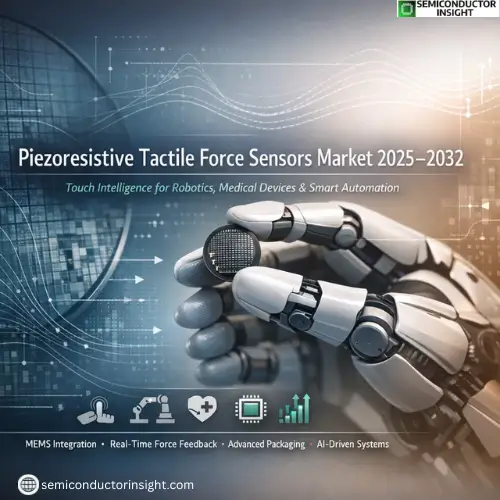
Piezoresistive Tactile Force Sensors Market Trends Rise with MEMS Innovation and Next-Gen Tactile Electronics
In the semiconductor world, sensing is no longer limited to light, temperature, or motion. A new frontier is touch itself. Piezoresistive tactile force sensors are enabling devices and machines to detect pressure, grip strength, surface contact, and subtle mechanical forces with high accuracy.
These sensors operate by converting applied force into a resistance change within a semiconductor-based material structure. That simple principle is now powering advanced applications in robotics, prosthetics, industrial automation, consumer electronics, and medical devices.
As industries move toward smarter machines and more responsive human–machine interfaces, the Piezoresistive Tactile Force Sensors Market is emerging as a critical segment of the broader sensor and MEMS ecosystem.
Core Semiconductor Mechanism behind Piezoresistive Touch Sensing
From a semiconductor engineering perspective, piezoresistive tactile sensors rely on the piezoresistive effect, where mechanical strain alters the electrical resistance of doped silicon or similar materials.
Piezoresistive sensors react to mechanical deformation immediately, in contrast to capacitive sensors, which gauge variations in electric fields. This makes them highly valuable in environments requiring:
- Precise force quantification
- Compact integration into MEMS architectures
- Stable output under continuous contact conditions
Because these sensors are often fabricated using established semiconductor processes, they align well with scalable manufacturing and chip-level integration.
Why Tactile Force Sensing Is Becoming a Strategic Electronics Priority?
Touch sensing is rapidly moving from a nice-to-have feature into a competitive requirement. Robotics systems, for example, can no longer rely only on vision. They must physically interact with objects safely and intelligently.
Similarly, surgical tools, rehabilitation devices, and wearable electronics are expected to provide feedback that feels natural and responsive.
This is where piezoresistive tactile force sensors stand out: they offer high sensitivity, fast response, and compatibility with miniaturized semiconductor packaging.
The market is gaining traction because electronics are being asked to do more than detect they must interpret force in real time.
You Can Freely Surf Our Latest Updated Report Here:
https://semiconductorinsight.com/report/piezoresistive-tactile-force-sensors-market/
Integration Trends across MEMS and Advanced Packaging
One of the strongest market drivers is the ability to integrate tactile sensors into MEMS-based platforms. Semiconductor manufacturers are increasingly embedding force sensing elements into:
- Flexible sensor arrays
- Micro-structured silicon diaphragms
- Multi-axis pressure mapping systems
- System-in-package (SiP) modules
Advanced packaging has become just as important as the sensing element itself. Modern applications demand ultra-thin, durable sensors that can survive repeated stress cycles without signal drift.
As a result, the market is seeing deeper collaboration between MEMS foundries, packaging specialists, and device OEMs.
High-Growth Application Zones Shaping Market Demand
The expansion of the piezoresistive tactile force sensors market is closely linked to high-growth technology sectors.
Robotics is one of the most influential. Collaborative robots require tactile feedback to safely operate alongside humans. Without force sensing, robotic grip remains inefficient and potentially unsafe.
Medical technology is another major demand engine. Prosthetics and rehabilitation devices increasingly depend on tactile sensors to replicate natural movement and pressure response.
Consumer electronics is also evolving. Haptic-enabled interfaces, pressure-sensitive wearable, and smart touch surfaces are pushing sensor manufacturers to deliver thinner, more responsive force-sensing solutions.
Key demand segments include:
- Industrial robotic grippers
- Smart prosthetics and assistive devices
- Automotive touch and safety controls
- Precision manufacturing tools
- Wearable health monitoring systems
Manufacturing Economics and Semiconductor Supply Chain Positioning
Unlike commodity sensors, tactile force sensors often require application-specific calibration and performance tuning. This creates a market where technical customization matters as much as volume.
Suppliers are investing in:
- Wafer-level MEMS scalability
- High-yield microfabrication techniques
- Cost-efficient sensor array production
- Long-cycle durability testing
Because these sensors are closely tied to semiconductor fabrication ecosystems, regions with strong MEMS infrastructure such as parts of Asia-Pacific, Europe, and the US are becoming strategic production hubs.
Performance Benchmarks Buyers Are Prioritizing
For OEMs and system designers, the purchasing decision is shaped by performance reliability, not just price.
Important evaluation metrics include:
- Sensitivity across force ranges
- Long-term stability under repeated loading
- Temperature compensation behavior
- Signal-to-noise ratio in compact electronics
- Compatibility with AI-based control systems
The market is increasingly moving toward sensors that can deliver consistent force mapping even in complex mechanical environments.
Competitive Strategies among Key Industry Players
Leading sensor and semiconductor companies in this space are focusing on differentiation through integration and application depth rather than generic product catalogs.
Common strategies include:
- Developing multi-axis tactile arrays for robotics
- Partnering with AI hardware firms for smart feedback systems
- Offering customized sensor geometries for medical OEMs
- Investing in flexible substrate tactile electronics
- Expanding MEMS foundry capacity for high-volume programs
Major players typically operate across MEMS sensing, semiconductor packaging, and industrial automation supply chains.
Important Lessons for Customers and Industry Purchasers
- Piezoresistive tactile sensors are becoming essential for robotics, medical devices, and smart automation.
- Semiconductor-based fabrication enables scalable MEMS integration and miniaturization.
- Market growth is driven by real-time force feedback needs in AI-powered systems.
- Future competition will focus on durability, packaging, and multi-axis sensing intelligence.
Recent Market Situations and Industry Direction
Current industry momentum is being shaped by the rise of AI-enabled robotics, reshoring of advanced manufacturing, and the rapid development of human-interactive machines.
Tactile sensing is now viewed as a missing layer in automation intelligence. Vision systems can identify objects, but tactile sensors determine how to hold, adjust, and safely interact.
At the same time, healthcare systems are investing more heavily in assistive technologies, further strengthening long-term demand for force-sensitive semiconductor components.

Comments (0)