
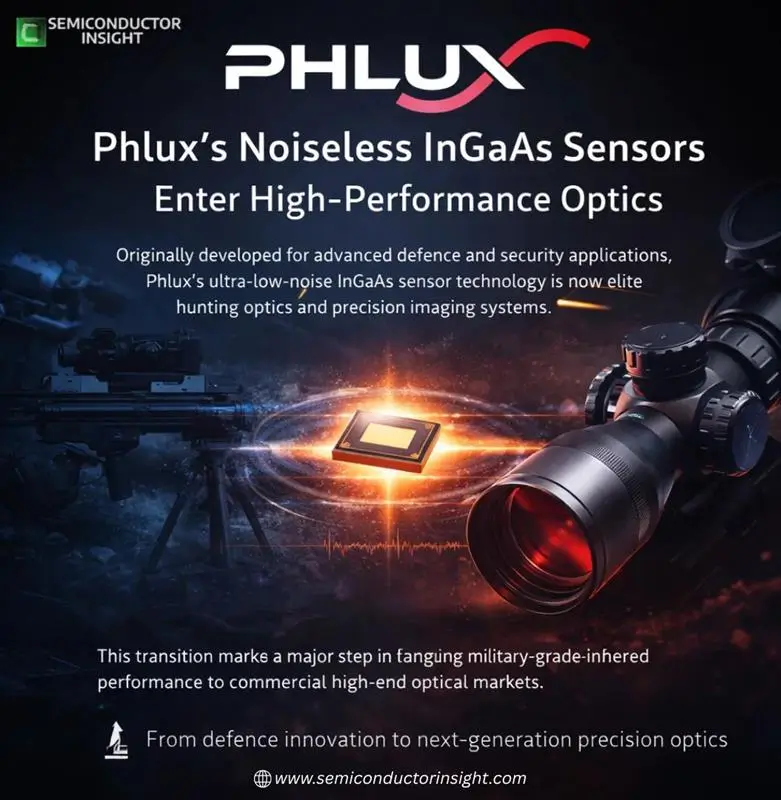
Phlux’s Noiseless InGaAs Sensors Gain Momentum in Premium Hunting and Precision Shooting Optics
Phlux Technology, a spin-out from the University of Sheffield, is expanding the reach of its Noiseless InGaAs infrared sensor technology into the global hunting and professional shooting optics market. Known for its performance in defense, telecommunications, and industrial applications, the company’s 1550nm avalanche photodiode (APD) sensors are now being evaluated by manufacturers of high-end laser rangefinders, ballistic scopes, and low-light targeting systems.
Phlux’s patented InGaAs APD technology is designed to detect extremely weak infrared signals at around 1550nm, delivering an order-of-magnitude improvement in sensitivity compared with conventional near-infrared detectors. This capability, previously relied upon in military laser rangefinders and fiber-optic network monitoring equipment, is now attracting attention from optics makers seeking longer range, higher accuracy, and greater reliability in real-world field conditions.
Why 1550nm Matters in Modern Optics?
The shift toward 1550nm infrared operation is reshaping advanced hunting and shooting systems. Unlike traditional 905nm devices, 1550nm wavelengths are considered eye-safe at higher power levels, enabling stronger signal returns without compromising safety or regulatory compliance.
Phlux’s Noiseless InGaAs sensors are optimized specifically for this wavelength, allowing manufacturers to:
- Extend effective ranging distances without increasing laser power
- Preserve performance while reducing system size and power consumption
- Achieve more consistent ranging in fog, drizzle, heat shimmer, and low-contrast terrain
- Improve detection of difficult targets such as dark coats, brush-covered animals, and complex backgrounds
Designed for Demanding Field Conditions
Professional hunters, long-range shooters, and pest-control operators increasingly rely on laser rangefinding and digital fire-control systems to ensure first-round accuracy at extended distances. Phlux’s ultra-low-noise sensor architecture enables the detection of weaker return pulses, providing more dependable range data precisely when conditions are least forgiving.
Because the technology originated in defense and telecom environments, it brings proven advantages in:
- Long-term reliability and thermal stability
- Consistent performance across changing weather conditions
- Robust operation over extended field use
Enabling the Next Generation of Smart Optics
Beyond stand-alone rangefinders, Phlux’s sensors are being explored for integrated optical systems that combine ranging, ballistic computation, and imaging. Potential applications include:
- Smart riflescopes that merge precise range data with ballistic profiles
- Compact binoculars and monoculars capable of fast, repeatable ranging on real-world targets
- Professional and tactical systems using 1550nm illumination that remains invisible to conventional night-vision devices
To support this transition, Phlux is working closely with leading 1550nm high-power laser manufacturers and offering application-level support to optics partners. This includes optimizing receiver design, refining optical layouts, and maximizing real-world range and reliability.
Phlux Technology confirms it is currently in discussions with major optics and electro-optics manufacturers serving the global hunting, precision rifle, and professional pest-control markets. As performance demands continue to rise, the company’s Noiseless InGaAs sensors are positioned to play a key role in shaping the next generation of premium optical systems.
You can browse our most recent, pertinent report for free here:
https://semiconductorinsight.com/report/ingaas-image-sensors-market/

Comments (0)