

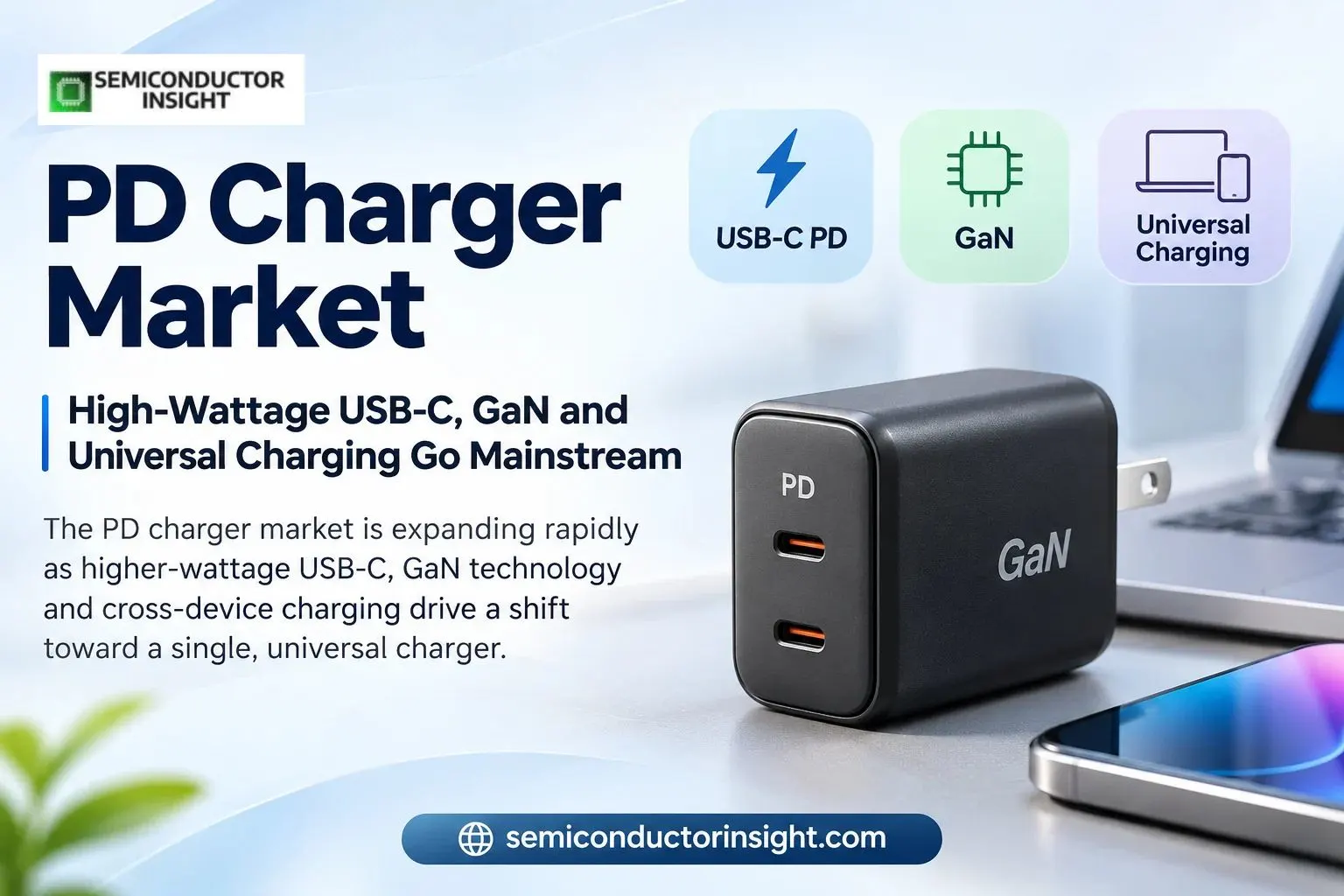
PD Charger Market Outlook 2026–2034 Tracking High-Wattage USB-C Adoption, GaN Integration and the Shift toward Universal Charging
The humble charging adapter is becoming a more sophisticated semiconductor product. Smartphones, tablets, gaming systems and laptops increasingly share USB-C connectivity, but their power requirements vary considerably. This is changing the PD Charger Market, where manufacturers are competing through higher output, smaller form factors, intelligent power allocation and improved thermal performance.
The industry is moving beyond basic fast charging. USB Power Delivery is increasingly relevant to multi-device households, mobile workstations and compact computing equipment, making charger design an important part of the wider consumer electronics ecosystem.
The 240W Threshold Is Expanding What a USB-C Charger Can Power
- A major development in USB Power Delivery has been the introduction of Extended Power Range (EPR), which enables compatible USB-C systems to deliver up to 240W.
- Earlier USB PD implementations were limited to 100W, making the higher-power specification significant for devices that require more energy, including performance laptops and specialised portable equipment.
- The 240W capability uses higher fixed voltage levels, including 28V, 36V and 48V. However, reaching the maximum output requires a compatible charger, cable and receiving device.
- This is creating opportunities for manufacturers to develop products across several power categories rather than concentrating only on smartphone adapters.
A Brief Look at Our Detailed Analysis Related Report: https://semiconductorinsight.com/report/pd-charger-market/
GaN Is Changing the Physical Design of Power Adapters
Gallium nitride (GaN) is becoming an important semiconductor technology in compact charging equipment. Its switching characteristics allow designers to develop smaller, high-power adapters while managing conversion losses and heat more effectively than many conventional silicon-based designs.
- The product pipeline reflects this direction. In May 2026, Kensington announced 70W and 140W multi-port GaN adapters alongside a 240W USB-C cable. These products demonstrate how manufacturers are combining higher output with multiple charging connections for laptops, tablets and smartphones.
For the semiconductor supply chain, this creates demand for GaN power transistors, controller ICs, protection components and thermal-management solutions.
USB-IF’s November 2026 Update Brings a New Specification Milestone
USB-IF’s document library listed USB Power Delivery Specification Revision 3.3 Version 1.0 on 5 November 2026. The release is an important standards milestone for charger manufacturers, component suppliers and device developers working on USB-C power systems.
Compliance is particularly important because a charger’s advertised wattage does not independently establish compatibility. The charger, cable and receiving device must negotiate supported power levels. USB-IF also specifies cable power-rating identification, including 60W and 240W markings, helping buyers distinguish between cable capabilities.
Europe’s Laptop Rules Are Giving Universal Charging a Wider Role
- The European Union’s common-charger requirements began applying to a range of portable electronics on 28 December 2024 and extended to laptops on 28 April 2026. Covered devices must support USB-C charging, subject to the directive’s scope and conditions.
- The policy has a wider commercial implication: consumers can increasingly reuse compatible chargers across different device categories. The European Commission has estimated that the rules could save consumers approximately €250 million annually through reduced unnecessary charger purchases.
- For manufacturers, this makes interoperability, clear power specifications and compatibility testing central to product planning.
From One Adapter to an Entire Personal Power Station
Multi-port charging is becoming a practical product category rather than an additional feature. A single adapter can serve a laptop, smartphone and wireless earbuds, provided its total output and individual port limits match the connected devices.
This creates a more demanding design environment. Power-management controllers must distribute available wattage intelligently, while thermal protection and over-current safeguards help maintain safe operation. The market is therefore expanding beyond the adapter itself into cables, connectors, controller chips and protection circuitry.
Does Tesla Use Silicon Carbide?
Yes. Tesla has used silicon-carbide (SiC) power semiconductor technology in electric-vehicle power electronics, particularly traction inverter applications. SiC supports efficient high-voltage switching in vehicle powertrains, but this is different from USB Power Delivery technology.
Tesla’s use of SiC should not be interpreted as evidence that its vehicle charging ports use SiC-based PD chargers. Its vehicles also include USB-C ports for charging personal electronics. For example, Tesla’s Model Y owner’s manual describes USB-C ports for charging devices inside the cabin.
This distinction matters: SiC is associated with high-voltage EV power conversion, while PD chargers commonly use power-management ICs and switching devices such as silicon or GaN.

Comments (0)