
PCB & PCBA Market Evolution Fueled by Miniaturization and Advanced Packaging
From smartphones and electric vehicles to advanced medical devices and aerospace systems, printed circuit boards (PCBs) and printed circuit board assemblies (PCBAs) are the foundational layers enabling modern electronics to function seamlessly. While chips often take the spotlight, PCBs and PCBAs act as the physical and electrical backbone that connects, supports, and powers semiconductor components.
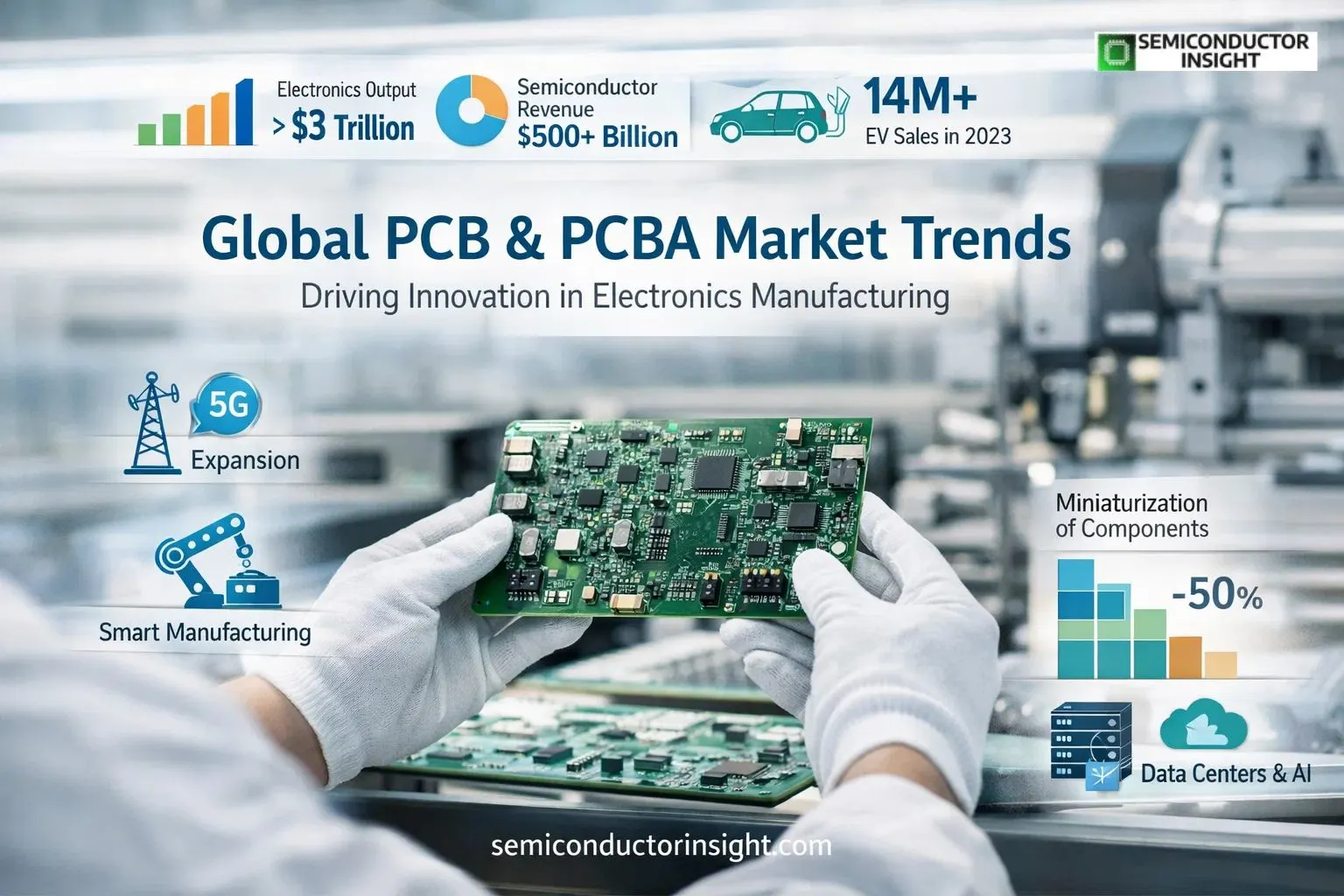
According to data published by Japan Electronics and Information Technology Industries Association, global electronics production has consistently expanded, with electronics output exceeding USD 3 trillion in recent years directly influencing PCB demand. Additionally, insights from World Semiconductor Trade Statistics indicate semiconductor revenues surpassed USD 500 billion in 2023, reinforcing the parallel growth of PCB and PCBA manufacturing ecosystems.
Precision Meets Scale in Modern PCB Manufacturing
- PCB and PCBA markets today are a fragile equilibrium between high-precision engineering and mass production. Modern PCBs have come a long way from the days of simple single-layer boards. Now, they can include more than 30 layers in high-performance settings like data centres and telecom infrastructure.
- The U.S. Department of Commerce says that modern electronics production is using more and more high-density interconnect (HDI) PCBs, which let more parts fit in a square inch. This is especially important for small consumer electronics and wearables, where making the most of space is quite important.
- In addition, data from the European Commission shows that the trend toward miniaturization is speeding up, with the sizes of electronic components dropping by almost 50% over the previous ten years. This has led PCB makers to use laser drilling, microvias, and new substrate technologies.
Electrification and Mobility Expanding PCB Horizons
The fast electrification of transportation is changing the PCB and PCBA market. Electric vehicles (EVs) need a lot more PCBs than regular cars and trucks with internal combustion engines since they have battery management systems, power electronics, and advanced driver assistance systems (ADAS).
The International Energy Agency says that sales of electric cars around the world reached over 14 million in 2023, a 35% increase from the previous year. Each electric vehicle (EV) can have up to twice the PCB value of a regular car, which has led to a huge increase in demand for high-reliability PCBAs.
Automotive-grade PCBs must also meet strict durability standards. They must be able to work at high temperatures and vibrations. This is why metal-core PCBs and flexible circuits are used in car electronics.
Take a Quick Glance at Our In-Depth Analysis Report: https://semiconductorinsight.com/report/pcb-pcba-market/
5G, AI and Data Infrastructure Intensifying Complexity
- The deployment of 5G networks and the rise of artificial intelligence are significantly increasing the complexity and performance requirements of PCBs. High-frequency signals in 5G systems demand low-loss materials and precise impedance control, while AI-driven data centers require multilayer boards capable of handling massive data throughput.
- According to International Telecommunication Union, global 5G subscriptions are expected to exceed 5 billion by 2028, reflecting massive infrastructure investments. This expansion directly fuels demand for advanced PCBAs used in base stations, routers, and edge computing devices.
- Simultaneously, hyperscale data centers operated by companies like Google and Amazon Web Services rely on high-layer-count PCBs to support servers and networking equipment. These boards must maintain signal integrity at extremely high speeds, often exceeding 25–56 Gbps.
Consumer Electronics Still Leading the Volume Game
Despite the rise of industrial and automotive applications, consumer electronics continues to dominate PCB production volumes. Devices such as smartphones, laptops, gaming consoles, and smart home systems require compact, lightweight, and cost-efficient PCB solutions.
According to data from India Brand Equity Foundation, India’s electronics manufacturing sector is projected to reach USD 300 billion by 2026, driven by strong domestic demand and government initiatives like Production Linked Incentive (PLI) schemes. This expansion is expected to significantly boost local PCB assembly capabilities.
In parallel, global smartphone shipments, as reported by International Data Corporation, have remained above 1 billion units annually, ensuring sustained demand for high-volume PCB production.
Automation and Smart Manufacturing Reshaping Assembly Lines
- The PCBA segment is undergoing rapid transformation with the integration of automation, robotics, and Industry 4.0 technologies. Surface mount technology (SMT) lines are becoming increasingly automated, improving production efficiency and reducing defect rates.
- According to International Federation of Robotics, industrial robot installations reached over 550,000 units globally in 2023, with electronics manufacturing being one of the largest adopters. Automated optical inspection (AOI) and AI-powered defect detection systems are now standard in advanced PCBA facilities.
- This shift toward intelligent manufacturing is not only enhancing quality but also enabling real-time monitoring and predictive maintenance, reducing downtime and operational costs.
PCB & PCBA market continues to evolve as a critical enabler of global technological progress. While often hidden beneath layers of components, these systems define the performance, reliability, and scalability of every electronic device.
As industries push toward smarter, faster, and more connected ecosystems, PCB and PCBA technologies will remain at the heart of innovation quietly powering the digital world while adapting to its ever-growing complexity.

Comments (0)