

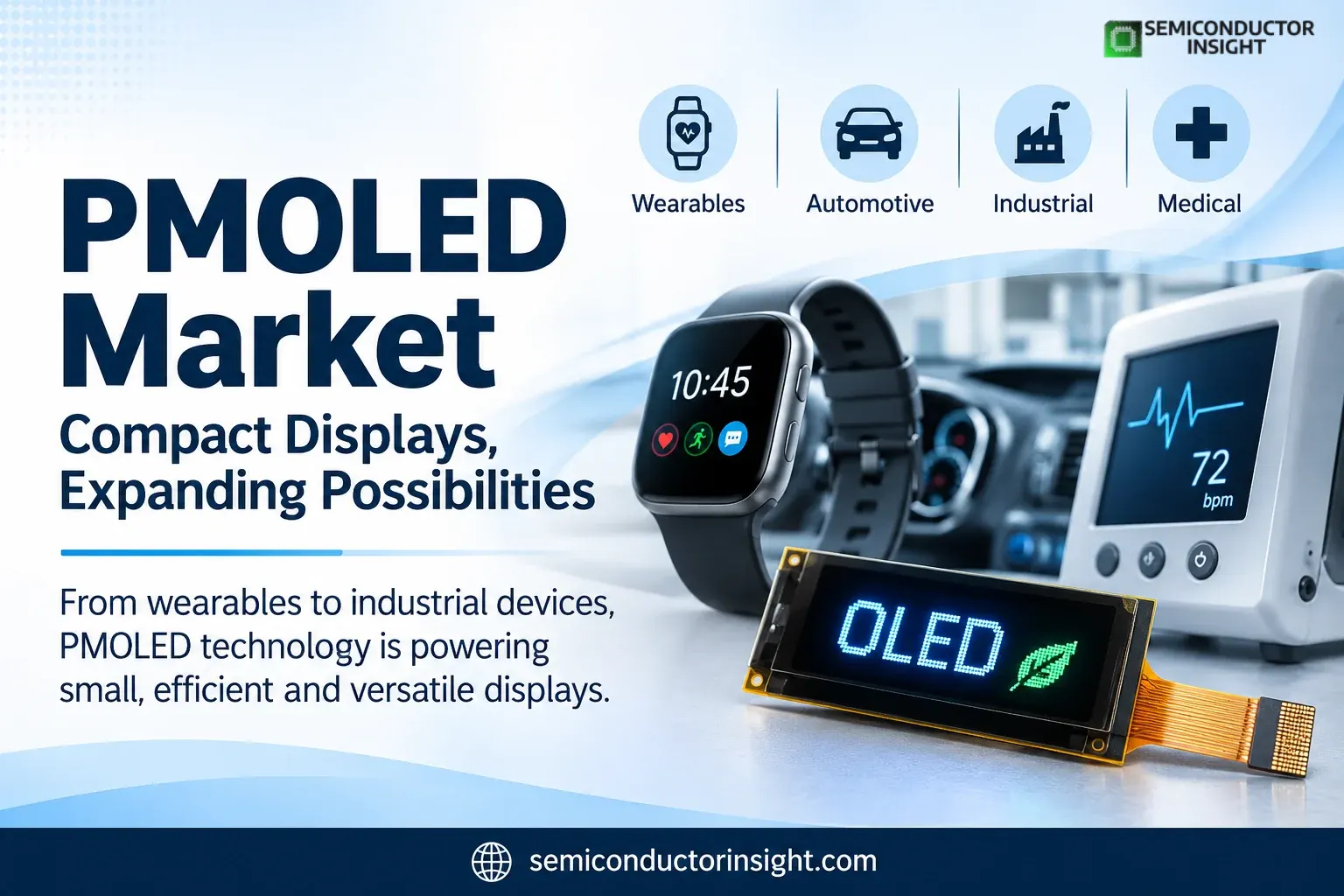
Passive Matrix Organic Light Emitting Diode Market in 2026 Examining Display Adoption, Product Design and Manufacturing Priorities
OLED technology is often associated with premium smartphones, televisions and foldable devices, but a different opportunity exists in compact electronic displays. The passive matrix organic light emitting diode (PMOLED) market serves products that require readable information, compact dimensions and relatively straightforward display control. Instead of competing directly with every large-format screen, PMOLED technology fits applications where a small interface can perform a specific task efficiently.
Despite AMOLED, PMOLED uses a simpler pixel-addressing architecture without an individual thin-film transistor at every pixel. This makes it attractive for selected low-resolution applications, although size, resolution and power consumption constrain its suitability for more demanding displays. As electronics manufacturers introduce additional digital features into compact products, PMOLED remains relevant for dedicated status screens and embedded interfaces.
Transparent OLED Designs Are Opening Unusual Product Possibilities
- One of the more distinctive developments is the integration of transparent displays into products where users need information without completely obstructing their view.
- Solomon Systech’s 2024 annual report describes display-driver IC products supporting transparent PMOLED displays, including applications such as diving goggles and golf goggles.
- These examples illustrate how display technology can become part of the product’s physical design rather than simply serving as a conventional screen.
- This direction creates opportunities for specialized optical equipment, wearable interfaces and other devices that combine visual information with real-world visibility.
- However, commercial adoption depends on more than transparency alone. Manufacturers must also address readability, optical clarity, power requirements, environmental protection and integration costs before such designs become suitable for wider deployment.
Wearables and Personal Electronics Keep Compact Displays Relevant
Wearables remain a natural application for small OLED panels because product designers often work within strict limits on space, thickness and battery capacity. Fitness accessories, portable electronics, audio equipment and selected smart devices can use compact displays to present notifications, operating status, settings or basic measurements without requiring a larger screen.
Orient Display’s July 2024 PMOLED product documentation illustrates the range of commercially available formats. Its listed modules include a 0.49-inch display with 64 × 32 pixels, a 0.96-inch version with 128 × 64 pixels and a 2.08-inch version with 256 × 64 pixels. The same catalogue includes monochrome, multicolor and RGB options. These specifications demonstrate how designers can select display dimensions and pixel arrangements according to the interface required.
For manufacturers, the commercial opportunity lies in matching display capability to the device’s actual function. A basic notification panel does not necessarily require the resolution, refresh capabilities or processing complexity of a premium smartphone display.
Want to learn more about the report? Check out our latest updated version for free: https://semiconductorinsight.com/report/passive-matrix-organic-light-emitting-diode-market/
Display-Driver ICs Are Becoming an Important Part of Product Differentiation
- PMOLED performance depends not only on the panel itself but also on the electronics responsible for controlling its pixels. Display-driver integrated circuits determine how display information is addressed and help manufacturers manage interface compatibility, operating requirements and product integration.
- Solomon Systech’s 2024 annual report identifies its OLED display-driver IC business as a core activity and describes the launch of the SSD2363, a passive-matrix microLED driver IC in March 2023.
- The report also identifies applications for small displays of 3 inches or less, including wearables, household appliances and industrial equipment. Although the SSD2363 supports microLED rather than PMOLED, it demonstrates the wider industry focus on specialized driver electronics for compact display architectures.
- This distinction matters because PMOLED and passive-matrix microLED are not interchangeable technologies. Nevertheless, advances in driver design can inform the broader development of compact display systems, especially where size, interface simplicity and application-specific functionality influence component selection.
Industrial and Medical Interfaces Demand Practical Display Design
Consumer electronics are only one part of the opportunity. Industrial instruments, medical equipment, measurement devices and control panels also need displays that present information clearly within limited physical space. In these environments, a screen may be used to show operating modes, numerical readings, alarms or equipment status rather than complex images.
The appeal of PMOLED depends on whether its visibility, lifetime, environmental tolerance and interface requirements meet the intended application’s specifications. Medical and industrial manufacturers may also require extended product availability and consistent component performance throughout lengthy equipment lifecycles. These considerations can make supplier qualification and long-term design support as important as the initial panel price.
The Next Opportunity Lies in Choosing the Right Display Architecture
The passive matrix organic light emitting diode market is best understood through application-specific demand rather than a simple contest between OLED technologies. AMOLED is better suited to many high-resolution and larger-screen applications, while PMOLED can remain practical for selected compact interfaces with relatively modest information requirements.
As transparent optics, wearable electronics and connected industrial equipment continue to develop, product engineers will need to balance display dimensions, readability, energy consumption, control electronics and lifecycle requirements. PMOLED’s strongest position will depend on how effectively manufacturers align these characteristics with real product needs. The most promising applications are therefore not necessarily those requiring the largest screens, but those where a small, purpose-built display delivers useful information without adding unnecessary complexity.

Comments (0)