

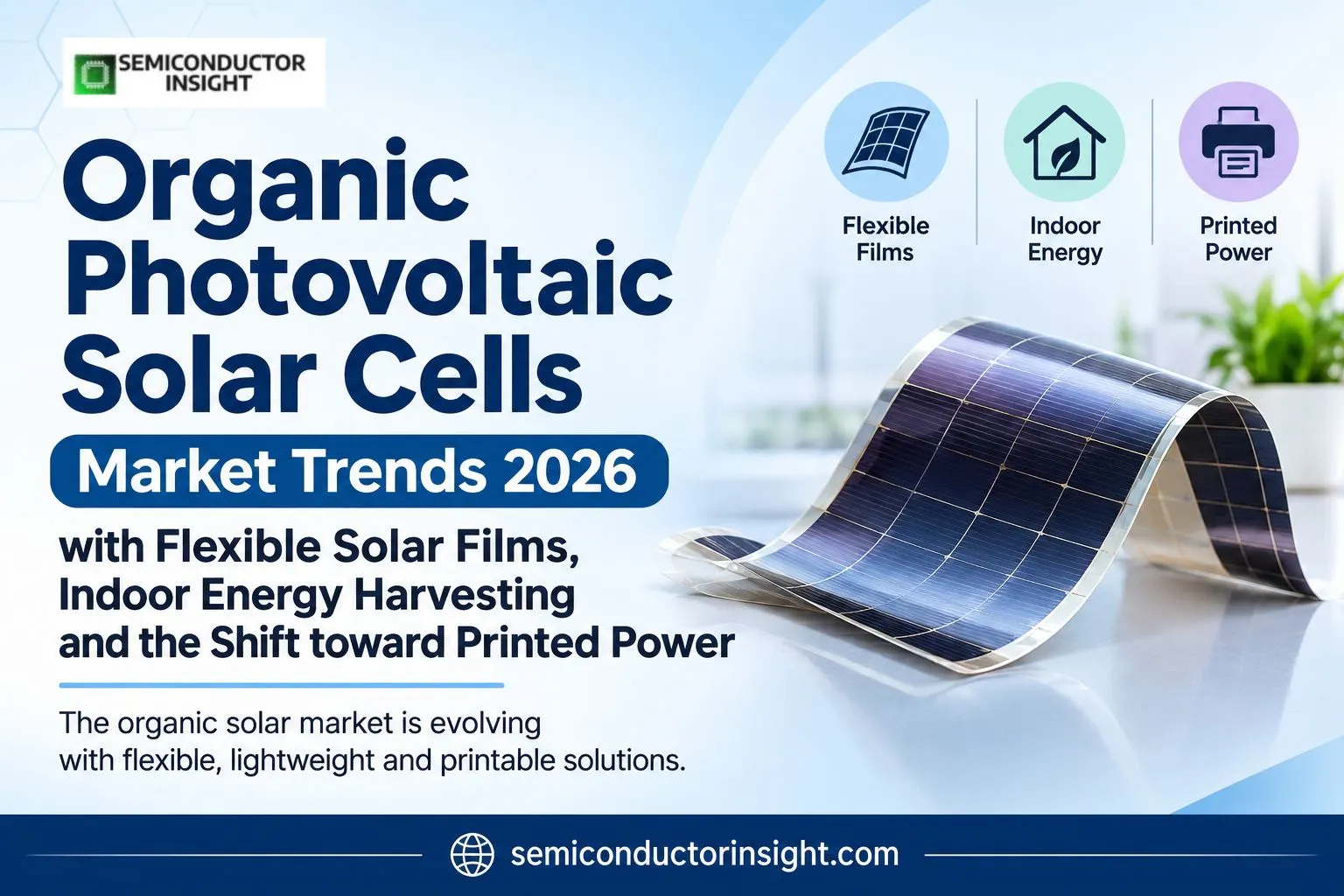
Organic Photovoltaic Solar Cells Market Trends 2026 with Flexible Solar Films, Indoor Energy Harvesting and the Shift toward Printed Power
Solar energy development is no longer limited to improving the output of conventional glass-and-silicon panels. Organic photovoltaic (OPV) technology is attracting attention because it can convert light into electricity through thin, lightweight and potentially semi-transparent films. Unlike conventional rigid modules, organic solar cells can be manufactured on flexible substrates and adapted to curved surfaces, façades, textiles and compact electronic products.
This difference is creating new opportunities in applications where conventional photovoltaic panels are difficult to install. Architects, electronics manufacturers and developers of connected devices are exploring OPV as an additional source of distributed electricity. The technology’s commercial progress, however, depends on more than laboratory efficiency. Material costs, operational lifetime, environmental stability and large-area manufacturing remain central considerations.
The Efficiency Race Is Entering a New Phase
- Research results published during 2026 demonstrate how quickly organic solar-cell performance is advancing.
- Emerging-PV’s research database recorded an OPV efficiency result of 21.36% on October 5, 2026. It also listed a 21.25% result marked as certified on October 12, showing that independently validated performance is becoming an important part of technology development.
- These are cell-level research results, not evidence that commercial OPV modules already deliver equivalent performance.
- The improvement is linked to developments in non-fullerene acceptors, molecular packing, charge transport and interface engineering. Researchers are working to reduce energy losses while improving the movement of electrical charges through the active layer.
- For manufacturers, the next milestone is translating these advances into repeatable production without sacrificing stability or increasing material complexity.
Semi-Transparent Films Are Finding a Place in Building Design
Building-integrated photovoltaics is one of the more distinctive application areas for OPV. Semi-transparent solar films can be incorporated into façades, windows, canopies and architectural surfaces, allowing buildings to generate electricity without relying exclusively on rooftop installations.
A notable 2026 development comes from ASCA, which reports that its new photoactive material system, developed with Raynergy Tek, enables semi-transparent OPV modules with output of up to 70 W/m². The company also introduced a turquoise colour option for architectural applications. The material system uses non-fullerene acceptors and has been adapted for industrial roll-to-roll production.
This development illustrates how colour, transparency and custom dimensions can become product-selection factors alongside electrical output. Commercial adoption will depend on how effectively these modules balance daylight transmission, energy generation, weather resistance and installation requirements.
You can freely browse our most recent updated report to learn more about it before scrolling further: https://semiconductorinsight.com/report/organic-photovoltaic-solar-cells-market/
Indoor Energy Harvesting Opens a Different Customer Base
Organic photovoltaics are also being investigated for indoor environments, where light intensity and spectral composition differ considerably from outdoor sunlight. This creates an opportunity to power low-energy electronics such as wireless sensors, smart labels, remote controls and Internet of Things devices.
A 2026 review in Nature examined indoor photovoltaic technologies, including organic cells, and highlighted the importance of designing devices around actual indoor lighting conditions. For OPV suppliers, this application could create demand for small, customized energy-harvesting components rather than large electricity-generating installations.
The commercial proposition is particularly relevant where replacing batteries involves repeated maintenance, labour or access difficulties. However, developers must demonstrate dependable output under different artificial-light sources and operating conditions before indoor OPV becomes a widely adopted solution.
Roll-to-Roll Manufacturing Is the Bridge between Research and Production
The ability to print active photovoltaic layers onto flexible substrates is a major manufacturing distinction for organic solar cells. Roll-to-roll processing allows successive functional layers to be deposited on continuous films, potentially supporting higher-throughput production than individually fabricated small-area devices.
ASCA describes a process involving printed PET films, multiple organic semiconductor layers, barrier-film encapsulation, laser structuring and lamination. Its OPV film weighs less than 500 grams per square metre and can be shaped for integration with materials including glass, plastics, metals, membranes and textiles. The company also states that product service life can reach up to 20 years depending on the application.
These features create opportunities for customized energy-generating surfaces. Nevertheless, scaling production requires consistent coating quality, reliable encapsulation, material availability and predictable performance across larger module areas.
Water-Based Processing and Material Stability Are Becoming Important
Manufacturing sustainability is increasingly connected to the chemistry used to produce photovoltaic films. Organic solar-cell research is examining water-based processing and alternative solvents to reduce dependence on conventional processing chemicals. An October 2026 publication listed by Emerging-PV reported a water-oil interfacial processing approach with 12.64% certified efficiency, demonstrating progress in this area.
At the same time, stability remains essential. Moisture, oxygen, ultraviolet exposure and temperature fluctuations can affect organic active layers and interfaces. Improving protective barriers and designing more durable material systems will therefore be necessary before OPV can expand into demanding outdoor applications.
The Next Commercial Opportunity Lies in Application-Specific Solar Design
Organic photovoltaic technology is developing a distinct position within the wider solar industry. Its strongest potential may not come from replacing conventional silicon panels across utility-scale installations, but from generating electricity on surfaces and products that traditional modules cannot easily serve.
Building façades, indoor sensors, wearable electronics, smart furniture and lightweight portable systems offer different routes to commercialization. As efficiency research advances and roll-to-roll manufacturing develops, the Organic Photovoltaic Solar Cells Market will increasingly be shaped by the ability to match material performance with the practical requirements of each application.

Comments (0)