
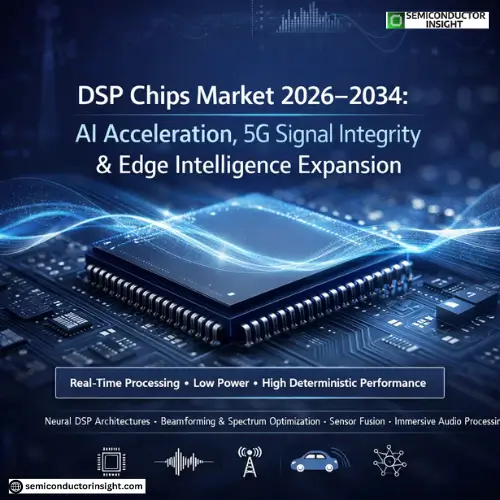
Next Generation DSP Chips Market Enabling Smart Connectivity and Signal Intelligence
Digital Signal Processor (DSP) chips are a fundamental component of modern electronics, designed specifically to handle complex mathematical computations required for real-time data transformation and interpretation. From noise cancellation in audio systems to sensor fusion in autonomous vehicles, DSP chips reliably process signals that drive the enriched experiences and functional intelligence of today’s devices.
As digital systems grow in advancement, DSP chips increasingly combine low power operation with advanced processing capabilities, positioning them at the core of communications, multimedia, and edge-AI implementations. Recent developments reveal how the DSP ecosystem is evolving beyond traditional boundaries, driven by innovation in architecture, integration methods, and application-specific enhancements.
How AI and Machine Learning Are Reshaping DSP Architectures
One of the most impactful shifts in DSP chip design is the integration of artificial intelligence (AI) and machine learning (ML) acceleration capabilities. Traditional DSPs primarily optimized mathematical functions such as Fourier transforms and filtering are now being redesigned to support neural inference workloads, especially in embedded and edge applications.
Recent product launches reflect this trend: companies are embedding DSP cores within SoCs tailored for real-time AI audio processing, vision analytics, and predictive signal adaptation. These chips can execute sophisticated models locally, reducing latency and reliance on cloud connectivity for mission-critical tasks.
DSP chips designed for AI now underlie voice assistants with high-accuracy speech recognition, adaptive noise suppression in conferencing systems, and real-time object detection in camera modules all without offloading data to remote servers.
Transforming Modern Connectivity through High Performance DSP Solutions
The deployment of 5G and upcoming wireless standards has underscored the importance of DSP chips for signal integrity, interference mitigation, and spectrum efficiency. Modern telecommunications infrastructures leverage multi-antenna systems and advanced modulation schemes that demand ultra-fast, deterministic computations DSPs excel here.
DSP solutions for 5G base stations and radio units improve beam forming accuracy and adaptive equalization, enabling reliable high-speed communication even in congested environments. Gorilla-level performance at the signal layer ensures minimal latency and improved throughput for applications ranging from autonomous factory automation to real-time critical communications.
Advanced network designs are increasingly blending programmable DSP cores with specialized hardware accelerators, creating hybrid platforms that can dynamically adapt to spectrum conditions across changing network loads.
DSP Chips in Cutting-Edge Automotive Intelligence
The automotive industry is adopting DSP chips not only for infotainment audio and navigation but as a central processing element in Advanced Driver Assistance Systems (ADAS). DSPs efficiently interpret high-frequency data streams from radar, lidar, and camera sensors turning raw signals into actionable vehicle controls for braking, lane-assistance, and collision avoidance.
As vehicles progress toward higher autonomy levels, DSP architectures are being reimagined to handle sensor fusion workloads, merging data from multiple sources in real time. This integration ensures smoother decision-making pipelines and enhances safety margins even in dynamic urban environments.
Automotive-grade DSPs now support sensor calibration, multi-channel audio imaging, and even driver monitoring systems that analyze biometric and visual cues for occupant safety and comfort.
Audio Processing Pushing DSP Innovation Boundaries
Another vibrant segment of the DSP market focuses on audio processing enhancements, where chips are finely tuned to deliver immersive sound, audio compression, and advanced equalization features for consumer and professional gear alike. DSPs in this arena are designed to handle multi-band filtering, real-time parametric equalization, and adaptive feedback suppression with high precision.
Recent collaborations between semiconductor vendors and premium audio brands have resulted in DSP platforms that power immersive automotive sound systems, high-fidelity wireless earphones, and smart speakers with enhanced voice separation and noise adaptation. These DSP solutions often leverage custom instruction sets and optimized libraries that accelerate complex audio workloads without sacrificing battery life or form factor.
By enabling richer audio landscapes and improved user experiences, DSP chips are helping to set new expectations for immersive media and interactive sound interfaces.
Specialized DSP Applications in Industrial and Sensing Domains
Industrial environments are now embracing DSP technology for predictive maintenance, vibration analysis, and process optimization, where rapid analysis of sensor data can prevent faults before they occur. DSP chips excel in extracting meaningful features from noisy or high-frequency sensor streams transforming raw electrical signals into actionable metrics for system health.
Other specialized applications include biomedical signal processing, where DSPs interpret ECG, EEG, and other physiological data in real time. In these settings, devices perform critical tasks such as heartbeat anomaly detection and motion analysis with computational efficiency necessary for wearable monitors and remote diagnostic tools.
The flexibility of DSP cores makes them suitable for configurable platforms that accommodate both standard signal workflows and bespoke application logic, often through programmable extensions or hybrid processing modes.
DSP and the Emerging Influence of Photonic and Hybrid Architectures
As demand for lower latency and higher bandwidth grows beyond the capabilities of purely electronic processors, research is pushing the boundaries of traditional DSP paradigms. Emerging work on photonic processing and hybrid analog-digital computing architectures promises transformational efficiency improvements.
For example, photonic DSP-free optical processors explore alternatives that bypass conventional DSP pipelines for ultra-long-distance, high-speed data transmission with dramatically reduced power footprints and latency. While still in research phases, these innovations indicate a future where signal processing may become a blend of optical, analog, and digital elements, extending performance far beyond current semiconductor norms.
Furthermore, hybrid analog-digital circuits leveraging memristor arrays show orders-of-magnitude improvements in signal processing energy efficiency suggesting a path where DSP functions may be distributed across unconventional computing substrates for ultra-fast communication systems.
To Stay Tuned with More meaningful and In-Depth Insights, Do Visit here:
https://semiconductorinsight.com/report/dsp-chips-market/
The Human Side: DSP Skills and Engineering Culture
Behind every DSP chip are engineers specialized in real-time computing, algorithm optimization, and embedded systems skills that intersect software and hardware disciplines. The demand for professionals who understand signal theory, hardware-software co-design, and low-power optimization reflects the complexity of developing high-performance DSP applications.
DSP engineers often work across domains, from developing custom audio pipelines to enabling adaptive wireless protocols, contributing to a culture that values precision, efficiency, and creative problem-solving in resource-constrained environments.
Digital Signal Processor sector remains a core enabler of intelligent systems, continuously evolving to meet the requirements of next-generation networking, autonomous technologies, immersive media, and real-time analytics. As DSP architectures integrate more advanced computing paradigms and adapt to emerging signal environments, they promise to deliver higher performance and smarter capabilities across an ever-expanding horizon of applications.

Comments (0)