
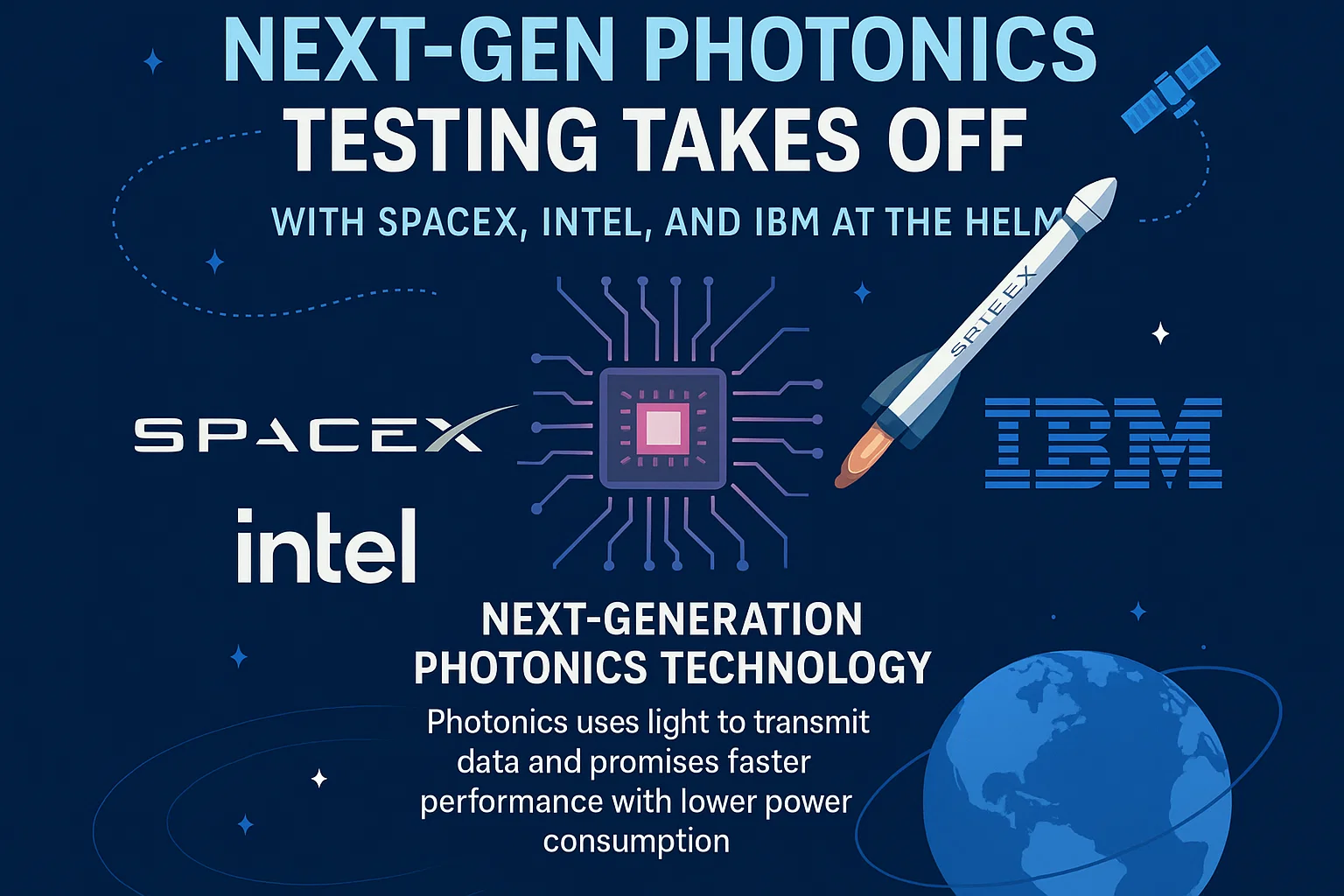
Next-Gen Photonics Testing Takes Off with SpaceX, Intel, and IBM at the Helm
In the fast-evolving world of high-speed communication, quantum computing, and next-generation AI hardware, Optical Test Systems (OTS) have emerged as indispensable tools for validating performance, ensuring reliability, and optimizing innovations across industries. As we move through 2025, the optical test system market is witnessing a significant transformation driven by technological advancement, strategic investments, and global demand for faster, more efficient data transfer.
According to the latest insights, the Optical Test System market was valued at USD 1,722 million in 2024 and is projected to reach USD 3,005 million by 2032, registering a CAGR of 8.5% over the forecast period. These figures signal a robust growth trajectory fueled by several noteworthy developments.
Access Your Free Sample Report- Optical Test System Market
1. Apple and NVIDIA Pioneer High-Speed Optical Testing for AI and Mixed Reality
AI-driven hardware is putting unprecedented pressure on data transmission infrastructure. Apple and NVIDIA have recently accelerated their investments in high-speed optical testing, particularly to support AI chipsets and co-packaged optics (CPO).
NVIDIA’s Blackwell GPU platform, central to their AI data centers, requires terabit-level throughput, necessitating real-time signal integrity analysis and jitter mitigation using advanced optical test instruments. Keysight Technologies and Anritsu have been quick to respond with updated test equipment, offering ultra-wideband signal analyzers that accommodate up to 1.6 Tbps throughput.
Apple, on the other hand, has reportedly begun developing in-house optical test setups tailored for its Vision Pro mixed-reality headset and custom silicon (M2/M3 series). The goal: reduce latency and improve power efficiency across optical interconnects. Insiders suggest Apple is integrating automated photonics testing earlier in the chip development lifecycle to accelerate time to market.
Takeaway: The future of AI and AR/VR hardware relies on next-gen optical testing infrastructure that can keep up with escalating bandwidth and fidelity demands.
2. Intel and IBM Dive into Quantum-Compatible Optical Testing
Quantum computing isn’t just a futuristic concept anymore—it’s shaping real hardware today. Intel and IBM are leading efforts to design quantum-compatible optical test systems, particularly for photonic quantum circuits.
IBM has taken strides in superconducting-photonic hybrid architectures, where optical links transmit entangled qubits between cryostats. To validate these links, researchers are leveraging test systems capable of analyzing single-photon-level signals, including advanced time-correlated single-photon counting (TCSPC) setups.
Intel, meanwhile, has expanded its Oregon-based photonics lab to prototype new silicon photonics chips for quantum interconnects. Their optical test requirements include precise spectral phase analysis and photon indistinguishability metrics.
Takeaway: Quantum hardware demands a rethinking of optical test standards, moving toward photon-level resolution and quantum noise management.
3. SpaceX and NASA’s Leap Toward Laser-Based Space Communication
Another exciting frontier is space-based optical communication, where SpaceX and NASA are teaming up to enable high-bandwidth laser communication links between satellites.
The deployment of Starlink’s laser mesh network in low-Earth orbit (LEO) requires ruggedized and highly accurate optical test equipment to ensure performance in extreme conditions. Optical test tools now used in orbit validation include:
- Dynamic environmental test modules
- Portable wavelength meters with <0.1 nm accuracy
- Bit error rate testers designed for Doppler shift compensation
NASA, meanwhile, has incorporated real-time link simulators to emulate long-distance signal degradation, allowing proactive calibration before deployment.
Takeaway: The success of satellite-based internet hinges on real-time, accurate optical link validation, even in the vacuum of space.
Download Sample Report PDF- Optical Test System Market
4. Huawei Advances Domestic Optical Testing for 800G/1.6T Networks
Facing growing trade restrictions, Huawei has shifted toward self-sufficiency, unveiling its in-house optical test platform for 800G and emerging 1.6T transceivers. The suite includes:
- AI-assisted Bit Error Rate (BER) analyzers
- Real-time optical spectrum analyzers with multi-channel capabilities
- Protocol-aware transceiver emulation
Huawei’s new platform is designed to support China’s push into 6G infrastructure, where latency, power efficiency, and reliability are critical. The platform also supports dynamic link training and optical channel equalization, making it suitable for ultra-dense urban 6G networks.
Takeaway: Geopolitics is driving innovation in test systems, with Huawei spearheading an era of localized, AI-enhanced photonic validation tools.
5. Universities Power Innovation with On-Chip Optical Testing
Academic institutions like MIT and the University of Tokyo are pushing the envelope in precision optical testing. Researchers have developed a new on-chip Optical Coherence Tomography (OCT) system capable of:
- Attosecond-scale temporal resolution
- Real-time biological tissue mapping
- Integrated phase-sensitive imaging
The technology has applications far beyond medicine. In nano-photonics and semiconductor diagnostics, these ultra-precise tools are now being used to characterize sub-wavelength optical structures and improve yield forecasting in silicon photonics manufacturing.
Takeaway: Academic research is spawning the next wave of miniaturized, high-resolution optical test tools that blend imaging and signal processing.
Market Outlook: What This Means for the Industry
As we look at the horizon, several themes emerge from these developments:
- Vertical Integration: Companies like Apple and Huawei are moving test operations in-house, driving proprietary innovation and tighter hardware-software integration.
- Photonics + AI: AI is not only the test subject but also the testing agent. Many systems now include AI-powered signal processing and error detection.
- Global Decoupling: Export restrictions and trade tensions are pushing regions to build domestic test ecosystems, especially in China and parts of Europe.
- Quantum Pressure: As quantum applications scale, test systems must evolve from classical light measurements to quantum state analysis.
Given these drivers, it’s no surprise that the Optical Test System market is on a strong upward trajectory. Reaching USD 3,005 million by 2032 from USD 1,722 million in 2024 reflects growing R&D spending, defense and aerospace modernization, and the digital infrastructure race worldwide.
Click Here To Download Full Sample Report- Optical Test System Market
2025 is proving to be a landmark year for the Optical Test System industry. From Earth to orbit, from AI chips to quantum networks, the need for accurate, intelligent, and adaptive optical testing tools is more critical than ever. As companies and researchers continue pushing the boundaries of what light can do, test systems will remain the unsung heroes ensuring performance, safety, and innovation.
The next wave of technological breakthroughs—whether in health, space, computing, or communication—will quite literally pass through the lens of optical testing. The spotlight is on, and the industry is ready.

Comments (0)