
Next-Gen Intelligent Systems Powering Humanoid Robots Market
The humanoid robots landscape is undergoing a significant transformation as advancements in semiconductors, artificial intelligence, and sensor technologies converge to create machines that closely resemble human behavior and interaction. These robots are no longer confined to research labs; they are increasingly entering real-world environments such as hospitals, warehouses, retail stores, and even homes. The integration of high-performance chips and edge computing capabilities has enabled humanoid robots to process vast amounts of data in real time, making them more responsive, adaptive, and efficient.
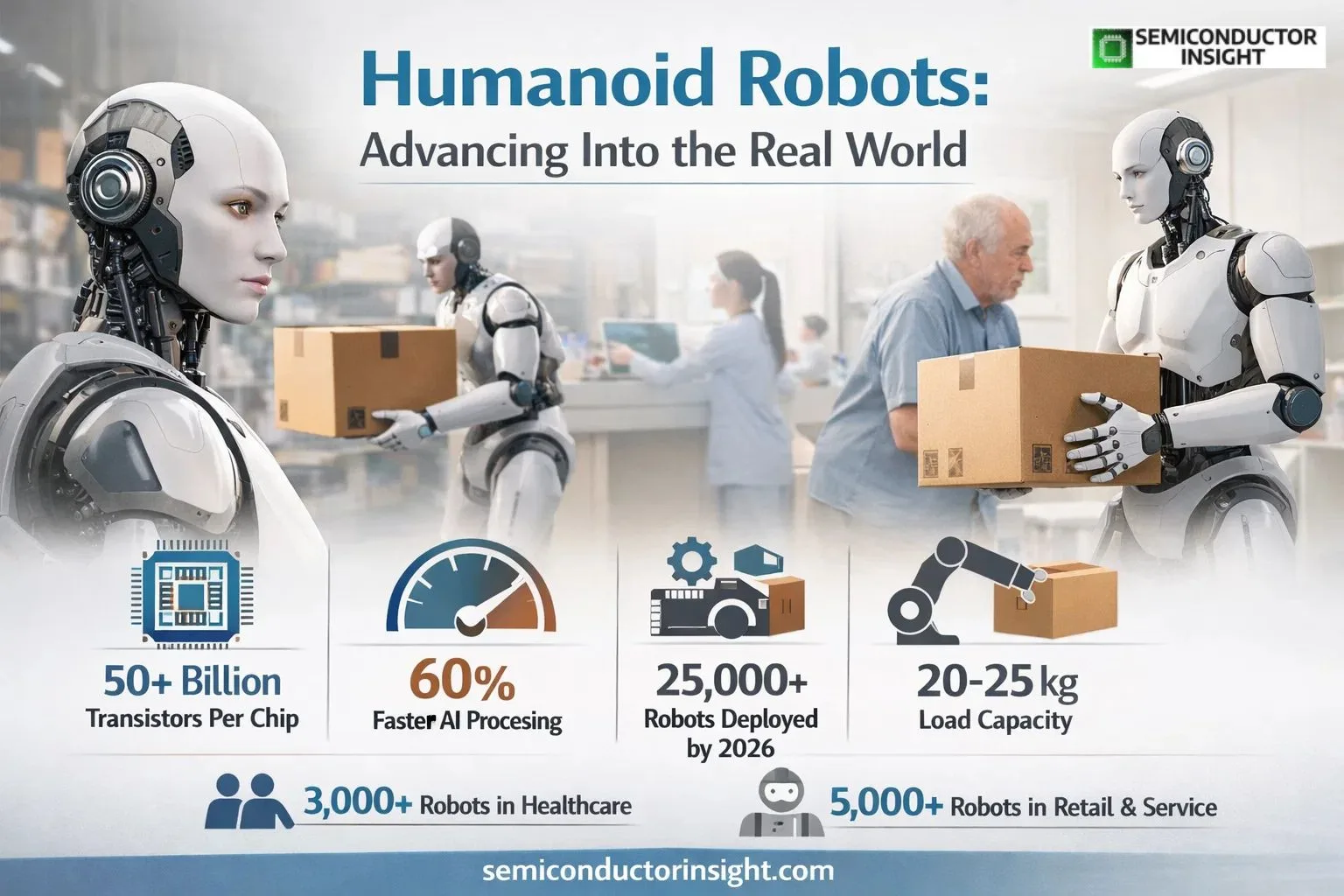
One of the most notable developments in this space is the growing scale of deployment. Recent estimates suggest that over 25,000 humanoid robots are expected to be deployed globally in commercial and service environments by the end of 2026. In manufacturing alone, pilot programs involving humanoid robots have increased by nearly 40% over the past two years, particularly in tasks that require precision and repetitive motion. These numbers highlight a clear shift from experimental adoption to practical implementation.
Semiconductor Innovation Powering Human-Like Intelligence
- At the core of humanoid robots lies semiconductor technology, which enables complex computations, motion control, and sensory processing.
- Modern humanoid robots rely on advanced processors with billions of transistors, often exceeding 50 billion transistors per chip, to handle AI workloads.
- These chips support machine learning models that allow robots to recognize faces, interpret speech, and navigate dynamic environments.
- In addition, the use of specialized AI accelerators has reduced latency by up to 60%, enabling faster decision-making.
- Memory components, including high-bandwidth memory (HBM), are also playing a critical role, with data transfer speeds surpassing 800 GB/s in some systems.
- This level of performance is essential for real-time interaction, particularly in environments where safety and precision are critical.
Real-World Deployments Gaining Momentum
Humanoid robots are increasingly being deployed in sectors where human interaction is essential. In healthcare, robots are assisting in patient monitoring, rehabilitation, and elderly care. For example, hospitals in Japan and South Korea have deployed over 3,000 humanoid robots collectively to support nursing staff and improve patient engagement.
Retail and hospitality sectors are also embracing this technology. More than 5,000 service robots are currently operating in customer-facing roles globally, handling tasks such as reception, guidance, and basic customer service. These robots are equipped with natural language processing capabilities, allowing them to interact with customers in multiple languages with accuracy rates exceeding 90%.
Workforce Augmentation Rather Than Replacement
A key narrative shaping the humanoid robots ecosystem is their role as collaborators rather than replacements for human workers. In logistics and warehousing, humanoid robots are being used to assist with lifting, sorting, and packaging tasks. Current deployments show that robots can handle loads of up to 20–25 kilograms and operate continuously for 8–10 hours with minimal downtime.
This collaborative approach is particularly valuable in addressing labor shortages. In regions experiencing workforce gaps, such as aging populations in developed countries, humanoid robots are filling critical roles. Estimates indicate that nearly 15% of logistics operations in advanced economies are expected to integrate humanoid assistance within the next five years.
Feel Free to Reach Our Most Recent Updates of the Related Report: https://semiconductorinsight.com/report/humanoid-robot-specific-chip-market/
Design Evolution Enhancing Human Compatibility
The design of humanoid robots has evolved significantly, with a strong focus on improving mobility, dexterity, and human-like appearance. Modern robots feature over 30 degrees of freedom, allowing for smoother and more natural movements. Advanced actuators and sensors enable precise control, with motion accuracy reaching up to 0.1 millimeters in certain applications.
Battery technology has also improved, with energy densities increasing by approximately 25% in recent years. This allows robots to operate for longer durations without frequent recharging, making them more viable for continuous operations. Additionally, lightweight materials such as carbon fiber composites have reduced overall robot weight by up to 20%, enhancing efficiency and agility.
AI Integration Driving Smarter Interactions
- Artificial intelligence is a defining element of humanoid robots, enabling them to learn from their environment and improve over time.
- Modern systems are capable of processing millions of data points per second, allowing for real-time adaptation.
- For instance, robots can now analyze human emotions through facial expressions and voice tones with accuracy levels exceeding 85%.
- Speech recognition systems have also advanced significantly, with error rates dropping below 5% in controlled environments. This level of precision is critical for applications in customer service and healthcare, where clear communication is essential.
- Furthermore, cloud connectivity allows robots to share data and learn collectively, accelerating the pace of improvement across entire fleets.
Broadening Market Scope Through Innovative Applications
While industrial and service sectors remain primary adopters, humanoid robots are expanding into new domains such as education, entertainment, and personal assistance. In education, robots are being used as interactive teaching aids, with over 1,500 units deployed in classrooms worldwide. These robots enhance engagement and provide personalized learning experiences.
In the entertainment industry, humanoid robots are being used in theme parks and live performances, attracting millions of visitors annually. Their ability to mimic human expressions and movements creates immersive experiences that were previously unattainable. Personal assistance is another emerging area, with early-stage deployments focusing on household tasks and companionship.

Comments (0)