
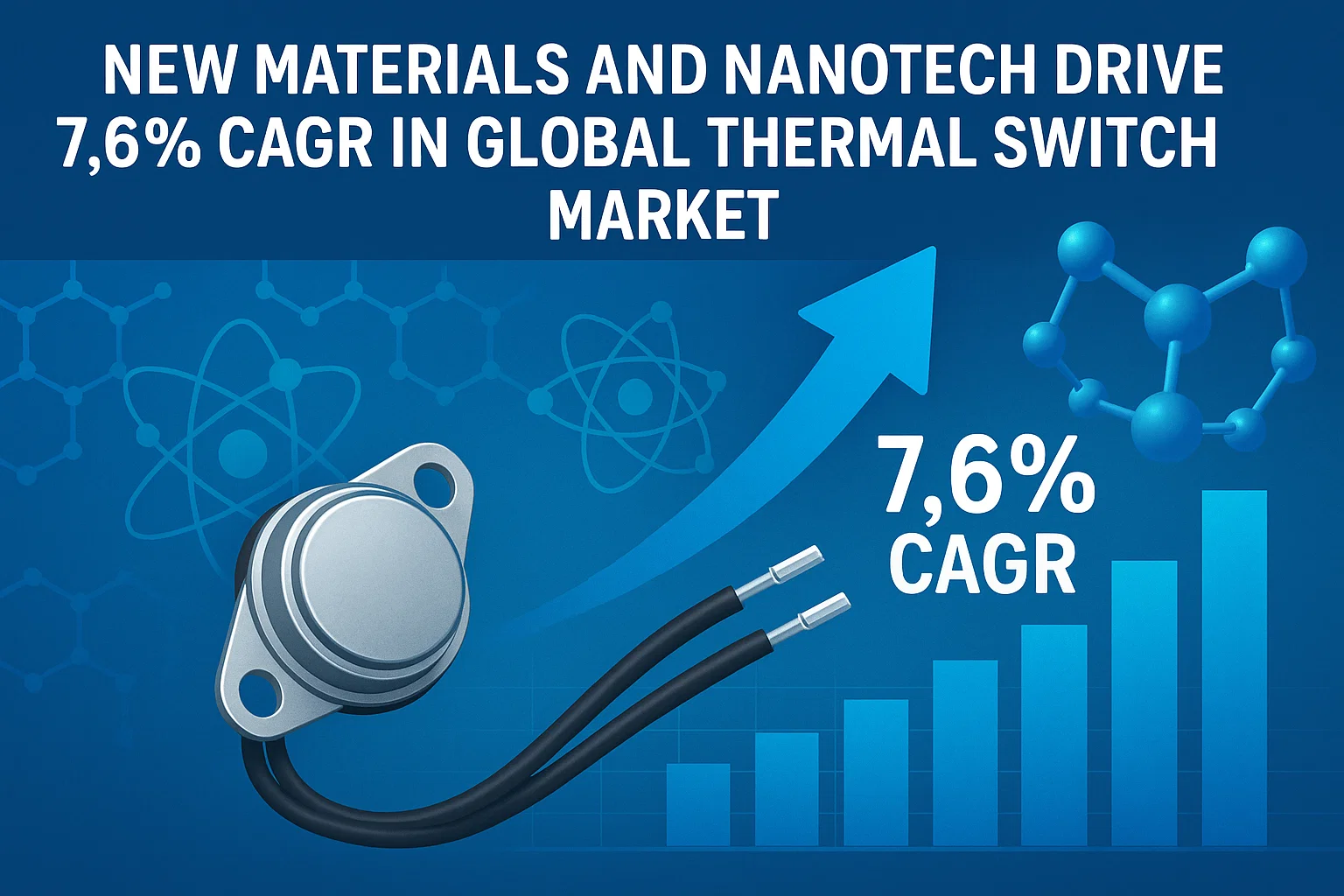
New Materials and Nanotech Drive 7.6% CAGR in Global Thermal Switch Market
Thermal switches, once a quiet niche of the electrical and mechanical components industry, have emerged as a crucial enabler of modern technology. From spacecraft and satellites to electric vehicles, data centers, and wearable devices, the need for precise temperature control and energy efficiency has created fertile ground for innovation. In 2024, the global thermal switches market was valued at approximately USD 1.388 billion, and according to projections, it is expected to grow to USD 2.378 billion by 2032, registering a steady CAGR of 7.6%.
This growth trajectory is being accelerated not only by increased demand for thermal protection and energy efficiency but also by game-changing technological advancements. Research institutions and companies worldwide are introducing new materials, concepts, and designs that redefine what thermal switches can achieve.
Access Your Free Sample Report- Thermal Switches Market
What Are Thermal Switches and Why They Matter
A thermal switch is a temperature-activated device that controls the flow of electricity or heat. Unlike thermal fuses, which are single-use devices, many thermal switches are designed to reset automatically or be actuated multiple times. Applications range widely:
- Electronics cooling: to prevent overheating of semiconductors and batteries.
- Aerospace and defense: precise control in satellites, spacecraft, and avionics.
- Automotive: temperature regulation in electric vehicle batteries and high-power circuits.
- Industrial: protection of motors, pumps, and heavy equipment.
- Consumer products: hairdryers, toasters, and appliances use them for safety cut-offs.
As devices become smaller, hotter, and more power-dense, the need for fast, reliable, and adaptive thermal management is growing. This sets the stage for the new developments we’ll discuss next.
Recent Breakthroughs in Thermal Switch Technology
1. Solid-State Thermal Switching with Graphite Films
Traditionally, thermal switches have been mechanical bimetallic strips or wax-filled actuators. But researchers at the University of Manchester’s National Graphene Institute have demonstrated a solid-state thermal switch using high-conductivity graphite films.
The core principle involves ion intercalation between graphite layers. When voltage is applied, ions lodge themselves in the layers, scattering phonons and reducing heat conduction dramatically. When the voltage is removed, the ions exit, restoring high thermal conductivity.
- Performance leap: up to 1,300% modulation in thermal conductivity.
- Implications: spacecraft can toggle between heat-dissipating and heat-insulating states; electronics can self-optimize cooling in real time.
- Advantages: no moving parts, faster response, and integration into thin, flexible form factors.
This breakthrough addresses a critical limitation of traditional mechanical switches their size, weight, and latency and could usher in a new generation of thermal switches for aerospace and advanced electronics.
2. Cerium Oxide (CeO₂) Thin-Film Electrochemical Thermal Switches
At Hokkaido University, another research team led by Hiromichi Ohta has developed thin-film thermal switches based on cerium oxide, a sustainable and abundant material. Using redox reactions (reduction and oxidation of CeO₂), the researchers achieved:
- On/Off thermal conductivity ratio: ~5.8.
- Thermal conductivity: from ~2.2 W/m·K in “off” state to ~12.5 W/m·K in “on” state.
- Durability: stable performance over at least 100 cycles.
This innovation is significant because it balances performance with sustainability. Unlike some advanced materials, cerium oxide is relatively inexpensive and widely available, making large-scale production more feasible. Industries such as EV battery management, industrial sensors, and smart building systems could benefit from cost-effective, durable thermal switches.
3. Nanoribbon Thermal Actuators for Ultra-Miniaturized Systems
A collaboration between UC San Diego and the University of Illinois has yielded another exciting development: nanoribbons that can flip between stable shapes purely due to thermal fluctuations. Essentially, these are passive nanoscale thermal switches or actuators.
Key characteristics:
- No external mechanical actuation needed; the shape change is triggered by heat alone.
- Potential to integrate into micro-electromechanical systems (MEMS) or nanoscale devices.
- Could lead to smart thermal sensors or self-regulating circuits in extremely small form factors.
While still at a research stage, this technology hints at a future where thermal switches can be built into the very fabric of microchips or nanodevices, dramatically improving performance, reliability, and size constraints.
4. Phase-Change and Metamaterial Thermal Switches
Beyond conductive thermal switches, researchers are also exploring radiative thermal switching, using metamaterials and phase-change compounds like vanadium dioxide (VO₂) and germanium-antimony-telluride (GST). These devices act like thermal transistors, controlling heat flow at the nanoscale via electromagnetic radiation instead of conduction.
- Advantages: extremely fast switching speeds, no direct contact needed.
- Applications: thermal cloaking, adaptive infrared emissions, and next-generation spacecraft coatings.
- Integration potential: could be combined with solid-state electronics for fully programmable thermal systems.
This represents a completely new paradigm thermal management as a dynamic, programmable property, rather than a fixed material characteristic.
Market Growth Drivers and Industry Dynamics
1. Electrification and EV Batteries
With the rise of electric vehicles, battery packs require precise temperature control for both performance and safety. Thermal switches provide reliable cutoffs and adaptive heat pathways, minimizing risks of overheating or runaway reactions.
2. Aerospace & Space Exploration
Satellites, spacecraft, and space stations face extreme thermal cycles. Solid-state thermal switches like the graphite-film model enable dynamic thermal control without adding weight or moving parts critical for next-gen missions.
3. Data Centers & High-Performance Computing
As chips and servers become denser, thermal management costs are skyrocketing. Advanced thermal switches could dramatically improve cooling efficiency, reduce power consumption, and enhance system reliability.
4. Smart Homes & Consumer Electronics
From smart thermostats to wearable health devices, miniaturized and efficient thermal switches will be essential for safety and energy efficiency.
Download Sample Report PDF- Thermal Switches Market
Comparative Overview of New Technologies
| Technology / Material | Key Feature | Switching Mechanism | Potential Market Segment |
| Graphite Film Solid-State Switch | 1300% modulation of thermal conductivity | Ion intercalation | Aerospace, high-performance electronics |
| Cerium Oxide Thin Film Switch | Sustainable, durable | Electrochemical redox reaction | EV battery management, industrial systems |
| Nanoribbon Thermal Actuators | Passive nanoscale switching | Thermal fluctuation shape change | MEMS, sensors |
| Phase-Change Metamaterial Switch | Radiative heat control, ultrafast | Phase-change / electromagnetic | Spacecraft coatings, adaptive IR surfaces |
Competitive Landscape
While much of the recent progress is in research labs, large industrial players and startups alike are taking note:
- Honeywell, Sensata Technologies, and Texas Instruments (traditional leaders in thermal management) are investing in next-gen solutions and acquiring startups.
- Aerospace contractors like Northrop Grumman and Lockheed Martin are studying these switches for satellite and defense applications.
- Automotive suppliers are integrating advanced thermal switches into battery management systems for EVs.
Partnerships between universities and corporations are accelerating commercialization helping new materials and devices transition from lab prototypes to real-world products.
Challenges and Considerations
Despite the excitement, several hurdles remain:
- Manufacturing scalability: Thin films, nanoribbons, and metamaterials are still expensive and complex to fabricate.
- Durability under real-world conditions: While lab tests show promise, long-term reliability in harsh environments needs proof.
- Standardization and testing protocols: As these are entirely new categories of components, standards for performance and safety are still evolving.
- Integration with existing systems: Engineers must adapt current circuit boards, cooling channels, and housings to accommodate solid-state or radiative switches.
Future Opportunities
1. Hybrid Systems
Combining mechanical and solid-state switches can yield more robust, fail-safe designs. For example, a cerium oxide thin-film switch paired with a traditional bimetal switch could provide both fast response and redundancy.
2. Smart and IoT-Enabled Thermal Switches
Integration with sensors and wireless communication could allow switches to self-report status, predict failures, and adjust settings autonomously perfect for Industry 4.0 factories.
3. Green Buildings & Renewable Energy
Thermal switches can regulate temperature in solar panel arrays, wind turbine components, and HVAC systems, improving energy efficiency and longevity.
4. Defense and Aerospace
Adaptive thermal camouflage and dynamic heat shields could become standard in future aircraft, satellites, and space suits, opening entirely new revenue streams.
Deeper Dive into Application Sectors
Automotive & EVs:
Thermal switches ensure batteries stay within optimal temperature ranges, prolonging life and preventing catastrophic failure. As governments push zero-emission vehicles, demand for thermal safety components will skyrocket.
Industrial & Heavy Machinery:
Motor windings, transformers, and high-load equipment can benefit from more responsive thermal protection, cutting downtime and maintenance costs.
Aerospace:
Satellites often alternate between blistering sunlight and deep cold in seconds. Traditional thermal control systems are heavy; lightweight solid-state switches can provide fine-grained control without the mass penalty.
Consumer Electronics:
Foldable phones, VR headsets, and wearables produce increasing amounts of heat in tight spaces. Ultra-miniaturized thermal switches could be the missing piece in sustaining performance without overheating.
Sustainability and Regulatory Trends
With environmental regulations tightening globally, manufacturers are under pressure to use earth-abundant, non-toxic materials. Cerium oxide and other eco-friendly compounds align with this movement. Additionally, energy efficiency mandates in buildings and electronics encourage the adoption of advanced thermal management components, indirectly benefiting the thermal switch industry.
Click Here To Download Full Sample Report- Thermal Switches Market
Key Takeaways
- Strong market growth: from USD 1.388 billion (2024) to USD 2.378 billion (2032), 7.6% CAGR.
- Breakthrough innovations: graphite solid-state switches, cerium oxide thin films, nanoribbons, and phase-change metamaterials.
- Broad applications: aerospace, automotive, data centers, consumer electronics, industrial machinery.
- Challenges: manufacturing, standards, durability, and integration.
- Opportunities: hybrid systems, IoT integration, green energy, defense applications.
With new materials like graphite and cerium oxide enabling solid-state switching, nanoribbons promising ultra-miniaturization, and metamaterials opening doors to radiative control, the sector is poised to leap from USD 1.388 billion today to over USD 2.378 billion by 2032. Companies that embrace these innovations early whether to manage EV batteries, cool data centers, or protect satellites will have a decisive edge in performance, sustainability, and cost efficiency.

Comments (0)