MARKET INSIGHTS
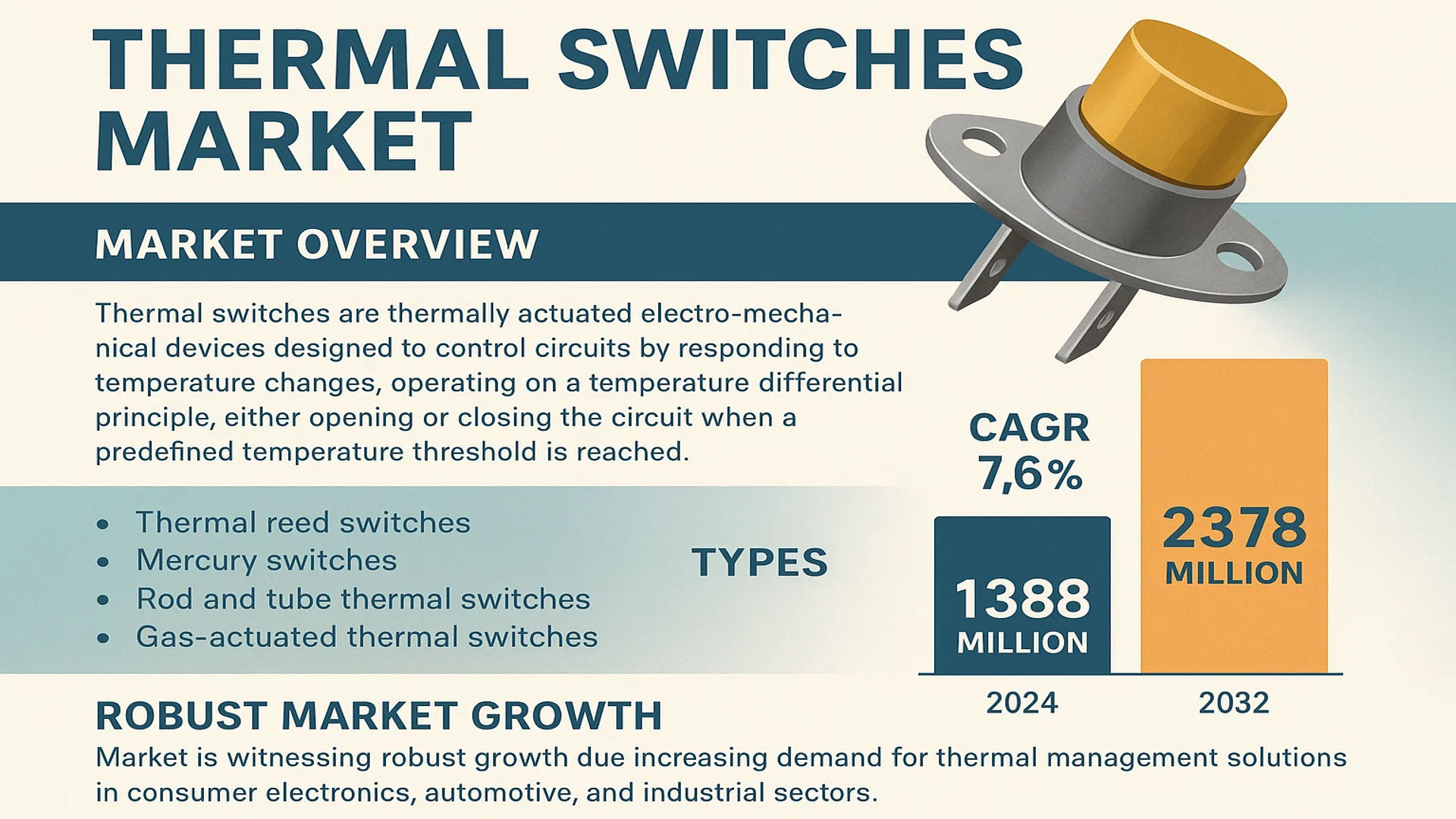
The global Thermal Switches Market was valued at 1388 million in 2024 and is projected to reach US$ 2378 million by 2032, at a CAGR of 7.6% during the forecast period.
Thermal switches are thermally actuated electro-mechanical devices designed to control circuits by responding to temperature changes. These reusable switches operate on a temperature differential principle, either opening or closing the circuit when a predefined temperature threshold is reached. Unlike thermal fuses, thermal switches can reset automatically or manually after the temperature normalizes, making them ideal for applications requiring repeated protection cycles. They are available in various types, including thermal reed switches, mercury switches, rod and tube thermal switches, and gas-actuated thermal switches.
The market is witnessing robust growth due to increasing demand for thermal management solutions in consumer electronics, automotive, and industrial sectors. The rise in miniaturization trends and the adoption of smart thermal switches with advanced sensing capabilities are further propelling the market. Key players such as Honeywell, Control Products (CPI), and EAW Relaistechnik are focusing on innovation to enhance product efficiency and compliance with environmental regulations, including RoHS standards.
MARKET DYNAMICS
MARKET DRIVERS
Growing Demand for Electronics Miniaturization Driving Thermal Switches Adoption
The global electronics industry continues its relentless push toward smaller, more compact devices across consumer, industrial and automotive applications. This miniaturization trend directly fuels demand for thermal switches designed specifically for space-constrained environments. Market analysis indicates compact thermal switches currently represent over 35% of total market share, with projections showing this segment growing at 8.2% CAGR through 2032. The proliferation of wearable devices, IoT sensors and 5G infrastructure components has created a critical need for reliable thermal management solutions in increasingly dense electronic packages. Thermal switch manufacturers have responded by developing micro-electromechanical systems (MEMS) based solutions that maintain performance while reducing footprint by up to 60% compared to conventional designs.
Stringent Safety Regulations Accelerating Market Penetration
Increasing regulatory focus on equipment safety and energy efficiency continues to drive thermal switch adoption across multiple industries. Recent updates to international standards such as IEC 60730 for appliance safety and ISO 26262 for automotive systems have mandated more robust thermal protection measures. The automotive sector in particular has seen rapid adoption, with thermal switch integration in electric vehicle battery management systems growing at 18% annually. Industrial applications account for approximately 42% of thermal switch deployments, as facility operators prioritize compliance with workplace safety regulations while seeking to reduce maintenance costs through predictive thermal monitoring.
Advancements in Smart Thermal Management Solutions
The integration of IoT capabilities and predictive analytics into thermal switches represents a significant market driver. Modern intelligent thermal switches now incorporate wireless connectivity and machine learning algorithms to provide real-time thermal mapping and failure prediction. These smart solutions currently command a 20% price premium over conventional thermal switches, with adoption concentrated in mission-critical industrial and data center applications. The ability to integrate with building management systems and industrial automation platforms has further expanded their value proposition. Recent product launches featuring cloud-based thermal analytics demonstrate how manufacturers are extending functionality beyond basic temperature monitoring.
MARKET RESTRAINTS
High Development Costs Limiting Market Expansion
While demand grows, the thermal switches market faces significant barriers from rising development and certification costs. Designing switches that meet increasingly stringent industry specifications requires substantial R&D investment – often exceeding $500,000 for new product development cycles. The aerospace and defense sector exemplifies this challenge, where qualification testing alone can account for 30-40% of total development expenses. These costs create particular challenges for small and medium manufacturers seeking to enter high-value market segments, effectively restricting innovation to established players with sufficient capital resources.
Material Supply Chain Disruptions Impacting Production
Thermal switch manufacturers continue grappling with material availability issues affecting production capacity. Specialty alloys and precision components used in high-performance switches remain subject to extended lead times and price volatility. The market for bimetallic strips – a key component in many thermal switch designs – has seen prices increase by 18-22% over the past two years. These supply constraints disproportionately affect manufacturers offering customized solutions, as proprietary material formulations limit substitution options. The resulting production bottlenecks have led to extended delivery timelines across the industry.
Technical Limitations in Extreme Environments
Performance limitations present ongoing challenges for thermal switch applications in extreme operating conditions. Many conventional switch designs struggle to maintain calibration accuracy in environments with rapid temperature fluctuations or vibration exposure. Industrial applications involving temperatures above 150°C currently represent an underserved market segment, with fewer than 15% of available products rated for these conditions. The development of ruggedized thermal switches capable of withstanding harsh industrial and automotive environments remains an area requiring significant technological advancement.
MARKET CHALLENGES
Standardization Issues Creating Integration Barriers
The lack of universal standards for thermal switch specifications and interfaces continues to challenge widespread adoption. With over 25 different switching configurations currently available across manufacturers, system integrators face compatibility issues when sourcing components. This fragmentation particularly impacts industrial automation projects where thermal protection systems must interface with equipment from multiple vendors. The resulting customization requirements add 15-20% to total implementation costs for complex installations.
Competitive Pressure from Alternative Technologies
Traditional thermal switches face increasing competition from solid-state alternatives and advanced thermal monitoring systems. Integrated circuit-based temperature sensors now offer comparable accuracy at lower price points for many consumer applications. While electromechanical thermal switches maintain advantages in reliability and simplicity, they must continually demonstrate value against these alternative solutions. The automotive sector exemplifies this dynamic, where traditional thermal protection devices now compete with software-based thermal management systems in next-generation vehicle architectures.
MARKET OPPORTUNITIES
Expansion in Renewable Energy Applications
The rapid growth of renewable energy infrastructure presents significant opportunities for thermal switch manufacturers. Solar inverters, wind turbine generators and battery storage systems all require robust thermal protection solutions capable of withstanding demanding outdoor environments. Market analysis suggests the renewable energy sector could account for 22% of total thermal switch demand by 2027, up from just 8% in 2022. This growth aligns with global investments in clean energy projected to exceed $1.7 trillion annually by 2025, creating a substantial addressable market for specialized thermal management solutions.
Development of Medical-Grade Thermal Protection Solutions
The healthcare sector represents an emerging high-value market for thermal switch innovations. Medical equipment manufacturers increasingly seek compact, reliable thermal protection devices for diagnostic imaging systems, sterilization equipment and portable medical devices. The stringent requirements of medical applications – including biocompatibility certifications and ultra-high reliability standards – create opportunities for manufacturers able to meet these specialized needs. With the global medical device market projected to reach $600 billion by 2025, thermal switch suppliers investing in FDA-compliant product development stand to capture significant market share.
Advancements in Additive Manufacturing Technologies
The adoption of additive manufacturing techniques presents opportunities for thermal switch innovation and production efficiency. 3D printing enables complex internal geometries that improve thermal response characteristics while reducing material usage. Early adopters report 30-40% reductions in prototyping costs and lead times through additive manufacturing. As the technology matures, it may enable mass customization capabilities – allowing manufacturers to produce application-specific thermal switches without traditional minimum order quantity constraints. Several industry leaders have already introduced 3D-printed switch components with performance characteristics exceeding conventionally manufactured alternatives.
THERMAL SWITCHES MARKET TRENDS
Smart Thermal Switches to Revolutionize Temperature Control
The thermal switches market is undergoing significant transformation with the rapid adoption of smart technologies. IoT-enabled thermal switches are gaining traction across industries, allowing real-time temperature monitoring and remote adjustments through integrated systems. These advanced switches provide higher energy efficiency, reducing operational costs by optimizing thermal management in applications ranging from industrial machinery to HVAC systems. Furthermore, manufacturers are improving response time accuracy, with some next-gen thermal switches achieving activation precision within ±2°C. This level of reliability is particularly crucial for mission-critical applications like data centers and medical equipment.
Other Trends
Miniaturization Across Industries
The demand for compact thermal switches continues growing as electronic devices become smaller and more sophisticated. In consumer electronics alone, the push for slimmer smartphones and tablets has driven innovations in micro thermal switches that occupy minimal PCB space while maintaining robust protection capabilities. The automotive sector is similarly adopting miniature solutions for battery management in EVs, where space optimization is paramount. Industry data suggests thermal switches under 5mm in size now account for over 35% of new device integrations.
Stringent Safety Regulations Driving Market Growth
Global safety standards are becoming increasingly rigorous, particularly for thermal switches used in high-risk applications like industrial boilers, power generation, and aerospace systems. Regulatory bodies worldwide now mandate redundant thermal protection in many of these systems, directly increasing market demand. The UL, CE, and RoHS certifications have become baseline requirements, pushing manufacturers to develop more compliant products using environmentally-friendly materials. This regulatory pressure, combined with rising liability concerns among equipment manufacturers, creates sustained demand for high-reliability thermal switches with proven safety records.
COMPETITIVE LANDSCAPE
Key Industry Players
Leading Companies Drive Market Growth Through Innovation and Strategic Expansion
The global thermal switches market is moderately fragmented, with a diverse mix of established players and emerging competitors vying for market share. Honeywell stands as a dominant force in the industry, leveraging its extensive distribution network and broad product portfolio that spans across multiple temperature ranges and applications. The company’s strong foothold in aerospace and industrial automation sectors contributes significantly to its leadership position.
Control Products (CPI) maintains a robust presence through its specialized thermal switch solutions for demanding applications, particularly in military and industrial environments. Their reputation for reliability in extreme conditions continues to attract partnerships with major OEMs across North America and Europe.
Meanwhile, EAW Relaistechnik has emerged as a key European player, recognized for its precision-engineered thermal switch products. The company’s focus on customized solutions for automotive and HVAC applications has enabled steady growth in regional markets.
Chinese manufacturers like Oukedianzi and Xiuzhu Electronics are making substantial inroads into the global market, competing primarily on price while gradually improving product quality. Their growing production capacities in Asia present both competition and partnership opportunities for western manufacturers.
The competitive intensity is increasing as companies invest heavily in R&D to develop smart thermal switches with IoT compatibility. Industry leaders are also expanding their geographical presence through strategic acquisitions and partnerships, particularly in emerging markets where demand is rising.
List of Key Thermal Switches Manufacturers
- Honeywell International Inc. (U.S.)
- Control Products, Inc. (CPI) (U.S.)
- EAW Relaistechnik GmbH (Germany)
- Setrab AB (Sweden)
- Senasys Corporation (U.S.)
- Miltec UV (U.S.)
- Oukedianzi Electronics Co., Ltd. (China)
- HENG HAO Electronic Co. (China)
- Dingshi Dianzi Technology Co. (China)
- Xiuzhu Electronic Precision Co. (China)
- Huakaiwei Electronic Technology Co. (China)
- Fuaosi Electric Co. (China)
Segment Analysis:
By Type
Thermal Reed Switches Segment Leads Due to High Reliability and Longevity in Electromechanical Applications
The market is segmented based on type into:
- Thermal Reed Switches
- Mercury Switches
- Rod and Tube Thermal Switches
- Gas-Actuated Thermal Switches
- Others
By Application
Industrial Segment Dominates Owing to Wide Utilization in Motors, Transformers and Heavy Equipment
The market is segmented based on application into:
- Industrial
- Commercial
- Military
- Others
By End User
Consumer Electronics Gains Traction with Rising Adoption in Smartphones and Laptops
The market is segmented based on end user into:
- Consumer Electronics
- Automotive
- Manufacturing
- Energy & Power
- Others
Regional Analysis: Thermal Switches Market
Asia-Pacific
The Asia-Pacific region dominates the global thermal switches market, accounting for over 40% of total revenue in 2024. This leadership position is driven by rapid industrialization and urbanization in countries like China, India, South Korea, and Japan. China, in particular, contributes nearly 30% of global demand, supported by its massive electronics manufacturing sector and expanding automotive production capacity. The region benefits from cost-effective manufacturing capabilities, with key players like Oukedianzi and Xiuzhu Electronics supplying thermal switches for consumer electronics and industrial applications. However, environmental regulations are becoming stricter, prompting manufacturers to shift toward lead-free and RoHS-compliant products.
North America
North America is a high-growth market for thermal switches due to stringent safety standards in industries such as automotive, aerospace, and consumer electronics. The U.S. holds the largest share in the region, with companies like Honeywell and Control Products (CPI) leading the market through innovative, high-performance thermal switches. The demand is further driven by EV battery management systems and smart home devices, which require precise temperature regulation. The Infrastructure Investment and Jobs Act has also indirectly boosted industrial applications, increasing the need for reliable thermal protection in machinery and energy systems.
Europe
Europe remains a key market, characterized by strong regulatory oversight under EU directives like RoHS and REACH, which mandate the use of eco-friendly materials in thermal switches. Germany and the U.K. are major contributors, supported by their advanced automotive and industrial automation sectors. Companies such as EAW Relaistechnik specialize in high-precision thermal switches for industrial equipment. While cost sensitivity restricts rapid adoption in Eastern Europe, Western European nations prioritize smart thermal switches with IoT integration, aligning with the region’s Industry 4.0 initiatives.
South America
The South American market is nascent but growing, led by Brazil and Argentina, where thermal switches are increasingly used in automotive and HVAC applications. Economic instability and limited local manufacturing capabilities, however, hinder faster adoption. Most thermal switches in the region are imported from Asia and North America. Brazil’s rising industrial automation investments—especially in food processing and energy—present long-term opportunities for thermal switch suppliers, though price competition remains intense.
Middle East & Africa
This region shows moderate growth potential, primarily driven by infrastructure development in the UAE, Saudi Arabia, and South Africa. The oil & gas sector is a key user of thermal switches for equipment protection, but market expansion is constrained by low industrialization rates outside energy-centric economies. Turkey and Israel, with their developing electronics industries, are emerging as notable markets. Though demand is rising, the lack of strict environmental regulations slows the shift toward sustainable thermal switch solutions.
Report Scope
This market research report provides a comprehensive analysis of the global and regional Thermal Switches markets, covering the forecast period 2024–2032. It offers detailed insights into market dynamics, technological advancements, competitive landscape, and key trends shaping the industry.
Key focus areas of the report include:
- Market Size & Forecast: Historical data and future projections for revenue, unit shipments, and market value across major regions and segments. The global Thermal Switches market was valued at USD 1,388 million in 2024 and is projected to reach USD 2,378 million by 2032, growing at a CAGR of 7.6% during the forecast period.
- Segmentation Analysis: Detailed breakdown by product type (Thermal Reed Switches, Mercury Switches, Rod and Tube Thermal Switches, Gas-Actuated Thermal Switches), application (Industrial, Commercial, Military, Others), and end-user industry to identify high-growth segments and investment opportunities.
- Regional Outlook: Insights into market performance across North America, Europe, Asia-Pacific, Latin America, and the Middle East & Africa, including country-level analysis where relevant. Asia-Pacific accounted for the largest market share of 38.5% in 2024.
- Competitive Landscape: Profiles of leading market participants, including their product offerings, R&D focus, manufacturing capacity, pricing strategies, and recent developments such as mergers, acquisitions, and partnerships. Top players include Honeywell, Control Products (CPI), and EAW Relaistechnik.
- Technology Trends & Innovation: Assessment of emerging technologies including smart thermal switches with enhanced sensing capabilities, miniaturization trends, and integration with IoT systems for better temperature monitoring.
- Market Drivers & Restraints: Evaluation of factors driving market growth (increasing demand from consumer electronics and automotive sectors) along with challenges (environmental regulations on mercury-based switches).
- Stakeholder Analysis: Insights for component suppliers, OEMs, system integrators, investors, and policymakers regarding the evolving ecosystem and strategic opportunities in thermal switch technology.
Primary and secondary research methods are employed, including interviews with industry experts, data from verified sources, and real-time market intelligence to ensure the accuracy and reliability of the insights presented.
FREQUENTLY ASKED QUESTIONS:
What is the current market size of Global Thermal Switches Market?
-> Thermal Switches Market was valued at 1388 million in 2024 and is projected to reach US$ 2378 million by 2032, at a CAGR of 7.6% during the forecast period.
Which key companies operate in Global Thermal Switches Market?
-> Key players include Honeywell, Control Products (CPI), EAW Relaistechnik, Setrab, Senasys, and Miltec UV, among others.
What are the key growth drivers?
-> Key growth drivers include increasing demand from consumer electronics, automotive thermal management systems, and industrial automation applications.
Which region dominates the market?
-> Asia-Pacific dominates the market with 38.5% share in 2024, driven by electronics manufacturing in China and Japan.
What are the emerging trends?
-> Emerging trends include miniaturization of thermal switches, development of lead-free alternatives, and integration with smart monitoring systems.

Get Sample Report PDF for Exclusive Insights
Report Sample Includes
- Table of Contents
- List of Tables & Figures
- Charts, Research Methodology, and more...
 Download Sample Report PDF