

Navitas Targets the AI Power Wall with Planned $232.8 Million Claros Acquisition
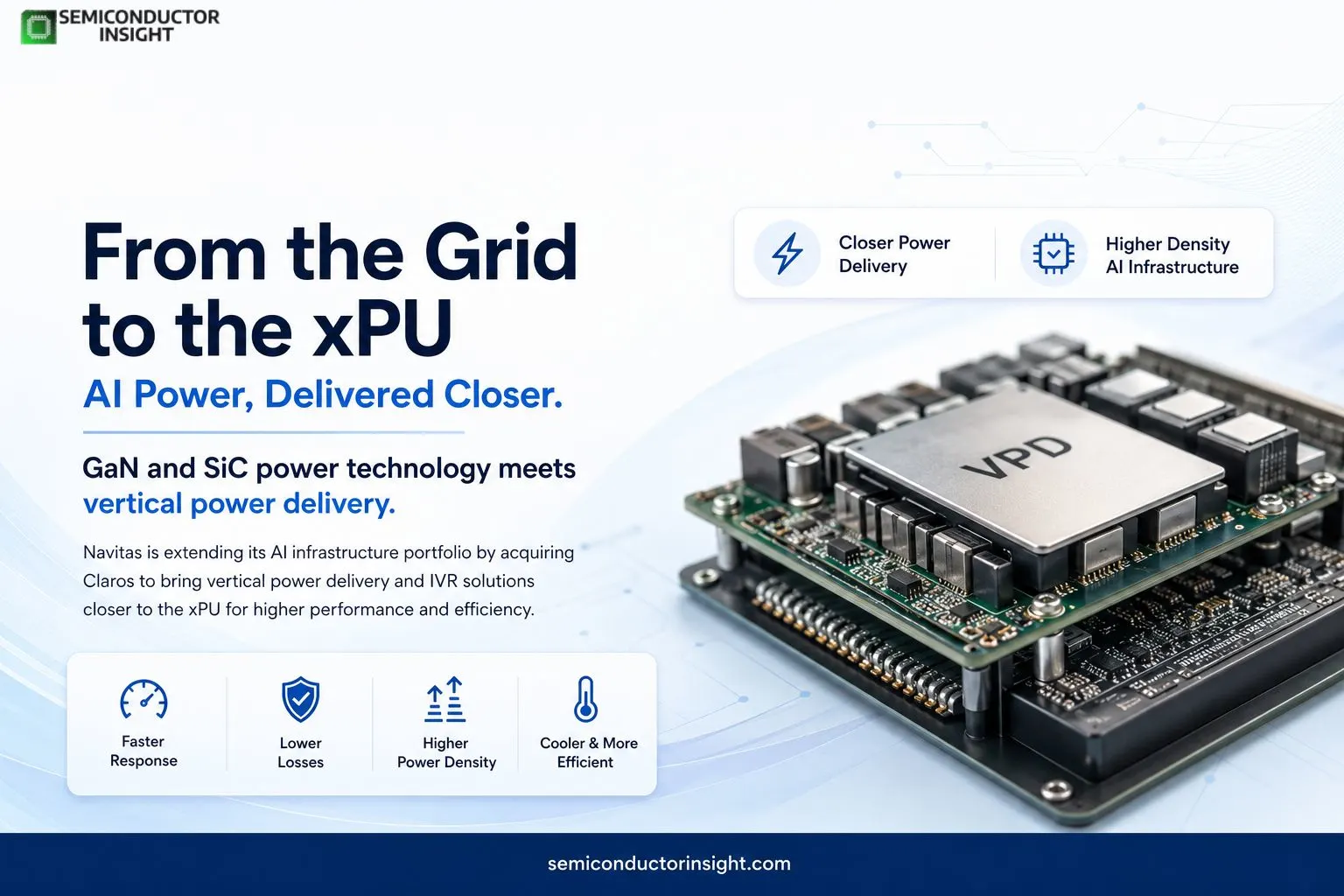
GaN and SiC power technology meets vertical power delivery as Navitas moves to extend its AI infrastructure portfolio from the grid to the xPU
As AI accelerators demand increasingly higher currents, faster response times and greater power density, the bottleneck in next-generation data centers is shifting beyond computing performance itself. Navitas Semiconductor is responding with a strategic move to bring power delivery closer to the processor.
The company has signed a definitive agreement to acquire Claros Inc., a power management technology developer focused on vertical power delivery (VPD) and integrated voltage regulator (IVR) solutions for advanced AI data centers. The transaction is valued at up to approximately $232.8 million, based on Navitas’ August 21 closing share price, and is expected to close before the end of 2026, subject to customary conditions and regulatory approvals.
The planned acquisition represents a significant expansion of Navitas’ strategy around AI infrastructure power management, combining Claros’ close-to-chip power delivery technologies with Navitas’ gallium nitride (GaN), high-voltage silicon carbide (SiC) and ultra-high-voltage SiC portfolio.
The rapid expansion of AI workloads is pushing GPUs, CPUs, TPUs, NPUs and other xPUs toward unprecedented power requirements. Modern processors increasingly need thousands of amps while also requiring power delivery systems capable of responding almost instantaneously to changing workloads.
This is creating what Navitas describes as an AI infrastructure “power wall.”
From Grid-to-xPU: A Different Power Architecture
Claros brings technologies designed to address the final stage of this power-delivery chain.
It’s VPD and IVR architectures integrate power conversion, control, drive circuitry and passive components into compact solutions that can be positioned directly beneath or within the processor package or PCB.
Instead of moving power across longer board-level distances, the architecture allows electricity to travel only a few millimeters toward the xPU.
According to Navitas, this approach can enable:
- Faster transient response
- Lower electrical impedance
- Reduced board-level power losses
- Higher power density
- Improved efficiency at sub-volt processor levels
- Reduced heat generation
- Greater compute density within AI infrastructure
This close-to-chip architecture is particularly relevant as AI accelerator platforms continue to increase their power consumption while maintaining strict requirements around thermal management and rack-level efficiency.
800V HVDC Creates the First Half of the Opportunity
The acquisition also fits into a broader transformation already underway in AI data-center power architecture.
Navitas has been developing 800V high-voltage direct-current (HVDC) power solutions designed to support higher-density AI racks. The company’s strategy combines GaN and high-voltage/ultra-high-voltage SiC technologies to address the earlier stages of the power conversion chain.
The Claros acquisition would extend that architecture much closer to the processor.
In effect, Navitas is attempting to build a more complete pathway:
Grid → HVDC → Rack Power → Board-Level Conversion → VPD/IVR → xPU
That broader positioning could allow the company to participate in multiple stages of the rapidly evolving AI power infrastructure ecosystem rather than focusing solely on individual semiconductor components.
Navitas’ investor materials identify AI data centers, energy and grid infrastructure, performance computing and industrial electrification as key high-power applications for its semiconductor technologies.
The strategic importance of the transaction extends beyond technology integration.
Following completion, Navitas expects it’s identified 2030 serviceable available market (SAM) to exceed $8 billion, more than doubling its previous opportunity.
The company expects the combined portfolio to include approximately:
$3.5 billion – GaN and high-voltage/ultra-high-voltage SiC
$3.5 billion+ – VPD and IVR opportunities being added through Claros
~$1 billion – New JFET technology opportunity
This expansion positions the acquisition as more than a bolt-on technology purchase. It is intended to broaden Navitas’ participation across the entire AI power-delivery chain.
Why Close-to-Chip Power Delivery Is Gaining Attention?
- AI computing is changing the economics and engineering requirements of data-center infrastructure.
- As processor performance increases, simply adding more computing capability does not guarantee proportional system-level gains. Power must arrive at the processor with sufficient current, voltage stability and speed.
- This makes the physical distance between the power source and the processor increasingly important.
A Strategic Move under Navitas 2.0
The acquisition follows Navitas’ broader Navitas 2.0 transformation, which has increasingly focused the company on high-power markets such as AI data centers, grid infrastructure and industrial electrification.
Navitas previously identified a $3.5 billion 2030 SAM for its GaN and high-voltage SiC opportunity, reflecting its strategic shift toward higher-power applications.
Importantly, the company says its existing short- to mid-term financial strategy remains unchanged. Claros is expected to provide an additional growth opportunity beginning around 2028-2029, alongside Navitas’ organic growth in 800V HVDC GaN and SiC solutions.
The transaction has been unanimously approved by the boards of both companies.
For a more thorough report, please contact us using our most recent report: https://semiconductorinsight.com/report/industrial-power-management-ic-market/

Comments (0)