
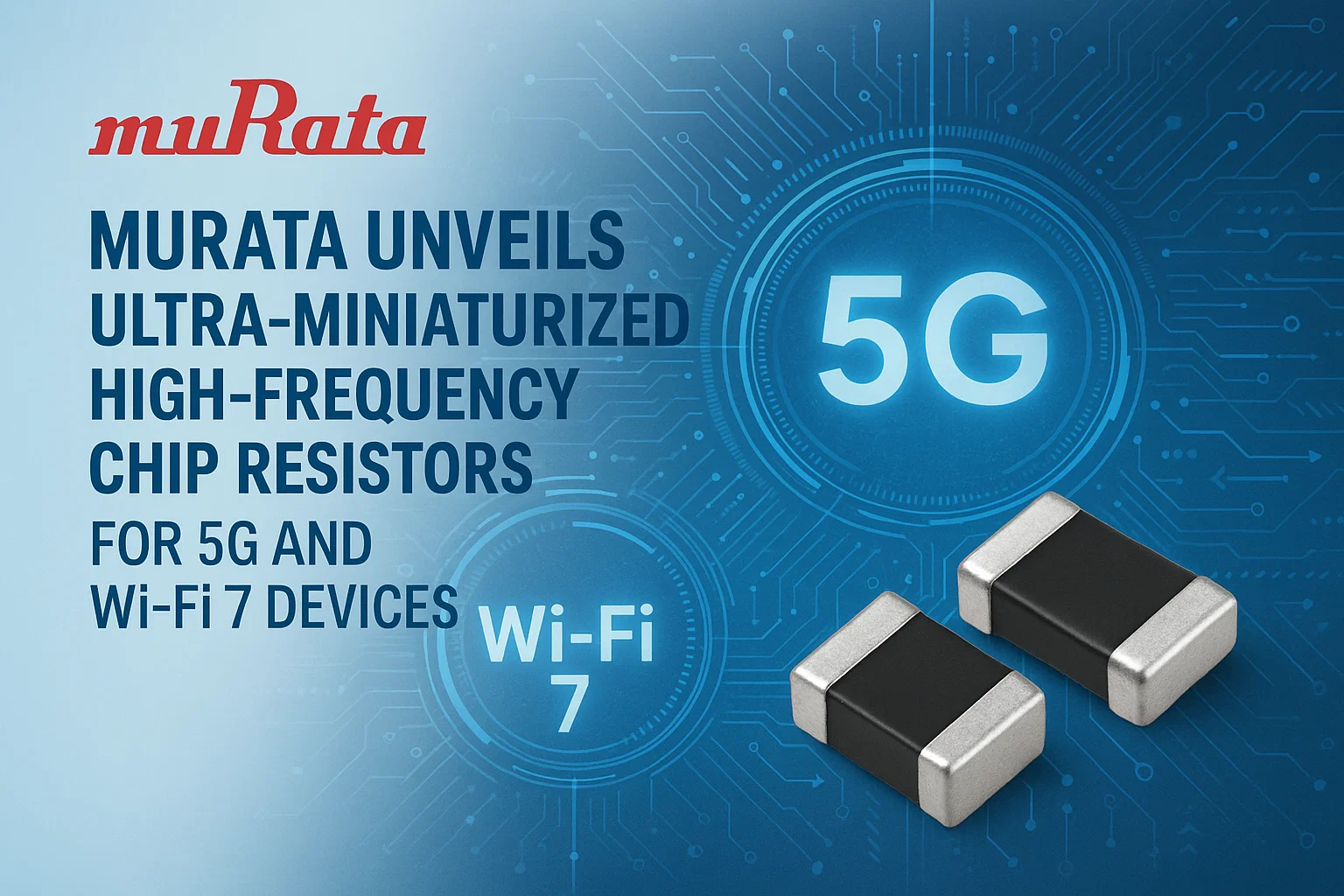
Murata Unveils Ultra-Miniaturized High-Frequency Chip Resistors for 5G and Wi-Fi 7 Devices
In the fast-paced world of electronics, components that once played behind-the-scenes roles are now stepping into the spotlight. One such component is the high-frequency chip resistor. While resistors might sound like a basic part of any circuit, their specialized high-frequency counterparts are essential for powering next-generation technologies from 5G infrastructure and Wi-Fi 7 routers to autonomous vehicles and satellite communications.
According to recent figures, the global High-Frequency Chip Resistors Market was valued at USD 1,086 million in 2024 and is projected to reach USD 1,503 million by 2032, growing at a CAGR of 4.9%. This steady growth reflects how crucial these components have become in addressing the world’s appetite for speed, connectivity, and reliability.
Access Your Free Sample Report- High Frequency Chip Resistors Market
Understanding High-Frequency Chip Resistors
Before diving into trends, it’s worth clarifying what sets high-frequency chip resistors apart. Unlike standard resistors, which simply oppose current flow, high-frequency resistors are engineered to maintain stability, accuracy, and minimal signal loss at RF and microwave frequencies.
In practice, this means they are optimized for:
- Low parasitics (inductance & capacitance): Preventing unwanted interference.
- Thermal stability: Handling heat in compact, high-power environments.
- Precision tolerance: Supporting mission-critical systems like radar and satellite links.
In other words, they may be tiny in size, but their role in enabling communication, sensing, and data transfer at lightning-fast speeds cannot be overstated.
Recent Industry Developments
1. Miniaturization & High-Power Handling
One of the most exciting developments in the past year has come from Murata Manufacturing, which unveiled a new generation of ultra-miniaturized high-frequency chip resistors. Covered by outlets like EE Times and Electronics Weekly, these components are designed to thrive in the sub-6 GHz and mmWave bands used in 5G and Wi-Fi 7 devices.
Key advancements include:
- Smaller footprints: Critical for smartphones, wearables, and IoT gadgets that demand compact RF modules.
- Better thermal dissipation: Allowing higher power handling without sacrificing reliability.
- Lower signal distortion: Ensuring smooth data flow in congested wireless environments.
With devices like the iPhone 16 and Samsung’s Galaxy Z series integrating ever more radios and antennas, these resistors are at the heart of keeping devices both slim and powerful.
2. Automotive Applications Take the Wheel
As cars evolve into computers on wheels, the need for high-frequency resistors in automotive radar is skyrocketing. Vishay Intertechnology recently expanded its portfolio of thin-film resistors optimized for 77 GHz radar systems. Outlets like Electronics360 have highlighted how this directly supports ADAS (Advanced Driver Assistance Systems) and the push toward autonomous driving.
Why does this matter?
- Radar precision: High-frequency resistors ensure low noise and high resolution in collision-avoidance systems.
- EV compatibility: With electric vehicles demanding compact, lightweight components, thin-film resistors offer efficiency gains.
- Safety-critical reliability: Automotive-grade resistors must withstand vibrations, extreme temperatures, and long lifespans.
In short, resistors are becoming just as important as lidar and cameras in shaping the future of mobility.
Download Sample Report PDF- High Frequency Chip Resistors Market
3. Aerospace & Defense: Reliability Above All
Defense and aerospace demand the highest levels of component stability, and high-frequency resistors are no exception. Coverage in Military & Aerospace Electronics reveals how TT Electronics and Susumu are delivering radiation-tolerant high-frequency resistors for satellites and radar systems.
Applications include:
- Satellite communications: Where thermal cycling and cosmic radiation can degrade standard components.
- Military radar: Operating at high power levels in harsh battlefield environments.
- Navigation systems: Ensuring GPS and tracking remain accurate under duress.
This segment highlights a recurring theme: in aerospace and defense, failure is not an option making resistors one of the unsung heroes of mission-critical reliability.
4. GaN and the Rise of 5G Infrastructure
The rollout of 5G base stations and upcoming 6G research have driven a shift toward GaN (Gallium Nitride) power amplifiers, which deliver higher efficiency at higher frequencies. To keep up, companies like Panasonic and Rohm are introducing resistors fine-tuned for GaN integration, as reported in Microwave Journal.
Key benefits include:
- Reduced distortion: Supporting clean, high-bandwidth signals in 5G/6G networks.
- Energy efficiency: Lowering operating costs for massive telecom infrastructure.
- Compatibility with satellite comms: Bridging terrestrial and space-based connectivity.
In essence, as GaN revolutionizes RF power electronics, high-frequency resistors are evolving to match.
5. Shifts in Supply Chains & Manufacturing
Beyond technology, geopolitical and economic factors are reshaping resistor production. According to Nikkei Asia, Japanese and Taiwanese manufacturers are expanding operations in Southeast Asia to reduce dependency on China.
This move has several implications:
- Supply chain resilience: Protecting global electronics makers from disruptions.
- Regional growth: Vietnam, Malaysia, and Thailand are emerging as production hubs.
- Cost control: Diversified manufacturing helps stabilize pricing in volatile markets.
In an industry where a single bottleneck can ripple across the world, these shifts highlight how geopolitics and technology are deeply intertwined.
Market Outlook: From 2024 to 2032
The projected growth from USD 1,086 million in 2024 to USD 1,503 million by 2032 reflects more than just steady demand. It underscores how connectivity, mobility, and defense priorities are converging.
Key Drivers of Growth:
- 5G and Wi-Fi 7 Expansion: Every smartphone, router, and base station requires advanced resistors to keep signals clean.
- Autonomous Vehicles: Radar, V2X communication, and in-vehicle networks depend on RF stability.
- Aerospace & Defense: With global defense budgets rising, reliable high-frequency components are in constant demand.
- IoT Ecosystem: Billions of connected devices need compact, efficient RF modules.
- Manufacturing Diversification: Regional hubs will boost capacity and stabilize supply.
Challenges to Watch:
- Raw material volatility (nickel, ruthenium, palladium).
- Design complexity as frequencies rise beyond 100 GHz in early 6G research.
- Intense competition pushing down margins in commodity resistor categories.
Click Here To Download Full Sample Report- High Frequency Chip Resistors Market
The Bigger Picture: Why High-Frequency Resistors Matter
To many outside the electronics world, resistors seem like the least glamorous component. But zoom in on today’s most pressing innovations driverless cars, smart cities, global internet coverage, next-gen smartphones and you’ll find high-frequency resistors embedded in every step.
They are the gatekeepers of signal integrity, ensuring that as data moves faster, systems remain stable. Without them, the ambitious vision of a hyper-connected world simply wouldn’t function.
The high-frequency chip resistor industry is experiencing a quiet but profound transformation. From Murata’s miniaturized innovations to Vishay’s automotive breakthroughs, from defense-ready resistors by TT Electronics and Susumu to GaN-optimized designs by Panasonic and Rohm, and finally to geopolitical supply chain shifts, the developments are both technological and strategic.
With the market set to grow at a CAGR of 4.9% through 2032, this sector is not just keeping pace with global electronics it’s actively enabling the future of 5G, EVs, aerospace, and IoT.

Comments (0)