MARKET INSIGHTS
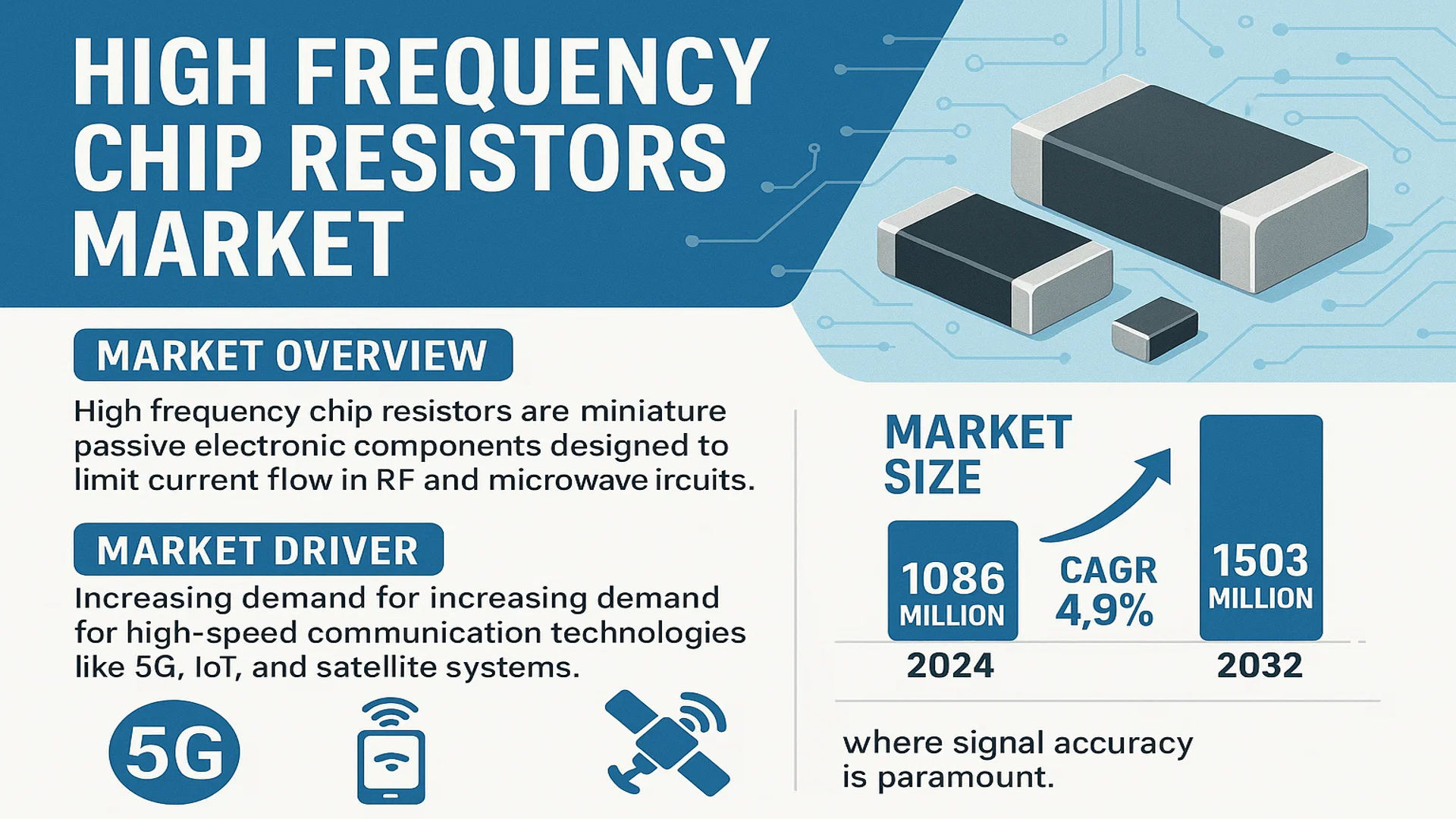
The global High Frequency Chip Resistors Market was valued at 1086 million in 2024 and is projected to reach US$ 1503 million by 2032, at a CAGR of 4.9% during the forecast period.
High frequency chip resistors are miniature passive electronic components designed to limit current flow in circuits operating at radio frequencies (RF) and microwave frequencies. These resistors are critical for maintaining signal integrity in applications requiring low parasitic effects and stable performance. They include various types such as metal film resistors, thin film chip resistors, thick film chip resistors, and others, each optimized for specific frequency ranges and precision requirements.
The market growth is driven by increasing demand for high-speed communication technologies like 5G, IoT, and satellite systems, where signal accuracy is paramount. Additionally, the aerospace and medical industries are adopting these components for applications like avionics and diagnostic equipment. Key players such as Vishay, Mini-Systems Inc., and Ohmite Manufacturing Co. are expanding their product portfolios to cater to emerging RF applications. While North America leads in technological adoption, Asia-Pacific is witnessing rapid growth due to expanding electronics manufacturing hubs in China and Japan.
MARKET DYNAMICS
MARKET DRIVERS
Proliferation of 5G Technology Accelerates Demand for High Frequency Chip Resistors
The rapid global deployment of 5G networks is significantly boosting demand for high-frequency chip resistors, as these components are essential for managing signal integrity in high-speed communication circuits. The 5G infrastructure market is projected to grow exponentially, requiring more advanced passive components capable of operating at millimeter-wave frequencies. High frequency chip resistors offer superior performance in RF applications due to their low parasitic effects and stable temperature coefficients, making them indispensable for 5G base stations, small cells, and network equipment. This technological shift is driving manufacturers to innovate their product lines to meet the stringent requirements of next-generation wireless communications.
Expansion of Aerospace and Defense Electronics Creates Sustained Demand
Modern aerospace and defense systems increasingly rely on high-frequency electronic components for radar systems, satellite communications, and avionics. The global aerospace industry’s continuous investment in electronic warfare systems and unmanned aerial vehicles is creating robust demand for precision resistors that can maintain performance in extreme environments. These applications require components with high reliability, tight tolerance, and excellent high-frequency characteristics. As defense budgets across major economies continue to allocate substantial resources to electronic modernization programs, the market for high frequency chip resistors is positioned for long-term growth.
Furthermore, the miniaturization trend in defense electronics is pushing manufacturers to develop smaller form factor resistors without compromising performance parameters, creating additional opportunities for innovation in this space.
➤ The increasing integration of AI and IoT in industrial automation is significantly expanding the application scope of high frequency chip resistors in motion control and sensor systems.
Additionally, the growing adoption of electric vehicles is contributing to market expansion, as these vehicles require advanced electronic systems where high frequency chip resistors play a crucial role in power management and signal conditioning circuits.
MARKET CHALLENGES
Stringent Performance Requirements Increase Manufacturing Complexities
While the market shows promising growth, manufacturers face significant challenges in meeting the increasingly stringent performance requirements for high frequency applications. The need for ultra-low parasitic inductance and capacitance, combined with tight tolerance specifications, complicates the manufacturing process. Producing resistors that can reliably operate at multi-GHz frequencies requires advanced materials and precision manufacturing techniques, which significantly increase production costs. This challenge is particularly acute for mid-sized manufacturers who must balance performance demands with competitive pricing pressures.
Other Challenges
Material Sourcing Constraints
The specialty materials required for high frequency chip resistors, including specific ceramic substrates and metal alloys, face periodic supply chain disruptions. These constraints can lead to production bottlenecks and increased lead times, impacting manufacturers’ ability to meet growing demand.
Thermal Management Issues
At high frequencies, power dissipation becomes a critical factor due to skin effect and other RF phenomena. Designing resistors that maintain stability while effectively managing thermal performance presents ongoing technical challenges for component engineers.
MARKET RESTRAINTS
High Development Costs Limit Market Penetration in Price-Sensitive Segments
The substantial R&D investments required to develop advanced high frequency chip resistors create a barrier to market expansion in cost-sensitive applications. While premium sectors like aerospace and telecommunications can absorb these costs, more price-conscious markets such as consumer electronics often opt for standard resistor solutions. This economic dynamic limits the addressable market for high-performance components, particularly in regions where cost competition is fierce. The industry must balance technological advancement with cost optimization strategies to overcome this restraint.
Additionally, the qualification processes for aerospace and military applications involve extensive testing and certification, which further adds to development timelines and costs, creating another significant barrier to market entry.
MARKET OPPORTUNITIES
Emerging Medical Imaging Technologies Open New Application Frontiers
The advancement of medical imaging technologies, particularly in MRI and ultrasound systems, presents significant growth opportunities for high frequency chip resistors. These medical applications require components that can maintain precision performance in high-frequency signal processing while meeting stringent reliability standards. As healthcare systems worldwide invest in next-generation diagnostic equipment, the demand for specialized resistors in medical electronics is expected to increase substantially. Manufacturers focusing on medical-grade certifications and biocompatible materials will be well-positioned to capitalize on this expanding market segment.
Moreover, the rise of wearable health monitoring devices creates additional opportunities, as these products increasingly incorporate RF functionality for wireless connectivity, requiring compact high-frequency components that can operate reliably in dynamic environments.
HIGH FREQUENCY CHIP RESISTORS MARKET TRENDS
Increased Demand for 5G Communication Infrastructure to Drive Market Growth
The global rollout of 5G networks has emerged as a critical driver for the high-frequency chip resistors market. These components are essential for ultra-fast signal processing in 5G base stations, mobile devices, and IoT applications where stability and minimal signal loss are paramount. With 5G adoption projected to cover over 65% of the global population by 2027, manufacturers are focusing on high-performance chip resistors that can operate efficiently at microwave frequencies. Thin film and metal film resistors, which provide superior high-frequency performance, are particularly in demand as they enable lower noise and better thermal stability in compact designs.
Other Trends
Expansion of Automotive Electronics
The automotive sector is increasingly integrating advanced driver-assistance systems (ADAS), radar, and in-vehicle connectivity, all of which rely on high-frequency chip resistors. With the global automotive electronics market expected to surpass $400 billion by 2030, the need for high-frequency resistors capable of maintaining stability under harsh environmental conditions is accelerating. Miniaturization trends in automotive PCBs are further pushing innovation in resistor technology, as components must fit compact layouts without sacrificing performance.
Advances in Aerospace and Defense Applications
The aerospace and defense industries demand high-reliability resistors for radar systems, avionics, and satellite communications, where component failure is not an option. The shift toward electronic warfare and next-generation radar systems is increasing the adoption of high-frequency chip resistors with precision tolerances and low-temperature coefficients. Furthermore, defense spending is on the rise globally, with NATO countries increasing budgets by over 3% annually, reinforcing demand for mission-critical electronic components.
COMPETITIVE LANDSCAPE
Key Industry Players
Manufacturers Focus on High-Performance Offerings to Gain Competitive Edge
The global high frequency chip resistors market features a mix of established players and emerging specialists, creating a dynamic competitive environment. Vishay Intertechnology, Inc. remains a dominant force, leveraging its extensive product portfolio and strong distribution network across North America, Europe, and Asia-Pacific. The company’s recent investments in ultra-precision thin film technology have further strengthened its market position.
Mini-Systems, Inc. and Ohmite Manufacturing Co. hold significant shares in the high-frequency segment, particularly for aerospace and defense applications. Their expertise in producing stable, low-noise resistors suitable for high-frequency circuits gives them an edge in specialized markets. Both companies are actively expanding their production capabilities to meet growing demand from 5G infrastructure and automotive radar systems.
Meanwhile, Piconics, Inc. and SV Microwave Inc. are emerging as strong contenders by focusing on niche applications requiring extreme frequency performance. These companies differentiate themselves through customized solutions and faster prototyping services, appealing to research institutions and defense contractors.
The competitive landscape is further shaped by strategic initiatives, with companies like Precision Resistive Products, Inc. and International Manufacturing Services, Inc. acquiring smaller specialists to enhance their high-frequency capabilities. This consolidation trend is expected to continue as manufacturers aim to offer complete passive component solutions.
List of Key High Frequency Chip Resistor Manufacturers Profiled
- Vishay Intertechnology, Inc. (Global)
- Mini-Systems, Inc. (U.S.)
- Ohmite Manufacturing Co. (U.S.)
- Piconics, Inc. (U.S.)
- SV Microwave Inc. (U.S.)
- Precision Resistive Products, Inc. (U.S.)
- International Manufacturing Services, Inc. (U.S.)
- State of the Art, Inc. (U.S.)
- Compex Corp. (U.S.)
- Caddock Electronics, Inc. (U.S.)
- M-Tron Components, Inc. (U.S.)
- Cal-Chip Electronics, Inc. (U.S.)
Segment Analysis:
By Type
Metal Film Resistors Segment Leads Due to High Stability and Low Noise Performance
The market is segmented based on type into:
- Metal Film Resistors
- Subtypes: Precision, High Power, and Others
- Thin Film Chip Resistors
- Thick Film Chip Resistors
- Others
By Application
Industrial Applications Dominate Due to Extensive Use in Telecommunications and Power Electronics
The market is segmented based on application into:
- Industrial Applications
- Aerospace
- Medical Industry
- Others
By End-User
Telecommunications Sector Drives Demand for High-Frequency Performance Components
The market is segmented based on end-user into:
- Telecommunications
- Automotive
- Defense
- Electronics Manufacturing
- Others
Regional Analysis: High Frequency Chip Resistors Market
Asia-Pacific
The Asia-Pacific region dominates the global high frequency chip resistors market, accounting for the largest revenue share. This is primarily driven by China’s massive electronics manufacturing sector, which produces approximately 70% of the world’s consumer electronics. Japan and South Korea follow closely, with their advanced semiconductor industries and strong automotive electronics sectors. The region benefits from robust supply chains, competitive manufacturing costs, and growing investments in 5G infrastructure. However, the market faces challenges from increasing price competition and fluctuations in raw material availability. With rapid technological advancements in telecommunications and IoT applications, demand for high-performance thin film chip resistors continues to rise across the region.
North America
North America represents the second-largest market for high frequency chip resistors, characterized by strong demand from defense, aerospace, and medical sectors. The U.S. government’s initiatives like the CHIPS Act have boosted domestic semiconductor component manufacturing. Key players such as Vishay and Ohmite Manufacturing Co. are investing in R&D for ultra-precise resistors used in advanced radar systems and satellite communications. While industrial automation and electric vehicle production drive steady growth, the market faces constraints from stringent export controls and fluctuating trade policies affecting component sourcing.
Europe
Europe maintains a technologically advanced high frequency chip resistors market, with Germany and the UK leading in industrial and automotive applications. The region’s emphasis on Industry 4.0 and renewable energy systems has increased demand for reliable passive components. Stringent EU regulations on electronic waste and materials push manufacturers toward developing more sustainable resistor technologies. However, higher production costs compared to Asian manufacturers and complex compliance requirements present ongoing challenges for market growth.
South America
The South American market shows moderate but growing demand for high frequency chip resistors, primarily driven by Brazil’s expanding telecommunications infrastructure and Argentina’s developing electronics sector. Local production remains limited, with most components imported from Asia and North America. Economic instability and currency fluctuations in key markets continue to hinder faster adoption of advanced resistor technologies, though increasing investment in industrial automation presents future growth opportunities.
Middle East & Africa
This emerging market demonstrates growing demand, particularly from telecommunications infrastructure projects in GCC countries and South Africa’s industrial sector. The lack of local manufacturing capabilities results in complete reliance on imports, primarily from Europe and Asia. While oil & gas applications provide stable demand for high-reliability components, political uncertainties and limited technical expertise in some regions slow down market development. Nevertheless, planned smart city initiatives and 5G network expansions suggest promising long-term potential.
Report Scope
This market research report provides a comprehensive analysis of the global High Frequency Chip Resistors market, covering the forecast period 2024–2032. It offers detailed insights into market dynamics, technological advancements, competitive landscape, and key trends shaping the industry.
Key focus areas of the report include:
- Market Size & Forecast: Historical data and future projections for revenue, unit shipments, and market value across major regions and segments. The global High Frequency Chip Resistors market was valued at USD 1,086 million in 2024 and is projected to reach USD 1,503 million by 2032, growing at a CAGR of 4.9%.
- Segmentation Analysis: Detailed breakdown by product type (Metal Film Resistors, Thin Film Chip Resistors, Thick Film Chip Resistors, Others) and application (Industrial Applications, Aerospace, Medical Industry, Others) to identify high-growth segments and investment opportunities.
- Regional Outlook: Insights into market performance across North America, Europe, Asia-Pacific, Latin America, and the Middle East & Africa. Asia-Pacific dominates the market, with China being a key growth region.
- Competitive Landscape: Profiles of leading market participants including Vishay, Mini-Systems, Inc., Ohmite Manufacturing Co., Piconics, Inc., and State of the Art, Inc., covering their product offerings, R&D focus, and recent developments.
- Technology Trends & Innovation: Assessment of emerging technologies in resistor manufacturing, miniaturization trends, and performance enhancements for high-frequency applications.
- Market Drivers & Restraints: Evaluation of factors driving market growth such as increasing demand for electronics and telecommunications equipment, along with challenges like raw material price volatility.
- Stakeholder Analysis: Insights for component manufacturers, OEMs, suppliers, and investors regarding market opportunities and strategic positioning.
Primary and secondary research methods are employed, including interviews with industry experts and analysis of verified market data, to ensure the accuracy and reliability of the insights presented.
FREQUENTLY ASKED QUESTIONS:
What is the current market size of Global High Frequency Chip Resistors Market?
-> High Frequency Chip Resistors Market was valued at 1086 million in 2024 and is projected to reach US$ 1503 million by 2032, at a CAGR of 4.9% during the forecast period.
Which key companies operate in Global High Frequency Chip Resistors Market?
-> Key players include Vishay, Mini-Systems, Inc., Ohmite Manufacturing Co., Piconics, Inc., State of the Art, Inc., Precision Resistive Products, Inc., and International Manufacturing Services, Inc., among others.
What are the key growth drivers?
-> Key growth drivers include increasing demand for high-frequency electronic devices, growth in telecommunications infrastructure, and advancements in automotive electronics.
Which region dominates the market?
-> Asia-Pacific is the largest market, driven by electronics manufacturing in China, Japan, and South Korea, while North America shows strong growth in high-tech applications.
What are the emerging trends?
-> Emerging trends include development of ultra-miniature chip resistors, integration of advanced materials for better performance, and increasing adoption in 5G infrastructure.

Get Sample Report PDF for Exclusive Insights
Report Sample Includes
- Table of Contents
- List of Tables & Figures
- Charts, Research Methodology, and more...
 Download Sample Report PDF